Essay on Holy Things
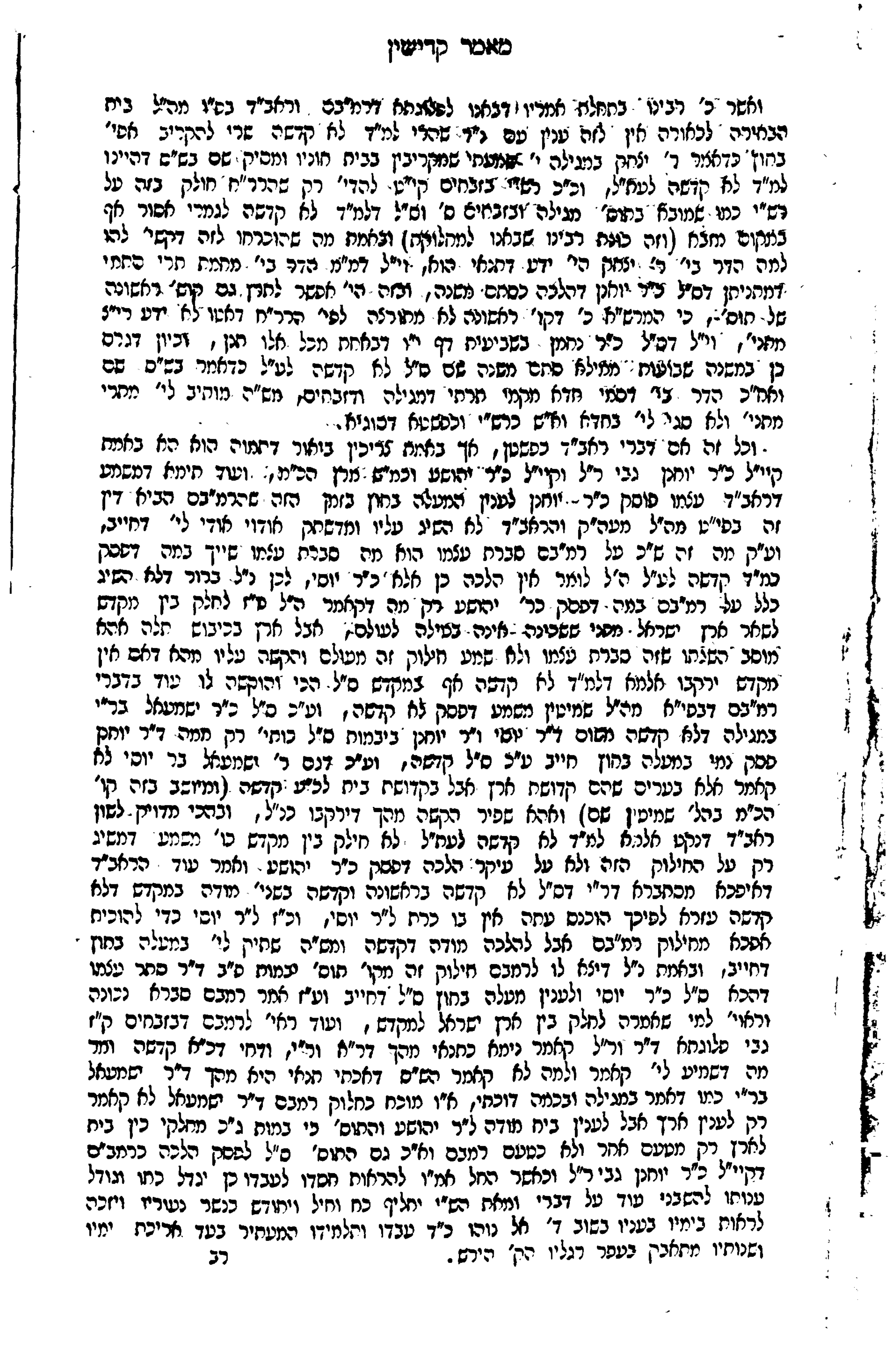
And as for what our master wrote at the beginning of his words, that we have come to the dispute of Maimonides and Rabad in chapter 6 of the Laws of the Chosen House: at first sight this has no bearing on our case, for according to the one who says it was not sanctified, it is permitted to sacrifice even outside, as Rabbi Isaac said in Megillah 10, "I have heard that they sacrifice in the house of Onias", and the Talmud concludes there that this is according to the one who says it was not sanctified for the time to come; and so Rashi wrote explicitly in Zevahim 119. Only Rabbenu Hayyim disagrees with Rashi on this, as is evident in Tosafot, Megillah, and Zevahim 60, and holds that according to the one who says it was not sanctified, it is entirely forbidden even in the place of the altar (and this is our master's meaning, that we have come to a dispute). And in truth, what compelled us to this is that it was difficult for them: why did Rabbi Isaac retract, when he knew that it is a dispute of the Tannaim? And one may say that in any case he retracted because of two trustworthy witnesses, for he holds like Rabbi Johanan, that the halakhah follows the anonymous Mishnah; and with this it would have been possible to answer. Also the difficulty about the reply in Tosafot —, for the Maharsha wrote that the difficulty about the reply is not answered according to Rabbenu Hayyim: did Rabbi Isaac then not know the Mishnah? And one may say that he holds like Rabbi Nahman in Shevi'it folio 16, that in truth "of all these" is taught; and since he read so in the Mishnah of Shevuot, in Megillah, the anonymous Mishnah there, he held that it was not sanctified for the time to come, as the Talmud says there; and afterwards he retracted, for one sets aside one before two, those of Megillah and Zevahim; therefore it refutes him from two Mishnahs, and did not think to refute him with one; and it is well according to Rashi and according to the plain sense of the passage.
And all this is if the words of Rabad are according to their plain sense; but in truth they need explanation, for it is astonishing: in truth we hold like Rabbi Johanan against Resh Lakish, and we hold like Rabbi Joshua, as our master the Kesef Mishneh wrote. And it is further astonishing, for it is implied that Rabad himself rules like Rabbi Johanan in the matter of one who offers up outside at the present time; for Maimonides brought this law in chapter 19 of the Laws of the Making of Sacrifices, and Rabad did not object to him, and from his silence he evidently agreed with him that he is liable. And it is further difficult: what is this that he wrote against Maimonides, "This is his own reasoning"? What has his own reasoning to do with his ruling according to the one who says it was sanctified for the time to come? He ought to have said, "The halakhah is not so, but according to Rabbi Jose." Therefore it seems clear to me that he did not object at all to Maimonides' ruling according to Rabbi Joshua, but only to what he said in the Laws, chapter 8, distinguishing between the Sanctuary and the rest of the Land of Israel because the Shekhinah is never annulled, whereas he made the Land depend on conquest; on this his objection turns, that this is his own reasoning, and he had never heard this distinction; and he raised against him the difficulty from that saying, "If there is no Sanctuary, they shall rot", which shows that the one who says it was not sanctified holds so even of the Sanctuary. And it was further difficult for him in the words of Maimonides in chapter 11 of the Laws of the Sabbatical Years, which imply that he ruled that it was not sanctified; and perforce he holds like Rabbi Ishmael son of Rabbi Jose in Megillah, that it was not sanctified, because Rabbi Jose and Rabbi Johanan in Yevamot hold like him; only, since Rabbi Johanan also ruled that one who offers up outside is liable, perforce he holds that it was sanctified; and perforce Rabbi Ishmael son of Jose too said so only of the cities, which have the sanctity of the Land, but as to the sanctity of the House, all agree that it was sanctified (and with this he settles the difficulty of the Kesef Mishneh in the Laws of the Sabbatical Years there). And yet he rightly raised the difficulty from that of "they shall rot", as above. And thereby the wording of Rabad is precise, who put it: "The halakhah: according to the one who says it was not sanctified for the time to come, he did not distinguish between the Sanctuary, etc.", which implies that he objects only to this distinction, and not to the main halakhah, in which he ruled according to Rabbi Joshua. And Rabad said further that the reverse is the more reasonable: that Rabbi Jose, who holds that it was not sanctified the first time and was sanctified the second, agrees regarding the Sanctuary that Ezra did not sanctify it; therefore one who enters now is not liable to excision, according to Rabbi Jose. And all this is according to Rabbi Jose, in order to prove the reverse of Maimonides' distinction; but as to the halakhah he agrees that it was sanctified, and therefore he kept silent toward him regarding one who offers up outside, that he is liable. And in truth it seems to me that this distinction came to Maimonides from the difficulty of Tosafot, Yevamot 82, that Rabbi Johanan contradicts himself, for here he holds like Rabbi Jose, and as to one who offers up outside he holds that he is liable; and on this Maimonides said that it is a sound reasoning, worthy of whoever said it, to distinguish between the Land of Israel and the Sanctuary. And a further proof for Maimonides: in Zevahim 107, regarding the dispute of Rabbi Johanan and Resh Lakish, it says, "Shall we say it is like the Tannaim, from that of Rabbi Eliezer and Rabbi Joshua?", and it rejects this: all agree that it was sanctified, and each master says what he heard. And why did the Talmud not say that it is still a dispute of the Tannaim, from that of Rabbi Ishmael son of Rabbi Jose, as it said in Megillah and in several places? It must be, then, that the distinction of Maimonides is proved, that Rabbi Ishmael said it only with regard to the Land, but with regard to the House he agrees with Rabbi Joshua. And Tosafot in Yevamot also distinguish between the House and the Land, only for another reason, and not for the reason of Maimonides; and if so, Tosafot too hold, as the decision of the halakhah, like Maimonides, that we hold like Rabbi Johanan against Resh Lakish. And as my lord and teacher has begun to show his kindness to his servant, so may his strength and the greatness of his humility increase, to reply to me again on my words; and from Yahweh, blessed be He, may he renew strength and might, and may his youth be renewed like the eagle's, and may he be privileged to see in his days, with his eyes, the return of Yahweh to His habitation. These are the words of his servant and disciple, who prays for the length of his days and years, who powders himself in the dust of his feet, the least, Hirsch.