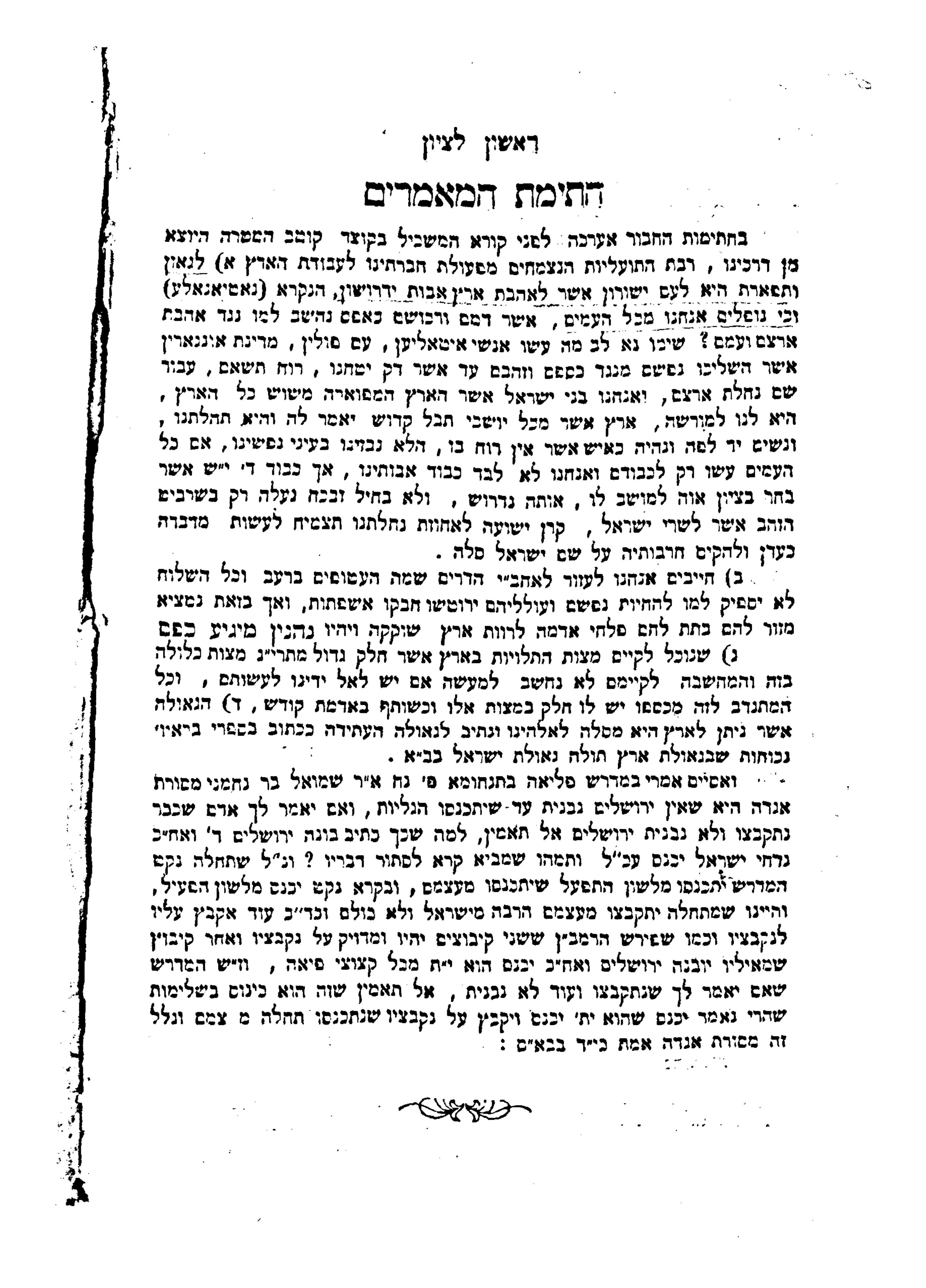
First to Zion
Conclusion of the Essays
In concluding the work I shall set out before the intelligent reader, in brief, the pivot of the aim that issues from our ways, and the many benefits that grow out of the activity of our society for the tilling of the Land: 1) It is a pride and a glory to the people of Jeshurun that they seek after the love of the land of their fathers, which is called (national). And are we then inferior to all the peoples, whose blood and possessions are counted as nothing to them against the love of their land and their people? Pray consider what the men of Italy, the people of Poland and the kingdom of Hungary have done, who risked their lives, their silver and their gold, until they were ground fine and the wind carried them off, for the sake of the name of the inheritance of their land; and we, the children of Israel, to whom the glorious Land, the joy of the whole earth, belongs as an inheritance, a land which all the inhabitants of the world call holy and which is our praise, shall we lay our hand upon our mouth and be as a man in whom there is no spirit? Shall we not be despised in our own eyes? If all the peoples acted only for their own honour, we act not only for the honour of our fathers but for the honour of Yahweh, blessed be His name, who chose Zion and desired it for His dwelling; her shall we seek, and not by might nor by power shall we go up, but only by the golden sceptre that belongs to the princes of Israel shall a horn of salvation spring forth for the possession of our inheritance, to make her wilderness like Eden and to raise up her ruins in the name of Israel, Selah.
-
We are obliged to help our brethren, the children of Israel, who dwell there, who faint with hunger, and all that is sent does not suffice them to keep themselves alive, and their little ones are dashed in pieces and embrace dunghills; and only in this way shall we provide a remedy for them, by giving them plots of ground to water a thirsty land, so that they may enjoy the labour of their hands
-
That we may be able to fulfil the commandments dependent on the Land, in which a large part of the six hundred and thirteen commandments is included; and the intention to fulfil them is not reckoned as the deed if it is in our power to do them; and whoever volunteers his money for this has a share in these commandments, as a partner in the holy soil. 4) The redemption that is granted to the Land is a highway for our God and a path to the future redemption, as is written in my book, with sound proofs, that upon the redemption of the Land depends the redemption of Israel, speedily in our days, Amen.
And I shall conclude my words with a wondrous Midrash in the Tanhuma, portion Noah: Rabbi Shmuel bar Nahmani said: It is a tradition of the aggadah that Jerusalem will not be built until the exiles are gathered in; and if a man says to you that they have already been gathered and Jerusalem has not been built, do not believe him. Why? For so it is written: "Yahweh builds up Jerusalem", and afterwards: "He gathers in the outcasts of Israel". Thus far its words. And people have wondered: he brings a verse to contradict his own words? And it seems to me that at first the Midrash used "yitkansu", in the reflexive form, that they will gather themselves of their own accord, while in the verse it used "yekhanes", in the causative form; that is, at first many of Israel, but not all, will gather of their own accord, and as it is written: "I will yet gather to him, besides his gathered ones", and as Nahmanides explained, that there will be two ingatherings, and this is precise in "besides his gathered ones"; and after the ingathering that comes of its own accord Jerusalem will be built, and afterwards He, blessed be He, will gather them in from all the utmost corners. And this is what the Midrash says: that if he says to you that they have been gathered and it has not yet been built, do not believe that this is the ingathering in its completeness, for it is said "yekhanes", that He, blessed be He, will gather in and assemble besides his gathered ones, who first gathered of their own accord; and on account of this the tradition of the aggadah is true. So may it be His will, speedily in our days, Amen, Selah.