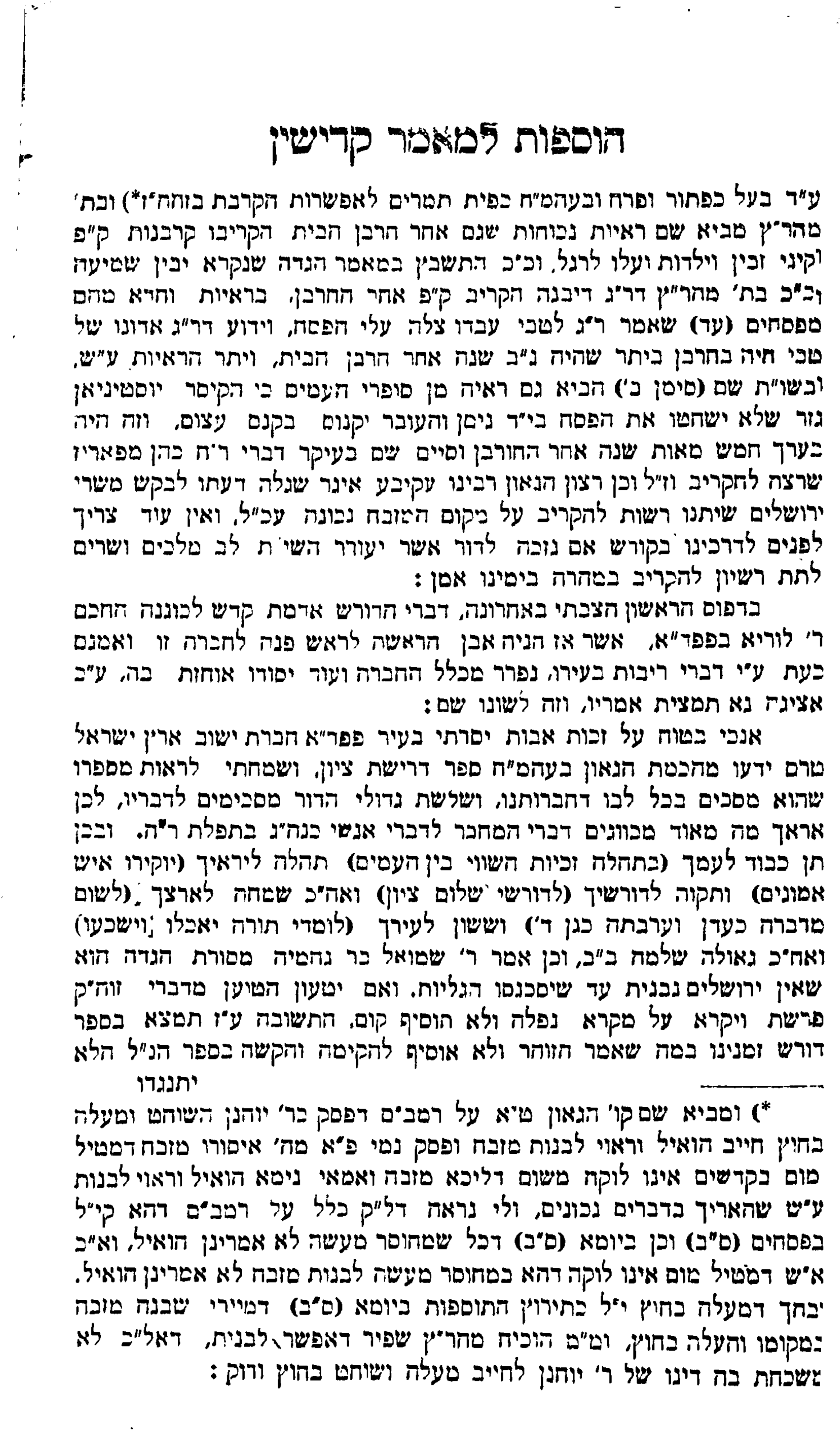
Additions to the Essay on Holy Things
…on the words of the author of Kaftor va-Ferah and of the author of the book Kappot Temarim, as to the possibility of offering sacrifices at the present time*). And in the Responsa of Maharatz he brings there sound proofs that even after the destruction of the Temple they offered sacrifices: Passover offerings, and the bird-offerings of men with an issue and of women after childbirth; and they went up for the pilgrim festivals. And so wrote the Tashbetz in the essay on the Haggadah called Yavin Shemu'ah; and so he wrote in the Responsa of Maharatz, that Rabban Gamaliel of Yavneh offered the Passover offering after the destruction, with proofs; and one of them is from Pesahim (74), where Rabban Gamaliel said to Tavi his slave, "Roast the Passover offering for me"; and it is known that Rabban Gamaliel, the master of Tavi, lived at the destruction of Betar, which was 52 years after the destruction of the Temple; and for the rest of the proofs see there. And in the Responsa there (section 20) he also brought a proof from the writers of the nations, that the Emperor Justinian decreed that they should not slaughter the Passover offering on the 14th of Nisan, and whoever transgressed would be punished with a heavy fine; and this was about five hundred years after the destruction. And he concluded there with the substance of the words of Rabbi Hayyim Kohen of Paris, who wished to offer sacrifices, and these are his words: "And such was the will of the Gaon, our master Akiva Eger, who disclosed his opinion, to ask the rulers of Jerusalem to give permission to offer sacrifices upon the place of the altar, properly." End of quotation. And our way in holiness needs no further elaboration, if we merit a generation in which Yahweh, blessed be He, will stir the heart of kings and princes to give permission to offer sacrifices in purity, in our days, amen.
In the first printing I set at the end the words of one who seeks the holy soil, to establish it, the sage Rabbi Lurie in Frankfurt-on-the-Oder, who then laid the headstone as the cornerstone of this society; but indeed, at this time, through matters of contention in his town, he has separated from the body of the society, yet his foundation still holds in it. Therefore I will now set out the essence of his words, and these are his words there:
Trusting in the merit of the fathers, I founded in the city of Frankfurt-on-the-Oder the Society for the Settlement of the Land of Israel, before they knew of the wisdom of the Gaon, the author of the book Seeking Zion; and I rejoiced to see from his book that he agrees with all his heart to our society, and that three great men of the generation agree with his words. Therefore I will show you how very closely the words of the author accord with the words of the Men of the Great Assembly in the prayer of Rosh Hashanah: "And so, give honour to Thy people" (first, the rights of equality among the peoples), "praise to them that fear Thee" (and they will hold the faithful man in esteem), "and hope to them that seek Thee" (to them that seek the peace of Zion), and afterwards "joy to Thy land" (to make her wilderness like Eden and her desert like the garden of Yahweh) "and gladness to Thy city" (those who study Torah shall eat and be satisfied), and afterwards complete redemption, speedily in our days. And so said Rabbi Shmuel bar Nehemiah: "It is a tradition of the Aggadah that Jerusalem will not be built until the exiles are gathered in." And if a claimant should argue from the words of the holy Zohar, portion Vayikra, on the verse "She is fallen, she shall no more rise": the reply to this you will find in the book Doresh Zemanenu, on what the Zohar said, "and I will no more raise her up"; and in the book mentioned above he objected: surely
*) And he cites there the difficulty of the Gaon, the Turei Even, against Maimonides, who ruled like Rabbi Yohanan that one who slaughters and offers up outside is liable, since it is fit to build an altar; and he also ruled, in chapter 1 of the Laws of Things Forbidden for the Altar, that one who inflicts a blemish on holy things is not flogged, because there is no altar. But why? Let us say "since it is fit to build"! See there, where he discussed it at length with sound words. And to me it seems that there is no difficulty at all against Maimonides; for we hold in Pesahim (62) and likewise in Yoma (62) that wherever an act is lacking, we do not say "since". And if so it is well that one who inflicts a blemish is not flogged, for where the act of building an altar is lacking we do not say "since". And in the case of one who offers up outside, one may say, as in the answer of Tosafot in Yoma (62), that it treats of one who built an altar in its place and offered up outside; and in any case Maharatz proved well that building is possible, for otherwise you would not find a case for Rabbi Yohanan's ruling, to hold liable one who offers up and slaughters outside. And examine it closely.