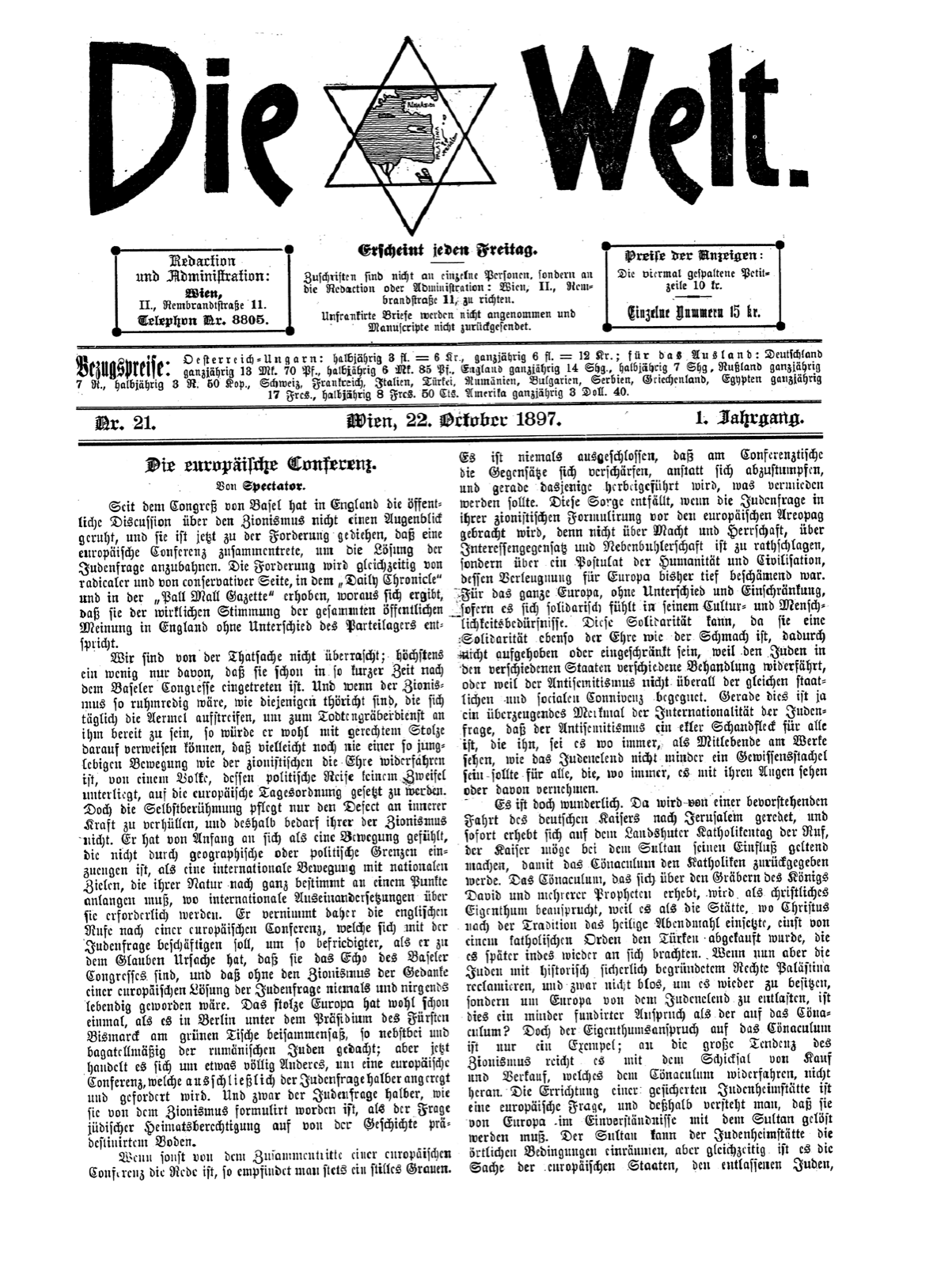
Die Welt.
|
Editorial Office and Administration: Vienna, II., Rembrandtstrasse 11. Telephone No. 8805. |
Appears every Friday. Communications are to be addressed not to individual persons, but to the Editorial Office or the Administration: Vienna, II., Rem= brandtstrasse 11. Unstamped letters will not be accepted, and manuscripts will not be returned. |
Advertising Rates: The four-column petit line 10 kr. Single numbers 15 kr. |
Subscription rates: Austria-Hungary: half-yearly 3 fl. = 6 kr., yearly 6 fl. = 12 kr.; for abroad: Germany yearly 18 Mk. 70 Pf., half-yearly 6 Mk. 85 Pf.; England yearly 14 Shg., half-yearly 7 Shg.; Russia yearly 7 R., half-yearly 3 R. 50 Kop.; Switzerland, France, Italy, Turkey, Roumania, Bulgaria, Servia, Greece, Egypt yearly 17 Frcs., half-yearly 8 Frcs. 50 Cts. America yearly 3 Doll. 40.
No. 21. | Vienna, 22 October 1897. | 1st Year of Issue.
The European Conference.
By Spectator.
Since the Congress at Basle the public discussion of Zionism in England has not rested for a single moment, and it has now ripened into the demand that a European conference be convened in order to prepare the way for a solution of the Jewish question. The demand is raised simultaneously from the radical and from the conservative side, in the "Daily Chronicle" and in the "Pall Mall Gazette," from which it follows that it answers to the true temper of the whole of public opinion in England, without distinction of party camp.
We are not surprised by the fact; at most a little only that it should have come about so short a time after the Basle Congress. And if Zionism were as boastful as those are foolish who daily roll up their sleeves to hold themselves in readiness for the gravedigger's office at its burial, it might well point with just pride to the circumstance that perhaps never yet has so young a movement as the Zionist one been accorded the honour of being placed upon the European order of the day by a people whose political maturity admits of no doubt. But self-praise is wont only to cloak a defect of inner strength, and therefore Zionism has no need of it. From the very beginning it has felt itself to be a movement not to be confined within geographical or political boundaries, an international movement with national aims, which by its very nature must quite certainly arrive at a point where international deliberations concerning it become necessary. It therefore hears the English calls for a European conference to occupy itself with the Jewish question with all the greater satisfaction, since it has cause to believe that they are the echo of the Basle Congress, and that without Zionism the idea of a European solution of the Jewish question would never and nowhere have come to life. Proud Europe did indeed once, when it sat together at the green table in Berlin under the presidency of Prince Bismarck, give a passing and trifling thought to the Roumanian Jews; but now it is a question of something wholly different, of a European conference which is proposed and demanded exclusively for the sake of the Jewish question. And that, moreover, of the Jewish question as it has been formulated by Zionism: as the question of a Jewish right of homeland upon soil predestined by history.
Whenever else the convening of a European conference is spoken of, one always feels a quiet dread. It is never to be excluded that at the conference table the antagonisms may be sharpened instead of blunted, and that precisely what should have been avoided is brought about. This anxiety falls away when the Jewish question in its Zionist formulation is brought before the European Areopagus, for the matter to be deliberated is not one of power and dominion, of conflicting interests and rivalry, but a postulate of humanity and civilisation, the denial of which has hitherto been deeply shameful for Europe. For the whole of Europe, without distinction and without limitation, in so far as it feels itself in solidarity in its need of culture and humanity. This solidarity, being a solidarity of honour no less than of disgrace, cannot be annulled or restricted by the fact that the Jews meet with different treatment in the different States, or that anti-Semitism does not everywhere encounter the same official and social connivance. This indeed is a convincing mark of the international character of the Jewish question: that anti-Semitism is a noble stain of shame upon all who, wheresoever it may be, see it at work as their contemporaries, just as Jewish misery ought no less to be a goad to the conscience of all who, wheresoever, behold it with their eyes or hear tell of it.
It is strange indeed. There is talk of an impending journey of the German Emperor to Jerusalem, and at once the cry is raised at the Catholic Congress at Landshut that the Emperor should exert his influence with the Sultan, in order that the Cenaculum may be restored to the Catholics. The Cenaculum, which rises above the tombs of King David and of several prophets, is claimed as Christian property because that place, where according to tradition Christ instituted the Last Supper, was once purchased from the Turks by a Catholic order, though the Turks afterwards brought it into their own hands again. But if now the Jews reclaim Palestine with a right assuredly grounded in history, and that not merely in order to possess it again, but in order to relieve Europe of the Jewish misery, is this a less well-founded claim than that to the Cenaculum? Yet the claim of ownership to the Cenaculum is but an example; with the fortunes of purchase and sale that have befallen the Cenaculum it does not reach up to the great tendency of Zionism. The establishment of a secured Jewish homestead is a European question, and therefore it is intelligible that it must be solved by Europe in agreement with the Sultan. The Sultan can grant the Jewish homestead its local conditions, but at the same time it is the affair of the European States to afford the discharged Jews,