No. 31. — "Die Welt" — Page 7.
Cologne. (Telegram). In view of the Basle Congress assembling a fortnight later, the wish has been expressed by several of those invited to the Bank Conference at Cologne that the Bank Conference likewise be held at Basle three or four days before the Congress. Thereby the loss of time of the double journey would be avoided. The Bank Committee will come to a resolution upon this question with all speed.
❇
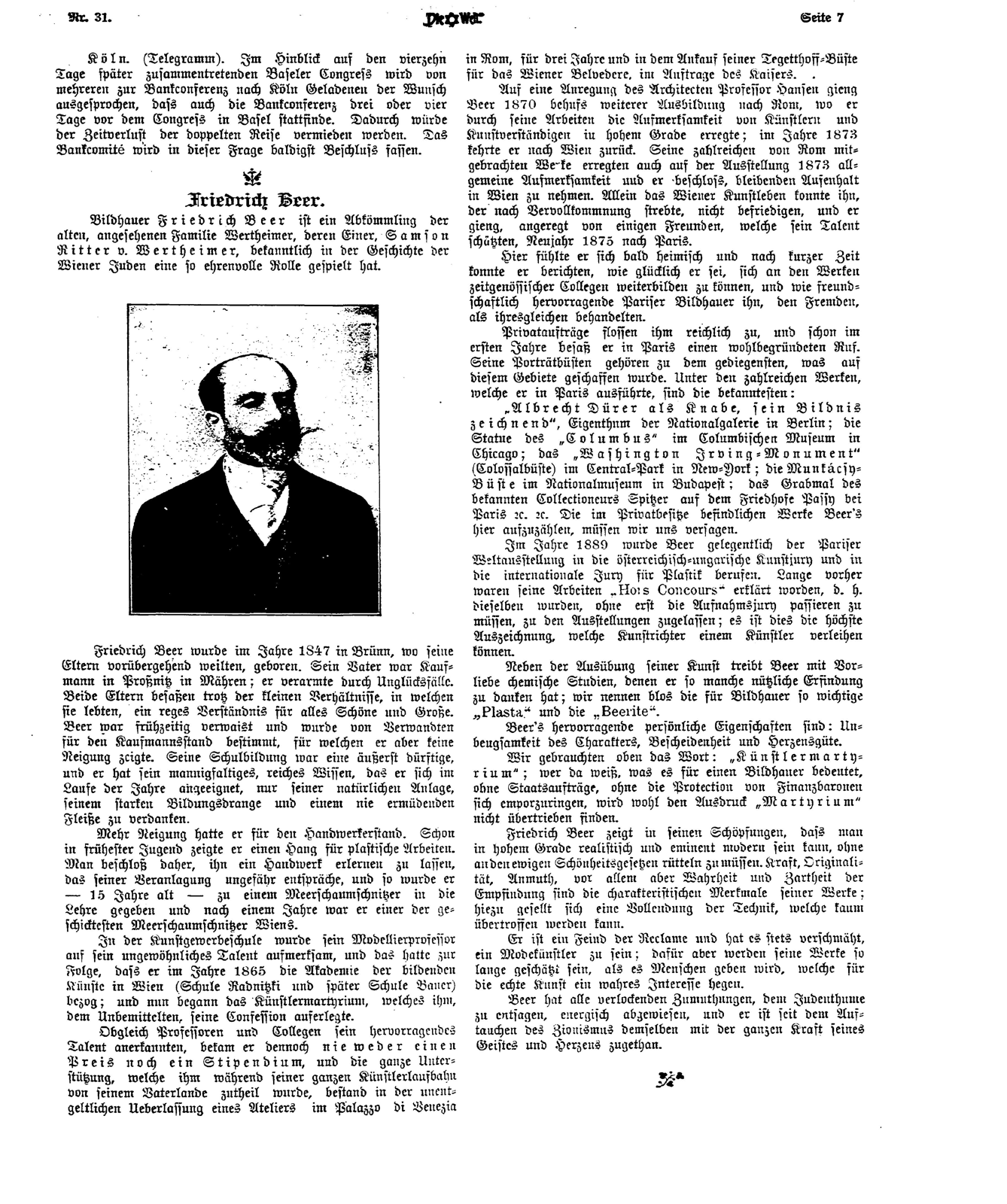
Friedrich Beer.
The sculptor Friedrich Beer is a descendant of the old and respected Wertheimer family, one of whom, Samson Ritter v. Wertheimer, is well known to have played so honourable a part in the history of the Jews of Vienna.
Friedrich Beer was born in the year 1847 at Bruenn, where his parents were then temporarily residing. His father was a merchant in Proßnitz in Moravia; he was reduced to poverty through misfortunes. Both parents, in spite of the humble circumstances in which they lived, possessed a lively understanding for all that is beautiful and great. Beer was early orphaned and was destined by relatives for the merchant's calling, for which, however, he showed no inclination. His schooling was an exceedingly scanty one, and the manifold and rich knowledge which he has acquired in the course of the years he owes solely to his natural endowment, to his strong craving for education, and to a never-wearying industry.
More inclination he had for the handicraftsman's estate. Already in earliest youth he showed a bent for plastic work. It was therefore resolved to let him learn a handicraft that should approximately correspond to his disposition, and so he was — fifteen years of age — apprenticed to a meerschaum carver, and after a year he was one of the most skilful meerschaum carvers in Vienna.
At the School of Arts and Crafts his professor of modelling became aware of his unusual talent, and that had for its consequence that in the year 1865 he entered the Academy of Fine Arts in Vienna (the school of Radnitzky and later the school of Bauer); and now began that artist's martyrdom which his confession laid upon him, the man without means.
Although professors and colleagues acknowledged his outstanding talent, he nevertheless never received either a prize or a stipend, and the whole support which fell to him from his native land during the whole of his artistic career consisted in the free grant of a studio in the Palazzo di Venezia at Rome for three years, and in the purchase of his Tegetthoff bust for the Vienna Belvedere, by command of the Emperor.
Upon a suggestion of the architect Professor Hansen, Beer went in 1870 to Rome for the purpose of further training, where by his works he excited in a high degree the attention of artists and of connoisseurs of art; in the year 1873 he returned to Vienna. His numerous works brought with him from Rome excited general attention at the Exhibition of 1873 as well, and he resolved to take up a lasting residence in Vienna. But the artistic life of Vienna could not satisfy him, who strove after perfection, and, urged by some friends who prized his talent, he went at the New Year of 1875 to Paris.
Here he soon felt himself at home, and after a short time he was able to report how happy he was to be able to train himself further upon the works of contemporary colleagues, and how amicably eminent Parisian sculptors treated him, the stranger, as one of their own kind.
Private commissions flowed in upon him abundantly, and already in the first year he possessed in Paris a well-founded reputation. His portrait busts belong to the most sterling that has been created in this field. Among the numerous works which he executed in Paris the best known are:
“Albrecht Dürer as a Boy, drawing his own Portrait,” property of the National Gallery in Berlin; the statue of “Columbus” in the Columbian Museum in Chicago; the “Washington Irving Monument” (colossal bust) in Central Park in New York; the Munkácsy bust in the National Museum in Budapest; the tomb of the well-known collector Spitzer in the cemetery of Passy near Paris, &c. &c. The works of Beer's which are in private possession we must forbear to enumerate here.
In the year 1889 Beer was called, on the occasion of the Paris World Exhibition, into the Austro-Hungarian art jury and into the international jury for sculpture. Long before that his works had been declared “Hors Concours,” that is to say, they were admitted to the exhibitions without having first to pass the jury of admission; this is the highest distinction which judges of art can confer upon an artist.
Beside the practice of his art Beer pursues with predilection chemical studies, to which he owes many a useful invention; we name only the “Plasta,” so important for sculptors, and the “Beerite.”
Beer's outstanding personal qualities are: unbendingness of character, modesty, and goodness of heart.
We used above the word “artist's martyrdom”; whoever knows what it means for a sculptor to struggle upward without State commissions, without the patronage of financial barons, will hardly find the expression “martyrdom” exaggerated.
Friedrich Beer shows in his creations that one can be realistic in a high degree and eminently modern without having to shake at the eternal laws of beauty. Strength, originality, grace, but above all truth and delicacy of feeling are the characteristic marks of his works; to these is joined a perfection of technique which can scarcely be surpassed.
He is an enemy of advertisement and has always scorned to be a fashionable artist; but in return his works will be prized so long as there shall be men who cherish a true interest in genuine art.
Beer has energetically rejected all the enticing demands that he renounce Judaism, and since the emergence of Zionism he has been devoted to it with the whole strength of his mind and heart.
❇