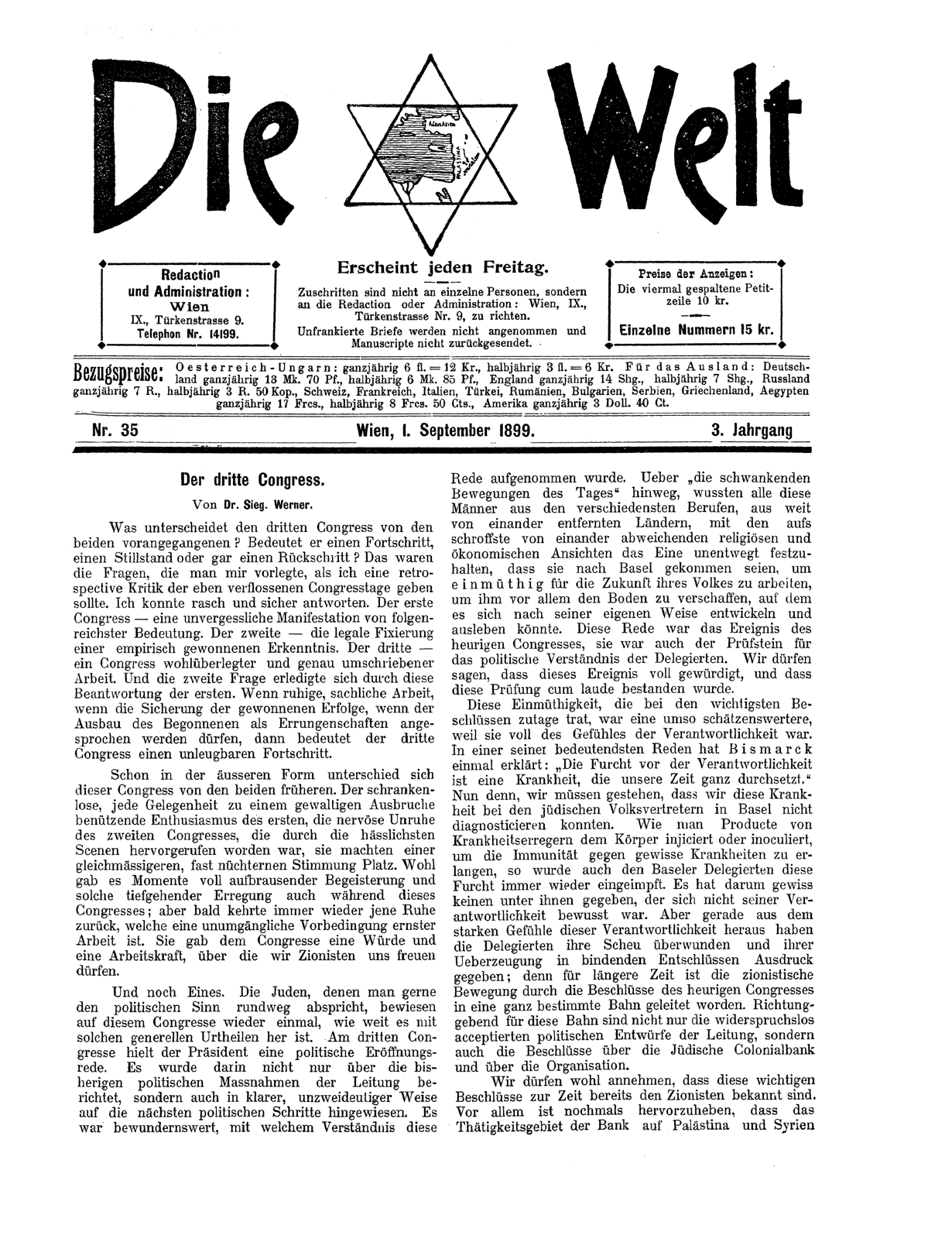
Die Welt
Editorial Office and Administration: Vienna, IX., Türkenstrasse 9. Telephone No. 14199.
Appears every Friday.
Communications are to be addressed not to individual persons, but to the Editorial Office or the Administration: Vienna, IX., Türkenstrasse No. 9.
Unstamped letters are not accepted, and manuscripts are not returned.
Rates for advertisements: the four-column petit line, 10 kr.
Single numbers 15 kr.
Subscription rates: Austria-Hungary: yearly 6 fl. = 12 Kr., half-yearly 3 fl. = 6 Kr. For abroad: Germany yearly 13 Mk. 70 Pf., half-yearly 6 Mk. 85 Pf., England yearly 14 Shg., half-yearly 7 Shg., Russia yearly 7 R., half-yearly 3 R. 50 Kop., Switzerland, France, Italy, Turkey, Roumania, Bulgaria, Servia, Greece, Egypt yearly 17 Frcs., half-yearly 8 Frcs. 50 Cts., America yearly 3 Doll. 40 Ct.
No. 35 | Vienna, 1 September 1899. | Third Year
The Third Congress.
By Dr. Sieg. Werner.
What distinguishes the third Congress from the two that went before it? Does it signify an advance, a standstill, or even a retrogression? These were the questions laid before me when I was to furnish a retrospective criticism of the Congress days just elapsed. I was able to answer quickly and with assurance. The first Congress — an unforgettable manifestation of the most far-reaching significance. The second — the legal fixing of a knowledge won by experience. The third — a Congress of well-considered and precisely circumscribed work. And the second question was disposed of by this answer to the first. If quiet, matter-of-fact work, if the securing of the successes already won, if the building out of what has been begun may be spoken of as achievements, then the third Congress signifies an undeniable advance.
Even in its outward form this Congress differed from the two earlier ones. The unbounded enthusiasm of the first, which seized upon every occasion for a mighty outburst, and the nervous unrest of the second Congress, which had been called forth by the ugliest scenes — these gave place to a more even, almost sober mood. There were indeed moments of surging enthusiasm during this Congress also, and moments of deep agitation; but there always soon returned that calm which is an indispensable precondition of serious work. It gave the Congress a dignity and a capacity for work in which we Zionists may rejoice.
And one thing more. The Jews, to whom political sense is so readily denied outright, proved once again at this Congress how much such general judgments are worth. At the third Congress the President delivered a political opening address. In it there was not only a report upon the political measures hitherto taken by the leadership, but also a clear and unambiguous indication of the next political steps. It was admirable with what understanding this speech was received. Above and beyond "the fluctuating movements of the day," all these men, from the most various callings, from countries far removed from one another, with religious and economic views diverging in the sharpest manner, knew how to hold fast unwaveringly to this one thing: that they had come to Basle to work with one mind for the future of their people, and above all to procure for it the soil upon which it might develop and live out its life after its own fashion. This speech was the event of this year's Congress; it was also the touchstone of the political understanding of the delegates. We may say that this event was fully appreciated, and that this examination was passed cum laude.
This unanimity, which came to light in the most important resolutions, was the more to be prized because it was full of the sense of responsibility. In one of his most notable speeches Bismarck once declared: "The fear of responsibility is a disease which wholly pervades our age." Well then, we must confess that we could not diagnose this disease in the Jewish representatives of the people at Basle. As one injects or inoculates the body with the products of disease-germs in order to obtain immunity against certain maladies, so was this fear again and again inoculated into the Basle delegates. There was therefore assuredly not one among them who was not conscious of his responsibility. But it was precisely out of the strong feeling of this responsibility that the delegates overcame their diffidence and gave expression to their conviction in binding resolutions; for by the resolutions of this year's Congress the Zionist movement has been directed for a considerable time to come into a quite definite course. Determining the direction of this course are not only the political plans of the leadership, accepted without contradiction, but also the resolutions concerning the Jewish Colonial Bank and concerning the Organisation.
We may well assume that these important resolutions are by this time already known to Zionists. Above all it is once more to be emphasised that the field of activity of the Bank to Palestine and Syria