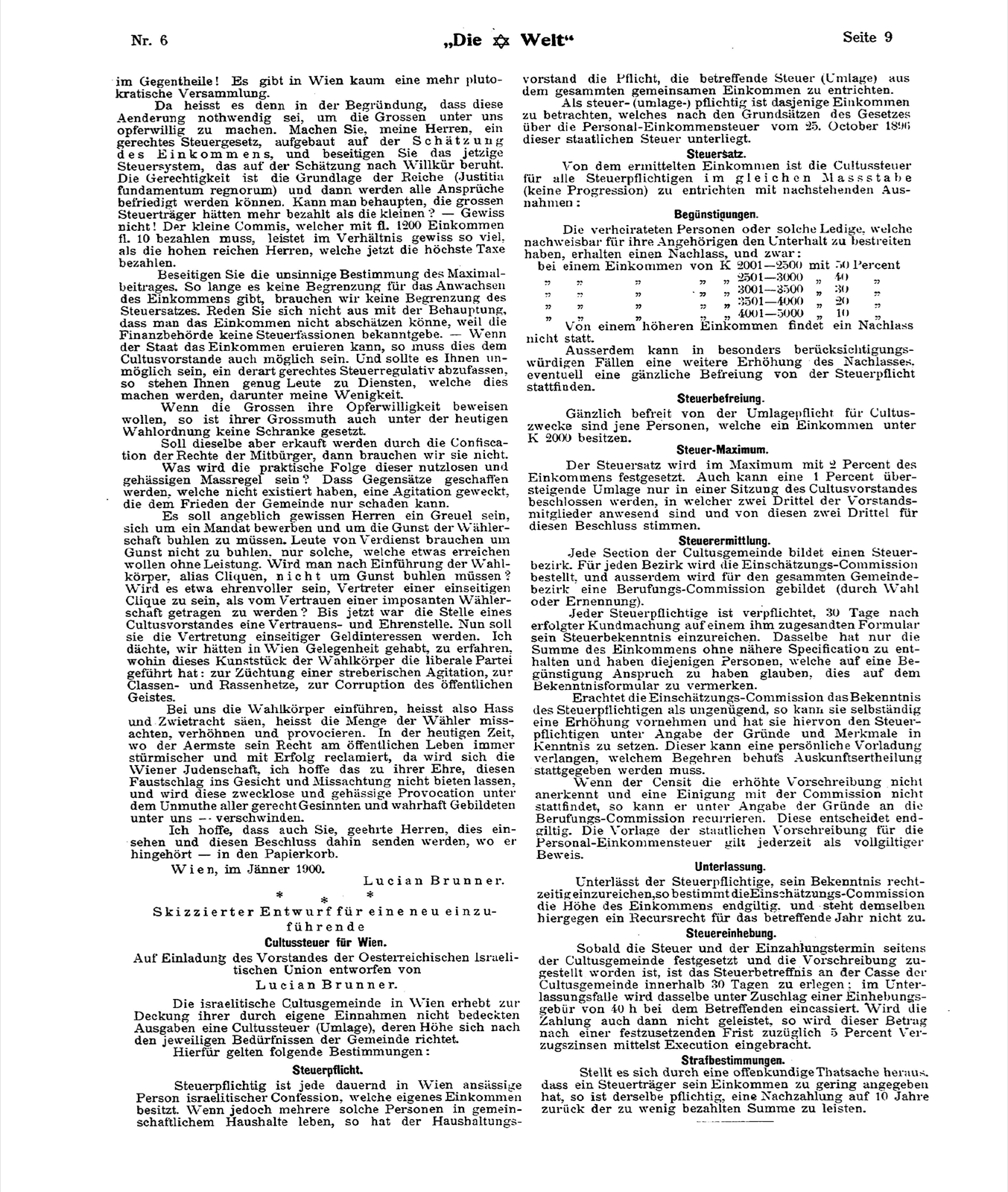
No. 6 — "Die Welt" — Page 9.
(continued from page 8)
…the contrary! There is hardly a more plutocratic assembly in Vienna.
The ground assigned is that this change is necessary in order to make the great ones among us willing to sacrifice. Make, gentlemen, a just tax law, built upon the assessment of income, and do away with the present system of taxation, which rests upon assessment by caprice. Justice is the foundation of kingdoms (Justitia fundamentum regnorum), and then all claims will be capable of satisfaction. Can it be maintained that the large taxpayers have paid more than the small? — Assuredly not! The little clerk who upon an income of fl. 1200 must pay fl. 10 renders in proportion quite as much as the great rich gentlemen who now pay the highest rate.
Do away with the senseless provision of a maximum contribution. So long as there is no limit to the growth of income, we need no limit to the rate of taxation. Do not excuse yourselves with the assertion that income cannot be assessed because the revenue authorities publish no tax returns. — If the State can ascertain income, this must be possible for the Board of the Community also. And should it be impossible for you to frame so just a tax regulation, there are people enough at your service who will do it, my humble self among them.
If the great ones wish to prove their willingness to sacrifice, no barrier is set to their generosity under the present electoral order either.
But if it is to be purchased by the confiscation of the rights of their fellow-citizens, then we do not need it.
What will be the practical consequence of this useless and malicious measure? That antagonisms will be created which have not existed, an agitation awakened which can only do harm to the peace of the community.
It is said to be an abomination to certain gentlemen that they must sue for a mandate and court the favour of the electorate. Men of merit have no need to court favour; only such as wish to attain something without performance. Will there be no courting of favour after the introduction of the electoral bodies, alias cliques? Will it be more honourable to be the representative of a one-sided clique than to be borne up by the confidence of an imposing body of electors? Hitherto the office of a member of the Board has been one of confidence and of honour. Now it is to become the representation of one-sided moneyed interests. I should have thought that we had had opportunity in Vienna to learn whither this trick of the electoral bodies has led the Liberal party: to the breeding of a place-hunting agitation, to the setting of class against class and race against race, to the corruption of the public spirit.
To introduce the electoral bodies among us means, then, to sow hatred and discord, means to despise, to deride and to provoke the mass of the electors. In the present day, when the poorest man reclaims his right in public life ever more stormily and with success, the Jewry of Vienna will not — I hope this for its honour — suffer this blow in the face and this contempt to be offered it, and this aimless and malicious provocation will, amid the displeasure of all the justly minded and truly educated among us, disappear.
I hope that you too, honoured gentlemen, will perceive this, and will send this resolution whither it belongs — into the waste-paper basket.
Vienna, January 1900.
Lucian Brunner.
* * *
Sketched draft for a community tax newly to be introduced for Vienna. Drawn up at the invitation of the Board of the Austrian Israelite Union by Lucian Brunner.
The Israelite Community of Vienna levies, for the covering of such of its expenditure as is not covered by its own receipts, a community tax (levy), the amount of which is governed by the current needs of the community. For this the following provisions hold good:
Liability to the tax. Liable to the tax is every person of the Israelite confession permanently resident in Vienna who possesses an income of his own. If, however, several such persons live in a common household, the head of the household has the duty of paying the tax (levy) in question out of the whole common income.
That income is to be regarded as liable to the tax (levy) which, according to the principles of the law upon the personal income tax of the 25th October 1896, is subject to that State tax.
Rate of the tax. Upon the income ascertained the community tax is to be paid by all persons liable in the same measure (no progression), with the following exceptions:
Abatements. Married persons, or such unmarried persons as have demonstrably to provide the maintenance of their relatives, receive a remission, namely:
with an income of K 2001—2500, of 50 per cent. " " " " 2501—3000, " 40 " " " " " 3001—3500, " 30 " " " " " 3501—4000, " 20 " " " " " 4001—5000, " 10 "
Upon a higher income no remission takes place.
Moreover, in cases specially deserving of consideration, a further increase of the remission, or possibly a complete exemption from liability to the tax, may take place.
Exemption from the tax. Wholly exempt from the obligation of the levy for community purposes are those persons who possess an income under K 2000.
Maximum of the tax. The rate of the tax is fixed at a maximum of 2 per cent. of income. Further, a levy exceeding 1 per cent. can be resolved upon only in a sitting of the Board at which two-thirds of the members of the Board are present and two-thirds of these vote for the resolution.
Ascertainment of the tax. Every section of the Community forms a tax district. For each district the assessing commission is appointed, and in addition an appeal commission is formed for the whole district of the Community (by election or by nomination).
Every person liable to the tax is bound, within 30 days after the publication has been made, to send in his declaration of income upon a form transmitted to him. The same has to contain only the sum of the income without further specification, and those persons who believe themselves entitled to an abatement have to note this upon the form of declaration.
If the assessing commission holds the declaration of the person liable to be insufficient, it may of its own motion make an increase, and has to inform the person liable thereof, stating the grounds and the indications. He may demand a personal summons, which request must be granted for the purpose of the giving of information.
If the person assessed does not acknowledge the increased assessment, and no agreement with the commission is arrived at, he may, stating his grounds, appeal to the appeal commission. This decides finally. The production of the State assessment for the personal income tax counts at all times as fully valid proof.
Omission. If the person liable omits to send in his declaration in due time, the assessing commission determines the amount of the income finally, and he has no right of appeal against this for the year in question.
Collection of the tax. As soon as the tax and the date of payment have been fixed by the Community and the assessment has been delivered, the amount of the tax is to be paid in at the office of the Community within 30 days; in case of omission the same is collected from the party concerned with the addition of a collection fee of 40 h. If payment is then still not made, this amount is, after a term to be fixed, recovered by execution with the addition of 5 per cent. interest for default.
Penal provisions. If it appears from a manifest fact that a taxpayer has declared his income too low, he is bound to make a supplementary payment, 10 years back, of the sum too little paid.