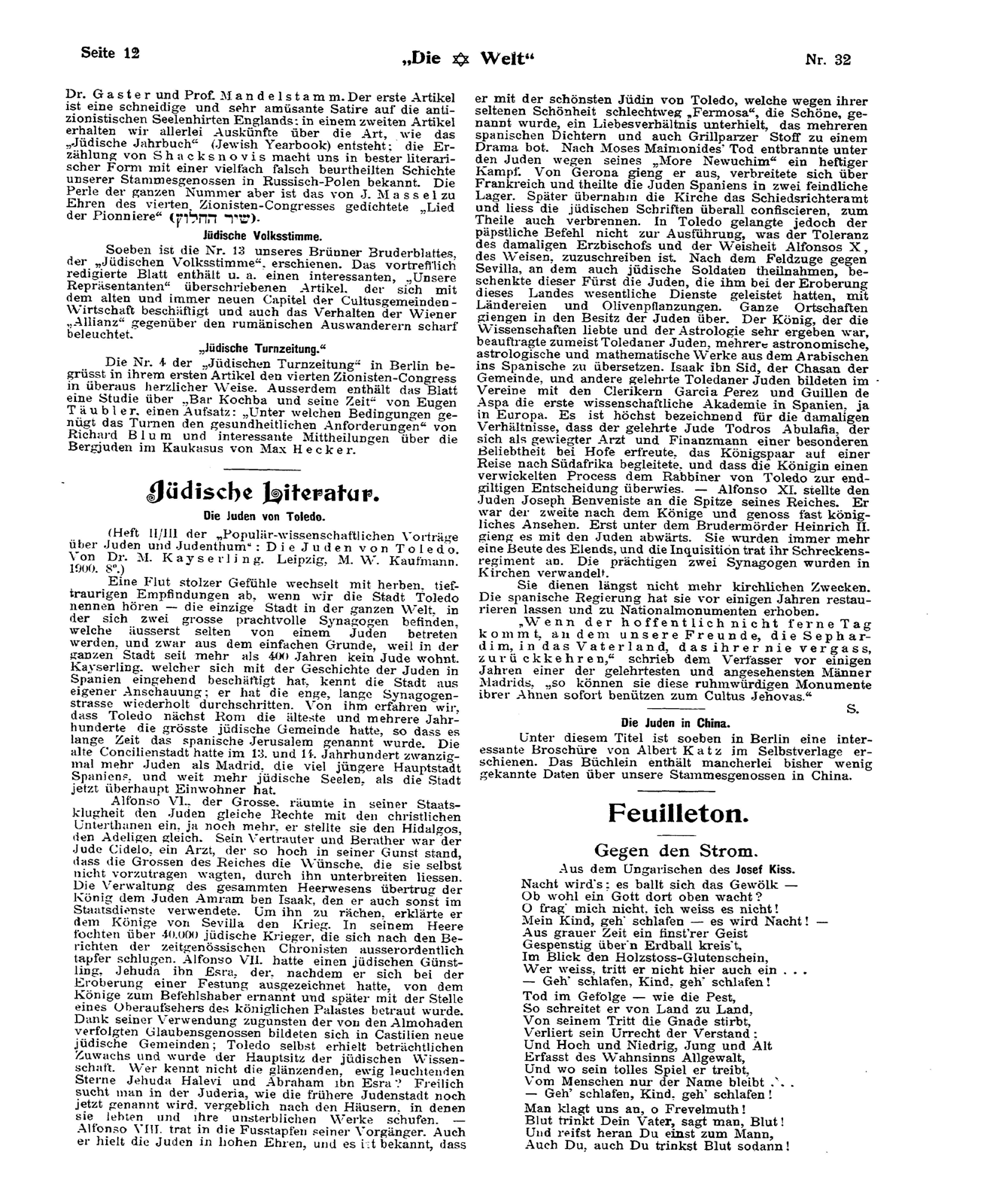
Page 12 — "Die Welt" — No. 32
(continued from page 11)
...Dr. Gaster and Prof. Mandelstamm. The first article is a trenchant and very amusing satire upon the anti-Zionist shepherds of souls of England; in a second article we receive all manner of information as to the manner in which the "Jewish Yearbook" comes into being; the tale by Shacksnovis makes us acquainted, in the best literary form, with a much misjudged stratum of our kinsmen in Russian Poland. The pearl of the whole number, however, is the "Song of the Pioneers" (שיר החלוץ), composed by J. Massel in honour of the fourth Zionist Congress.
Jüdische Volksstimme.
No. 13 of our Bruenn sister paper, the "Jüdische Volksstimme," has just appeared. The excellently edited paper contains, among other things, an interesting article headed "Our Representatives," which occupies itself with the old and ever new chapter of the management of the religious communities and also throws a sharp light upon the conduct of the Vienna "Allianz" towards the Roumanian emigrants.
"Jüdische Turnzeitung."
No. 4 of the "Jüdische Turnzeitung" in Berlin greets the fourth Zionist Congress in its opening article in an exceedingly cordial manner. Besides this the paper contains a study upon "Bar Kochba and his Time" by Eugen Täubler, an essay, "Under what conditions does gymnastics satisfy the requirements of health," by Richard Blum, and interesting communications upon the mountain Jews of the Caucasus by Max Hecker.
Jewish Literature.
The Jews of Toledo.
(Parts II/III of the "Popular Scientific Lectures upon Jews and Judaism": The Jews of Toledo. By Dr. M. Kayserling. Leipzig, M. W. Kaufmann. 1900. 8°.)
A flood of proud feelings alternates with bitter, deeply sorrowful emotions when we hear the city of Toledo named — the only city in the whole world in which there stand two great and splendid synagogues that are entered by a Jew but most rarely, and that for the simple reason that in the whole city no Jew has dwelt for more than 400 years. Kayserling, who has occupied himself thoroughly with the history of the Jews in Spain, knows the city from his own observation; he has repeatedly walked through the narrow, long Street of the Synagogues. From him we learn that Toledo, next to Rome, possessed the oldest and, for several centuries, the largest Jewish community, so that it was long called the Spanish Jerusalem. In the 13th and 14th centuries the old city of the Councils had twenty times more Jews than Madrid, the much younger capital of Spain, and far more Jewish souls than the city now has inhabitants at all.
Alfonso VI., the Great, in his statecraft granted the Jews equal rights with the Christian subjects; nay more, he placed them upon an equality with the hidalgos, the nobles. His confidant and counsellor was the Jew Cidelo, a physician who stood so high in his favour that the great men of the realm caused the wishes which they did not themselves venture to present to be submitted through him. The administration of the entire military establishment the king entrusted to the Jew Amram ben Isaak, whom he also employed otherwise in the service of the state. To avenge him he declared war upon the King of Seville. In his army there fought over 40,000 Jewish warriors, who, according to the accounts of contemporary chroniclers, bore themselves extraordinarily bravely. Alfonso VII. had a Jewish favourite, Jehuda ibn Esra, who, after he had distinguished himself at the conquest of a fortress, was appointed commander by the king and later entrusted with the post of chief overseer of the royal palace. Thanks to his intercession on behalf of the co-religionists persecuted by the Almohades, new Jewish communities were formed in Castile; Toledo itself received a considerable increase and became the chief seat of Jewish learning. Who does not know the brilliant, eternally shining stars Jehuda Halevi and Abraham ibn Esra? To be sure, one seeks in vain in the Juderia, as the former Jews' town is still called, for the houses in which they lived and created their immortal works. — Alfonso VIII. trod in the footsteps of his predecessors. He too held the Jews in high honour, and it is well known that he maintained a love affair with the most beautiful Jewess of Toledo, who on account of her rare beauty was called simply "Fermosa," the fair one — an affair which furnished several Spanish poets, and Grillparzer as well, with material for a drama. After the death of Moses Maimonides a violent struggle broke out among the Jews on account of his "More Newuchim." It proceeded from Gerona, spread over France and divided the Jews of Spain into two hostile camps. Later the Church assumed the office of arbiter and caused the Jewish writings to be everywhere confiscated and in part burned as well. In Toledo, however, the papal command was not carried into execution, which is to be ascribed to the tolerance of the archbishop of that day and to the wisdom of Alfonso X., the Wise. After the campaign against Seville, in which Jewish soldiers also took part, this prince bestowed lands and olive plantations upon the Jews who had rendered him essential services in the conquest of that country. Whole townships passed into the possession of the Jews. The king, who loved the sciences and was much devoted to astrology, commissioned for the most part Toledan Jews to translate several astronomical, astrological and mathematical works from the Arabic into Spanish. Isaak ibn Sid, the Chasan of the community, and other learned Toledan Jews formed, in conjunction with the clerics Garcia Perez and Guillen de Aspa, the first scientific academy in Spain, nay, in Europe. It is highly characteristic of the conditions of that day that the learned Jew Todros Abulafia, who as an accomplished physician and financier enjoyed a particular favour at court, accompanied the royal pair upon a journey to South Africa, and that the queen referred an intricate lawsuit to the rabbi of Toledo for final decision. — Alfonso XI. placed the Jew Joseph Benveniste at the head of his realm. He was the second after the king and enjoyed an almost royal consideration. Not until the reign of the fratricide Henry II. did matters go downward with the Jews. They became more and more a prey to misery, and the Inquisition entered upon its reign of terror. The two magnificent synagogues were transformed into churches.
They have long ceased to serve ecclesiastical purposes. The Spanish government caused them to be restored some years ago and raised them to the rank of national monuments.
"When the day comes, not distant, it is to be hoped, on which our friends, the Sephardim, return to the fatherland that never forgot them," one of the most learned and most respected men of Madrid wrote to the author some years ago, "they will be able at once to employ these glorious monuments of their forefathers for the worship of Jehovah."
S.
The Jews in China.
Under this title there has just appeared in Berlin an interesting pamphlet by Albert Katz, published by the author himself. The little book contains a variety of hitherto little known data concerning our kinsmen in China.
Feuilleton.
Against the Stream.
From the Hungarian of Josef Kiss.
Night falls; the clouds are massing close —
Is there a God who watches there?
O ask me not, I do not know!
My child, go sleep — the night draws near! —
Out of grey ages a darksome ghost
Goes spectral circling round the earth,
The faggot's glow within its eye,
Who knows but here too it may tread . . .
— Go sleep, my child, go sleep! —
With death in its train — as doth the plague,
So strides it onward, land to land,
Beneath its footfall mercy dies,
Reason forgoes its primal right:
And high and low, and young and old,
The sovereign power of madness seizes,
And where it drives its frenzied game,
Of man there but the name remains . . .
— Go sleep, my child, go sleep! —
They lay it to our charge — O wanton crime!
Thy father drinketh blood, they say, blood!
And when thou ripenest one day to man,
Thou too, thou too shalt then drink blood!