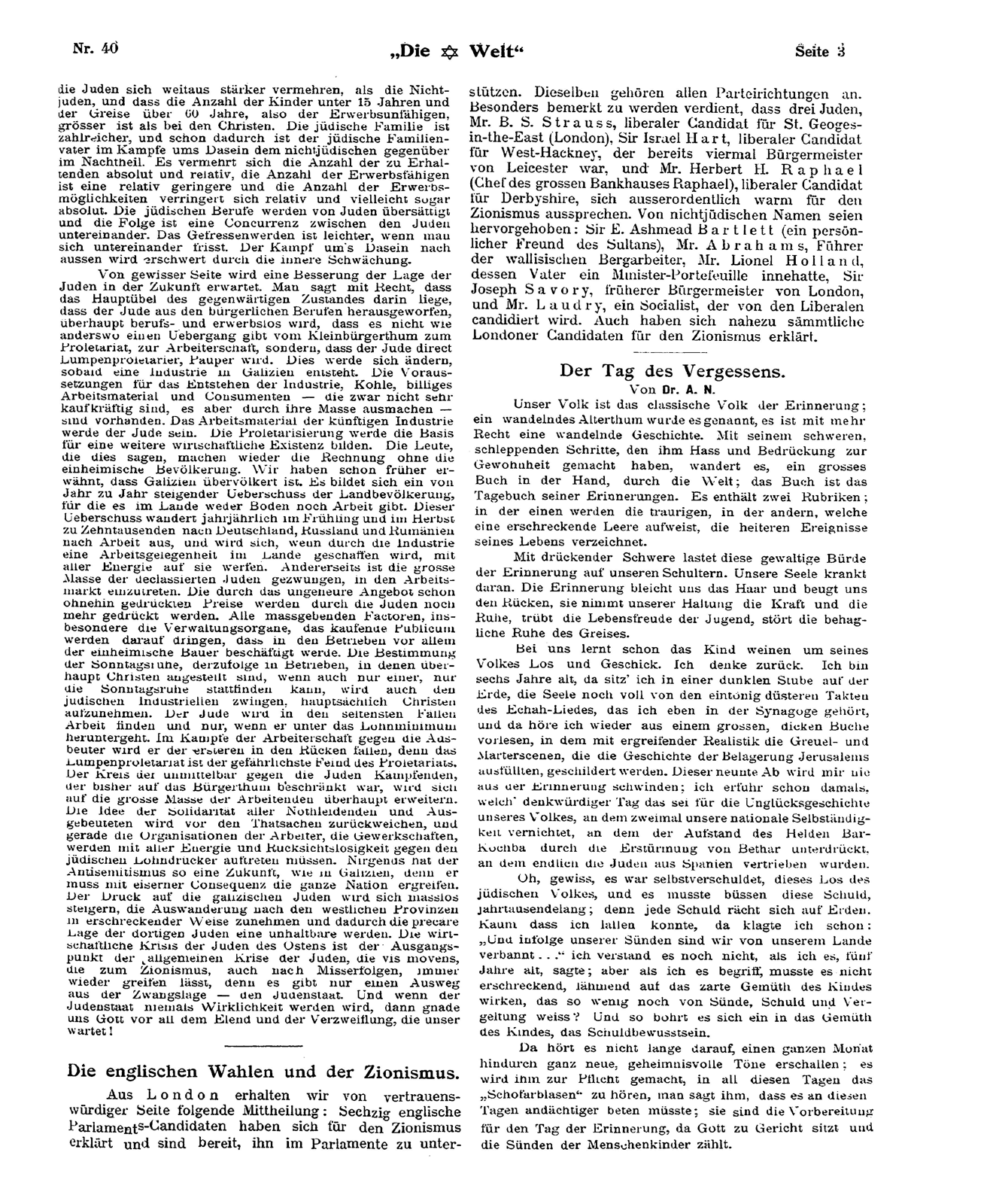
No. 40 — "Die ✡ Welt" — Page 3
(continued from page 2)
...the Jews increase far more strongly than the non-Jews, and that the number of children under fifteen years and of aged men over sixty years — that is, of those incapable of earning — is greater than among the Christians. The Jewish family is more numerous, and by that alone the Jewish father of a family is at a disadvantage in the struggle for existence as against the non-Jewish. The number of those to be maintained increases absolutely and relatively; the number of those capable of earning is relatively smaller; and the number of opportunities of earning diminishes relatively and perhaps even absolutely. The Jewish callings are over-saturated with Jews, and the consequence is a competition among the Jews themselves. Being devoured is the easier when one devours one's own. The struggle for existence outwards is made harder by the weakening within.
From a certain quarter an improvement in the position of the Jews is expected in the future. It is said with justice that the chief evil of the present condition lies in this, that the Jew, thrown out of the burgher callings, becomes altogether without calling and without earnings; that there is not, as elsewhere, a transition from the petty burgher class to the proletariat, to the working class, but that the Jew becomes directly a lumpen-proletarian, a pauper. This, it is said, will alter so soon as an industry arises in Galicia. The conditions for the rise of industry — coal, cheap labour material, and consumers, who indeed have no great purchasing power, but make up for it by their mass — are present. The labour material of the future industry, it is said, will be the Jew. Proletarisation will form the basis for a further economic existence. The people who say this again make their reckoning without the native population. We have already mentioned earlier that Galicia is over-populated. There is forming a surplus of the rural population, rising from year to year, for which there is in the country neither soil nor work. This surplus emigrates year by year, in spring and in autumn, by tens of thousands to Germany, Russia and Roumania in search of work, and will, if by industry an opportunity of work be created in the country, throw itself upon it with all its energy. On the other hand, the great mass of declassed Jews is compelled to enter the labour market. The prices, already depressed in any case by the enormous supply, will be depressed still further by the Jews. All the decisive factors, in particular the organs of administration and the purchasing public, will press for the native peasant to be employed in the works before all others. The provision of the Sunday rest law, according to which in works in which Christians are employed at all, be it but a single one, only the Sunday rest can take place, will compel the Jewish manufacturer also to engage chiefly Christians. The Jew will find work in the rarest cases, and only if he goes below the minimum of wages. In the struggle of the working class against the exploiters he will fall upon the back of the former, for the lumpen-proletariat is the most dangerous enemy of the proletariat. The circle of those fighting immediately against the Jews, hitherto confined to the burgher class, will widen out to the great mass of the working population generally. The idea of the solidarity of all who suffer want and are exploited will give way before the facts, and precisely the organisations of the workers, the trade unions, will have to come forward with all energy and ruthlessness against the Jewish under-cutter of wages. Nowhere has anti-Semitism such a future as in Galicia, for with iron consistency it must seize upon the whole nation. The pressure upon the Galician Jews will increase beyond measure, emigration to the western provinces will grow in terrifying fashion, and thereby the precarious position of the Jews there will become an untenable one. The economic crisis of the Jews of the East is the starting-point of the general crisis of the Jews, the vis movens which makes them reach again and again for Zionism, even after failures; for there is but one way out of the strait — the Jewish State. And if the Jewish State shall never become reality, then may God have mercy upon us in the face of all the misery and the despair that awaits us!
The English Elections and Zionism.
From London we receive from a trustworthy quarter the following communication: Sixty English parliamentary candidates have declared themselves for Zionism and are ready to support it in Parliament. They belong to all shades of party. It deserves particular notice that three Jews — Mr. B. S. Strauss, Liberal candidate for St. Georges-in-the-East (London); Sir Israel Hart, Liberal candidate for West-Hackney, who has already been four times Mayor of Leicester; and Mr. Herbert H. Raphael (head of the great banking house of Raphael), Liberal candidate for Derbyshire — express themselves extraordinarily warmly for Zionism. Among non-Jewish names let these be singled out: Sir E. Ashmead Bartlett (a personal friend of the Sultan); Mr. Abrahams, leader of the Welsh miners; Mr. Lionel Holland, whose father held a ministerial portfolio; Sir Joseph Savory, formerly Mayor of London; and Mr. Laudry, a Socialist who is put forward as candidate by the Liberals. Nearly all the London candidates, too, have declared themselves for Zionism.
The Day of Forgetting.
By Dr. A. N.
Our people is the classic people of remembrance; a wandering antiquity it has been called — with more justice it is a wandering history. With its heavy, dragging step, which hatred and oppression have made habitual to it, it wanders through the world, a great book in its hand; the book is the diary of its memories. It contains two columns; in the one are entered the sorrowful, in the other, which shows a terrifying emptiness, the glad events of its life.
With oppressive weight this mighty burden of remembrance lies upon our shoulders. Our soul sickens under it. Remembrance blanches our hair and bows our back; it takes from our bearing its strength and its repose, dims the joy of life in youth, and disturbs the comfortable rest of the old man.
Among us the child already learns to weep over the lot and destiny of its people. I think back. I am six years old; there I sit upon the ground in a dark room, my soul still full of the monotonously gloomy measures of the Echah chant that I have just heard in the synagogue, and there I hear reading again out of a great, thick book, in which with moving realism are portrayed the scenes of horror and of torment that filled the history of the siege of Jerusalem. That ninth of Ab will never vanish from my remembrance; even then I learned what a memorable day that is for the history of our people's misfortune — the day on which twice our national independence was destroyed, on which the rising of the hero Bar-Kochba was crushed by the storming of Bethar, on which finally the Jews were driven out of Spain.
Oh, assuredly it was self-incurred, this lot of the Jewish people, and it had to atone for this guilt for thousands of years; for every guilt avenges itself upon earth. Scarcely could I babble, and already I was lamenting: "And because of our sins we are banished from our land..." I did not yet understand it when, five years old, I said it; but when I did grasp it, must it not have worked terrifyingly, paralysingly upon the tender mind of the child, which as yet knows so little of sin, guilt and retribution? And so it bores itself into the mind of the child — the consciousness of guilt.
Then, not long afterwards, it hears wholly new, mysterious tones resound through a whole month; it is made its duty on all these days to hear the "blowing of the Shofar"; it is told that on these days it must pray more devoutly; they are the preparation for the Day of Remembrance, when God sits in judgment and numbers the sins of the children of men.