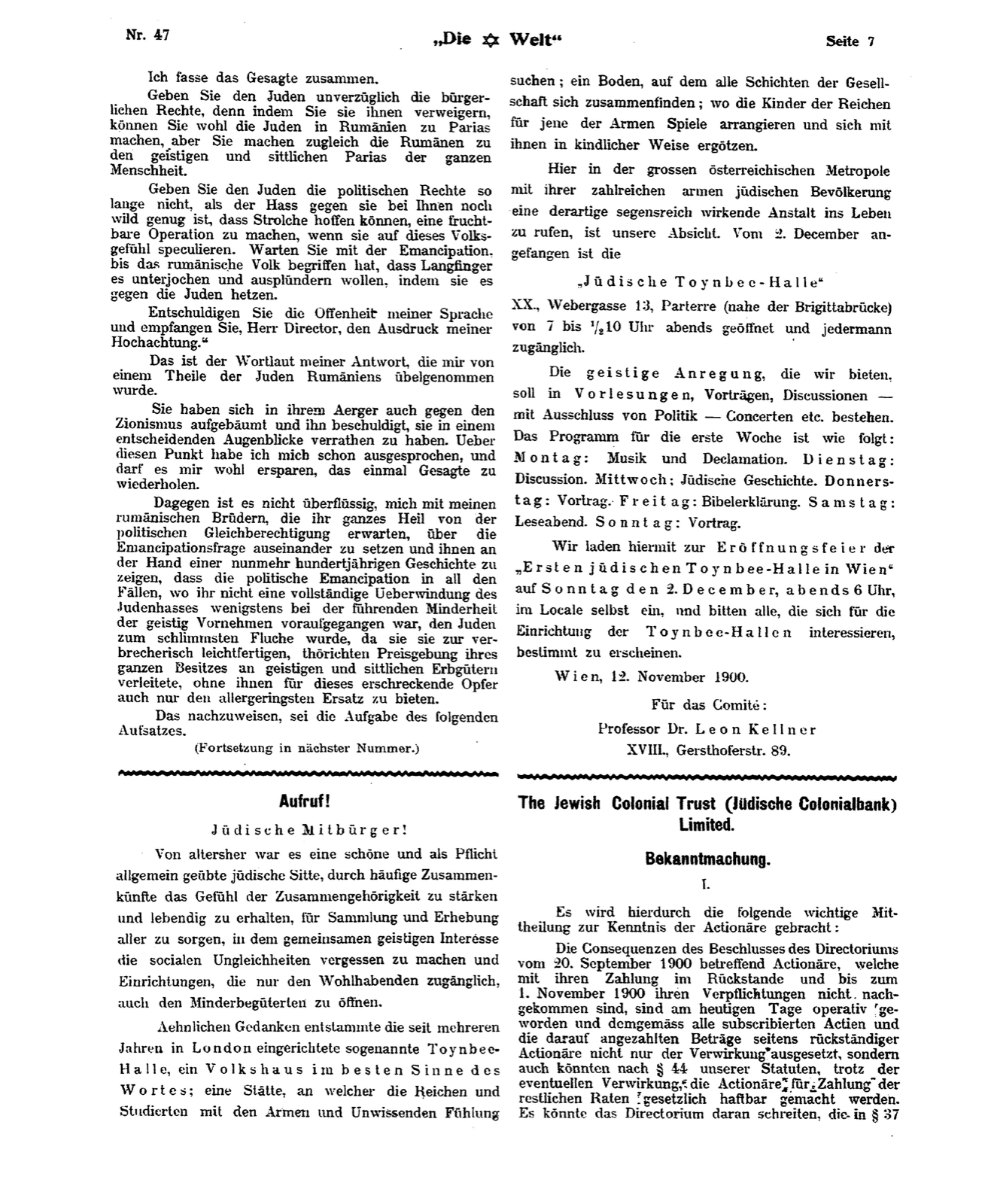
No. 47. — "Die Welt" — Page 7.
I sum up what I have said.
Give the Jews the civil rights without delay; for by refusing them you may indeed make the Jews in Roumania pariahs, but you make the Roumanians at the same time the intellectual and moral pariahs of all mankind.
Do not give the Jews the political rights so long as the hatred against them among you is still savage enough for ruffians to be able to hope for a fruitful operation by speculating upon this popular sentiment. Wait with the emancipation until the Roumanian people has understood that light-fingered gentry mean to subjugate and plunder it by baiting it against the Jews.
Pardon the frankness of my language, and receive, Mr. Director, the expression of my high esteem."
Such is the text of my reply, which was taken ill of me by a section of the Jews of Roumania.
In their vexation they reared up against Zionism as well, and accused it of having betrayed them at a decisive moment. Upon this point I have already spoken, and may well spare myself the repetition of what has once been said.
On the other hand it is not superfluous that I should come to an understanding upon the question of emancipation with my Roumanian brethren, who look for their whole salvation to political equality of rights, and should show them, at the hand of a history now a hundred years old, that political emancipation, in all those cases in which it was not preceded by a complete conquest of Jew-hatred at least among the leading minority of the intellectually distinguished, became the worst of curses to the Jews, since it seduced them into the criminally frivolous and foolish surrender of their whole possession of intellectual and moral heirlooms, without offering them for this appalling sacrifice even the very slightest compensation.
To demonstrate this shall be the task of the following essay.
(To be continued in the next number.)
Appeal!
Jewish Fellow-Citizens!
From of old it was a beautiful Jewish custom, universally practised as a duty, to strengthen and keep alive the feeling of solidarity by frequent gatherings, to provide for the ingathering and the elevation of all, to make social inequalities be forgotten in the common intellectual interest, and to open also to the less well-endowed those institutions which are accessible only to the well-to-do.
From similar thoughts sprang the so-called Toynbee Hall, established in London several years ago, a people's house in the best sense of the word; a place at which the rich and the educated seek contact with the poor and the unlettered; a ground upon which all strata of society come together; where the children of the rich arrange games for those of the poor and take a childlike delight in their company.
It is our intention to call into life here, in the great Austrian metropolis with its numerous poor Jewish population, an institution of the like beneficent working. From December 2nd onward the
"Jewish Toynbee Hall"
XX., Webergasse 13, ground floor (near the Brigitta Bridge), is open from 7 to 9.30 o'clock in the evening and accessible to everyone.
The intellectual stimulus which we offer is to consist of readings, lectures, discussions — politics excluded — concerts, etc. The programme for the first week is as follows: Monday: Music and declamation. Tuesday: Discussion. Wednesday: Jewish history. Thursday: Lecture. Friday: Exposition of the Bible. Saturday: Reading evening. Sunday: Lecture.
We hereby invite all to the opening celebration of the "First Jewish Toynbee Hall in Vienna" on Sunday, December 2nd, at 6 o'clock in the evening, in the premises themselves, and we beg all who take an interest in the institution of Toynbee Halls to be sure to attend.
Vienna, November 12th, 1900.
For the Committee: Professor Dr. Leon Kellner XVIII., Gersthoferstr. 89.
The Jewish Colonial Trust (Jewish Colonial Bank) Limited.
Notice.
I.
The following important communication is hereby brought to the knowledge of the shareholders:
The consequences of the resolution of the Directorate of September 20th, 1900, concerning shareholders who are in arrear with their payment and who by November 1st, 1900, have not met their obligations, have become operative on this day; accordingly all subscribed shares and the amounts paid upon them by shareholders in arrear are not only exposed to forfeiture, but, under § 44 of our statutes, the shareholders may also, notwithstanding such eventual forfeiture, be made legally liable for payment of the remaining instalments. The Directorate could proceed to those which in § 37