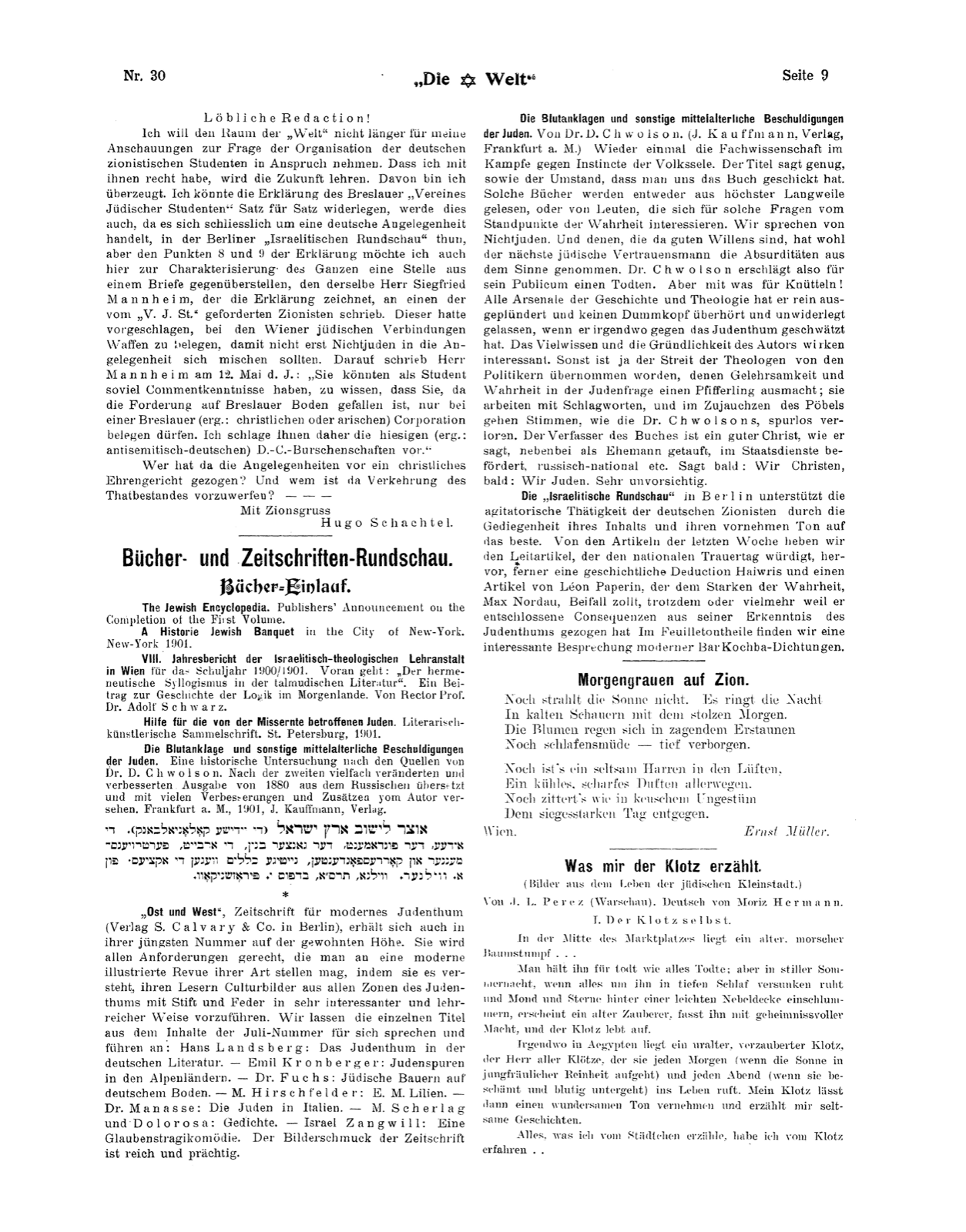
No. 30. — "Die Welt" — Page 9.
Worthy Editors!
I do not wish to occupy the space of Die Welt any longer with my views upon the question of the organisation of the German Zionist students. That I am right in them the future will teach. Of that I am convinced. I could refute the declaration of the Breslau "Verein Jüdischer Studenten" sentence by sentence, and shall indeed do so — since it is after all a German affair — in the Berlin "Israelitische Rundschau"; but against points 8 and 9 of the declaration I should like, here also, by way of characterising the whole, to set a passage from a letter which the same Herr Siegfried Mannheim who signs the declaration wrote to one of the Zionists challenged by the "V. J. St." The latter had proposed that arms should be taken up with the Vienna Jewish fraternities, so that non-Jews should not have to be mixed up in the affair at all. Upon this Herr Mannheim wrote on the 12th of May of this year: "As a student you might have knowledge enough of the Comment to know that, since the challenge was given upon Breslau soil, you may take up arms only with a Breslau (supply: Christian or Aryan) corporation. I therefore propose to you the local (supply: anti-Semitic German) D.-C. Burschenschaften."
Who, then, has dragged the affairs before a Christian court of honour? And who is to be charged with the perversion of the facts? — — — —
With Zion's greeting Hugo Schachtel.
Review of Books and Periodicals.
Books Received.
The Jewish Encyclopedia. Publishers' Announcement on the Completion of the First Volume. A Historie Jewish Banquet in the City of New-York. New-York 1901. VIII. Annual Report of the Israelitish-Theological Institute in Vienna for the school year 1900/1901. Prefixed to it: "The Hermeneutic Syllogism in Talmudic Literature." A contribution to the history of logic in the Orient. By Rector Prof. Dr. Adolf Schwarz. Aid for the Jews Stricken by the Failure of the Harvest. A literary and artistic miscellany. St. Petersburg, 1901. The Blood Accusation and Other Mediaeval Charges against the Jews. An historical investigation from the sources, by Dr. D. Chwolson. Translated from the Russian after the second, much altered and improved edition of 1880, and furnished by the author with many improvements and additions. Frankfort-on-Main, 1901, J. Kauffmann, publisher.
אוצר לישוב ארץ ישראל ("Treasury for the Settlement of the Land of Israel") (The Jewish Colonisation). The idea, the foundation; the whole edifice, the work, representation and correspondence, necessary rules concerning the shares. By A. Wilner. Vilna, תרס״א, printed by J. Pirozhnikov.
*
"Ost und West," a journal for modern Judaism (published by S. Calvary & Co. in Berlin), maintains in its latest number also its accustomed level. It satisfies every demand that may be made of a modern illustrated review of its kind, understanding as it does how to set before its readers, with pencil and pen, pictures of culture from every zone of Jewry in a highly interesting and instructive manner. We let the several titles from the contents of the July number speak for themselves, and cite: Hans Landsberg: Judaism in German Literature. — Emil Kronberger: Traces of the Jews in the Alpine Lands. — Dr. Fuchs: Jewish Peasants upon German Soil. — M. Hirschfelder: E. M. Lilien. — Dr. Manasse: The Jews in Italy. — M. Scherlag and Dolorosa: Poems. — Israel Zangwill: A Tragi-Comedy of Faith. The pictorial adornment of the journal is rich and splendid.
The Blood Accusation and Other Mediaeval Charges against the Jews. By Dr. D. Chwolson. (J. Kauffmann, publisher, Frankfort-on-Main.) Once again specialist scholarship in the struggle against the instincts of the popular soul. The title says enough, as does the circumstance that the book has been sent to us. Such books are read either out of the extremity of boredom, or by people who take an interest in such questions from the standpoint of truth. We are speaking of non-Jews. And as for those who are of good will, the nearest Jewish man of confidence has doubtless already driven the absurdities out of their heads. Dr. Chwolson, then, slays a dead man for his public. But with what cudgels! He has plundered clean out all the arsenals of history and theology, and has left no blockhead unheard and unrefuted who has anywhere babbled against Judaism. The vast knowledge and the thoroughness of the author are interesting in their effect. For the rest, the quarrel of the theologians has been taken over by the politicians, to whom learning and truth in the Jewish question are not worth a brass farthing; they work with catchwords, and amid the exultation of the mob voices such as Dr. Chwolson's are lost without a trace. The author of the book is a good Christian, as he says, incidentally baptised as a husband, promoted in the State service, Russian-national, etc. He says now: We Christians, now: We Jews. Very imprudent.
The "Israelitische Rundschau" in Berlin supports the agitational work of the German Zionists in the best way by the solidity of its contents and its distinguished tone. Among the articles of the past week we single out the leading article, which does honour to the national day of mourning, further a historical deduction by Haiwri, and an article by Léon Paperin, which pays tribute to that strong man of truth, Max Nordau, notwithstanding, or rather because, he has drawn resolute consequences from his recognition of Judaism In the feuilleton portion we find an interesting discussion of modern Bar Kochba poems.
Daybreak upon Zion.
Not yet does the sun shine forth. The night still wrestles In cold shudderings with the proud morning. The flowers stir in timid wonderment, Still heavy with sleep — deep hidden.
Still there is a strange waiting in the airs, A cool, keen fragrance upon every side. Still it trembles, as in chaste impetuousness, Towards the day that is strong in victory.
Vienna. Ernst Müller.
What the Log Tells Me.
(Pictures from the Life of the Jewish Small Town.) By J. L. Perez (Warsaw). German version by Moriz Hermann.
I. The Log Itself.
In the middle of the market-place there lies an old, rotten tree-stump . . .
It is held to be dead, as all dead things are; but on a still summer night, when everything about it lies sunk in deep sleep and moon and stars are slumbering behind a light coverlet of mist, an old magician appears, lays hold of it with mysterious power, and the log comes to life.
Somewhere in Egypt there lies a primeval, enchanted log, the lord of all logs, which calls them into life every morning (when the sun rises in virginal purity) and every evening (when it goes down abashed and bloody). My log then utters a wondrous sound and tells me strange stories.
All that I tell of the little town I have learned from the log . .