— 19 —
(continued from page 18)
…apt" it. Nachman places himself from the outset outside of the religious law He is unhappy "to belong to a people that has nothing in the world save the religious law," he who "thirsts to be a free man, who has other aims in life than to fight for or against the religious law." For the Bet-Hamidrasch liberalism which believed that it could save Jewry by the "permission for the use of peas on the Passover festival, or by the combating of the superstition of devils and angels," Nachman has only a pitying smile. His goal is infinitely higher. It is not upon the excrescences that he lays his hand, but upon the groundwork: the rebuilding of Jewry must begin at the foundations. His hatred is against the Book — not against any particular book, but against the Book in itself! — which has murdered our life and made us slaves of the word; his hatred is against the old Jewish house of learning, the Bet-Hamidrasch, which appears to him as the prison of the Jewish people. He cannot content himself with being allowed to eat peas on the Passover festival; he will live, free and glad and full and whole. "I will be no watcher of graves, no soldier of this strange law-guarding army — live I will, live like all men; I will not be buried alive, like all those about me."
And one morning he awoke without God. On that day he did not perform his prayer and did not lay on the phylacteries. He feels that between him and his own a gulf has opened that cannot be bridged. And yet his place is within, in their midst, at their head. "But no, he is a traitor; he has not gone away, he has run away. No, he has not become free, he has deserted out of the camp of the vanquished into the camp of the victor. But that is not the true freedom! That house of lamentation, held together as it is, out of which he has fled — it is his house; those who within it eke out their unhappy existence — they are his brethren; and this new, rich house into which he has broken — it is strange to him. No, that cannot be the solution of the question!... I will go back to my people, I will be its captain! But not to

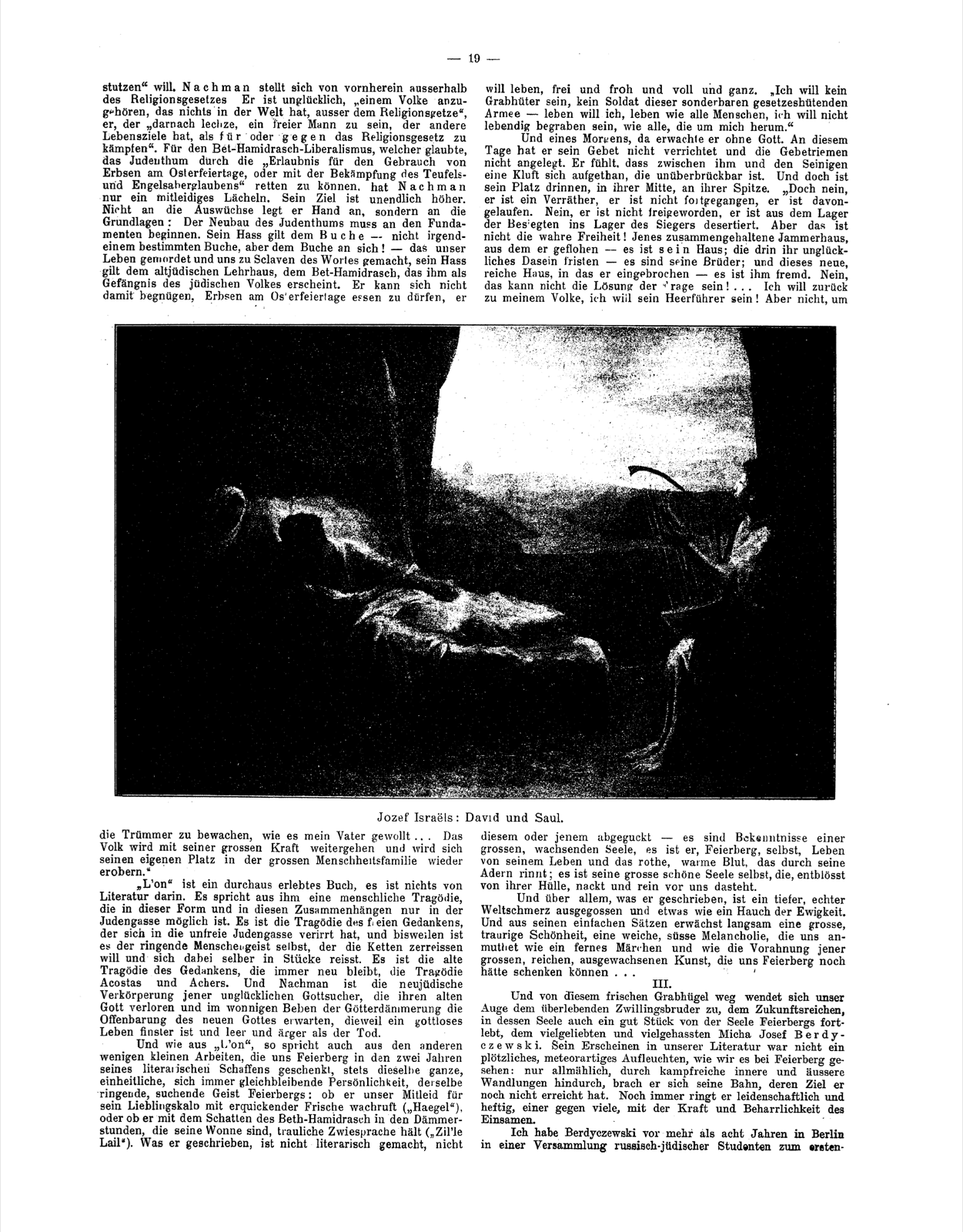
Jozef Israëls: David and Saul.
guard the ruins, as my father would have had it ... The people will go forward with its great strength and will win back for itself its own place in the great family of mankind."
"L'on" is a book thoroughly lived through; there is nothing of literature in it. There speaks out of it a human tragedy which, in this form and in these connections, is possible only in the Judengasse. It is the tragedy of the free thought that has strayed into the unfree Judengasse, and at times it is the wrestling human spirit itself, which would tear the chains asunder and in so doing tears itself to pieces. It is the old tragedy of thought, which ever remains new, the tragedy of Acosta and of Acher. And Nachman is the new-Jewish embodiment of those unhappy seekers after God who have lost their old God and, in the blissful trembling of the twilight of the gods, await the revelation of the new God, since a godless life is dark and empty and worse than death.
And as out of "L'on," so also out of the other few small works which Feierberg has given us in the two years of his literary creating there speaks always the same whole, unified, ever self-consistent personality, the same wrestling, seeking spirit of Feierberg; whether he awakens our compassion for his favourite calf with refreshing freshness ("Haegel"), or whether he holds familiar colloquy with the shadow of the Beth-Hamidrasch in the twilight hours that are his delight ("Zil'le Lail"). What he has written is not literary made, not caught from this man or that — they are the confessions of a great, growing soul; it is he, Feierberg, himself, life of his life and the red, warm blood that runs through his veins; it is his great beautiful soul itself, which, stripped of its covering, stands before us naked and pure.
And over all that he has written there is poured a deep, genuine Weltschmerz and something like a breath of eternity. And out of his simple sentences there slowly grows a great, sad beauty, a soft, sweet melancholy, which comes upon us like a far-off fairy tale and like the foreboding of that great, rich, full-grown art which Feierberg might yet have given us . . .
III.
And away from this fresh grave-mound our eye turns to the surviving twin brother, to him who is rich in future, in whose soul too a good part of Feierberg's soul lives on, to the much-loved and much-hated Micha Josef Berdyczewski. His appearance in our literature was not a sudden, meteor-like flashing forth, such as we have seen in Feierberg: only gradually, through inward and outward transformations full of struggle, did he break his own path, whose goal he has not yet reached. Still he wrestles passionately and vehemently, one against many, with the strength and the persistence of the solitary man.
I saw Berdyczewski more than eight years ago in Berlin, at a gathering of Russian-Jewish students, for the first-