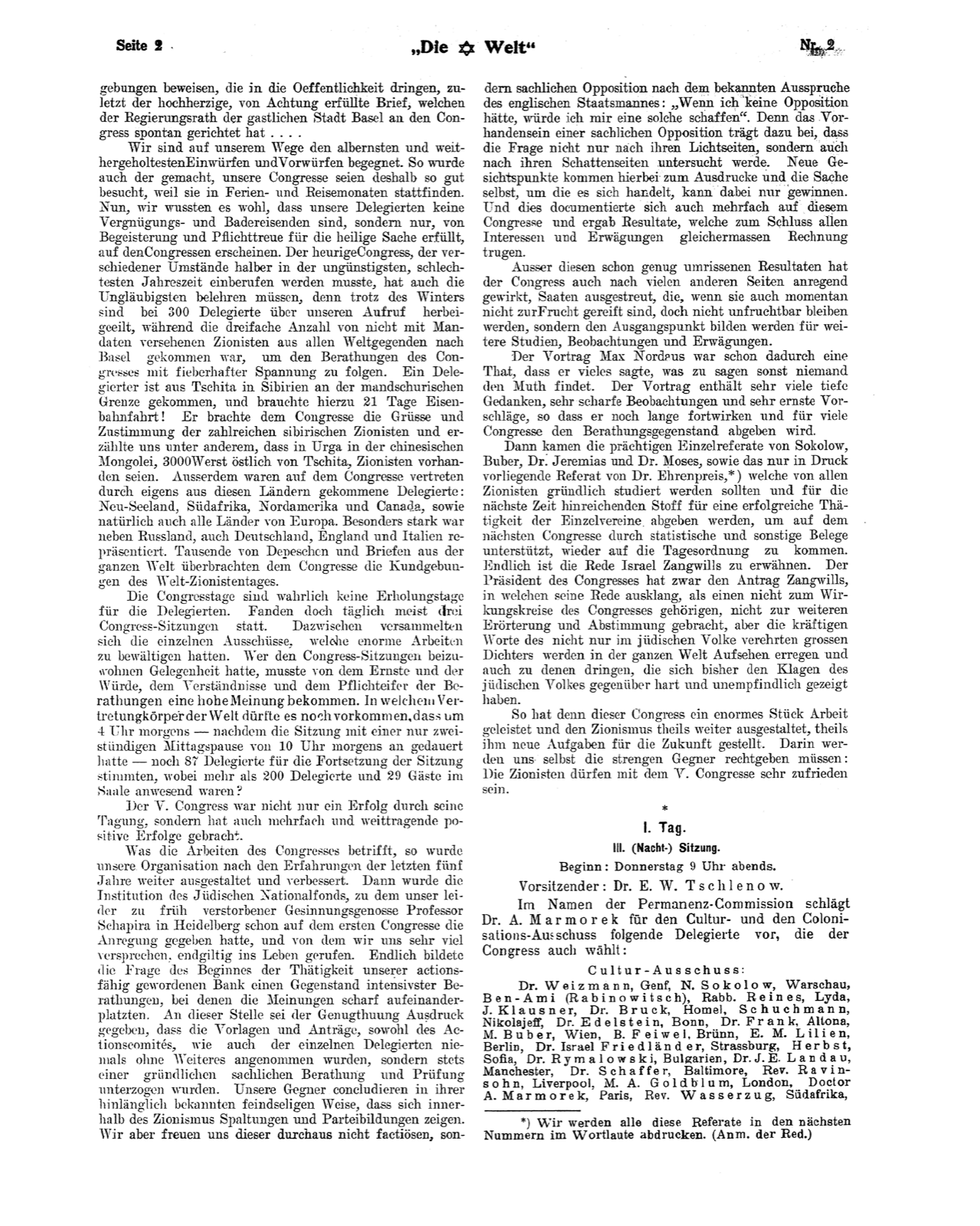
Page 2 — "Die Welt" — No. 2
(continued from page 1)
…tations that reach the public prove, most recently the high-minded letter, full of respect, which the Government Council of the hospitable city of Basle spontaneously addressed to the Congress . . . .
On our way we have met with the silliest and most far-fetched objections and reproaches. Among them was this one: that our Congresses were so well attended because they took place in the holiday and travelling months. Well, we knew full well that our delegates are no pleasure-seekers or visitors to watering-places, but appear at the Congresses solely out of enthusiasm and fidelity to duty in the holy cause. This year's Congress, which owing to various circumstances had to be convened at the most unfavourable, the worst season of the year, must have taught even the most incredulous, for in spite of the winter some 300 delegates hastened to answer our summons, while three times that number of Zionists without mandates had come to Basle from every quarter of the globe, to follow the deliberations of the Congress with feverish suspense. One delegate came from Tschita in Siberia, on the Manchurian frontier, and needed 21 days of railway travel to do so! He brought the Congress the greetings and assent of the numerous Siberian Zionists, and told us among other things that there are Zionists in Urga in Chinese Mongolia, 3000 versts east of Tschita. Represented at the Congress, moreover, by delegates who had come expressly from those lands, were: New Zealand, South Africa, North America and Canada, as well, of course, as all the countries of Europe. Besides Russia, Germany, England and Italy were especially strongly represented. Thousands of telegrams and letters from all the world brought the Congress the greetings of the World Zionist Day.
The days of the Congress are truly no days of recreation for the delegates. As a rule three sittings of the Congress were held daily. In between, the several committees assembled, which had enormous labours to accomplish. Whoever had occasion to attend the sittings of the Congress could not but form a high opinion of the earnestness and dignity, the understanding and the zeal for duty of its deliberations. In what representative body of the world could it happen that at 4 o'clock in the morning — after the sitting had lasted from 10 o'clock in the morning with only a two-hour break at midday — 87 delegates still voted for the continuation of the sitting, while more than 200 delegates and 29 guests were present in the hall?
The Fifth Congress was not only a success by the mere fact of its meeting, but has also brought manifold and far-reaching positive results.
As regards the labours of the Congress, our organisation was further developed and improved in the light of the experience of the last five years. Next, the institution of the Jewish National Fund, which our fellow Zionist Professor Schapira of Heidelberg, alas too early deceased, had already proposed at the first Congress, and from which we promise ourselves a very great deal, was definitively called into being. Finally, the question of the beginning of operations by our Bank, which has now become capable of action, formed the subject of most intensive deliberations, in which opinions clashed sharply. Let satisfaction be expressed here that the bills and motions, both of the Actions Committee and of individual delegates, were never adopted as a matter of course, but were always subjected to thorough and objective discussion and examination. Our opponents conclude, in their sufficiently well-known hostile fashion, that divisions and the formation of parties are appearing within Zionism. We, however, rejoice in this by no means factious, but objective opposition, after the well-known saying of the English statesman: "If I had no opposition, I should create one for myself." For the existence of an objective opposition helps to ensure that a question is examined not only from its bright side but also from its dark side. New points of view find expression thereby, and the matter itself that is at issue can only gain. And this was demonstrated more than once at this Congress, and produced results which in the end took equal account of all interests and considerations.
Besides these results, already sufficiently outlined, the Congress has had a stimulating effect in many other directions, and has sown seeds which, even if they have not ripened into fruit for the moment, will not remain barren, but will form the starting-point for further studies, observations and considerations.
The address of Max Nordau was a deed if only because it said much that no one else finds the courage to say. The address contains very many profound thoughts, very keen observations and very serious proposals, so that it will long continue to have its effect and will furnish the subject of deliberation for many Congresses.
Then came the splendid special reports of Sokolow, Buber, Dr. Jeremias and Dr. Moses, as well as the report of Dr. Ehrenpreis, available only in print,*) which ought to be thoroughly studied by all Zionists, and which will furnish sufficient material for the fruitful activity of the individual societies in the near future, so as to come up again on the agenda of the next Congress supported by statistical and other evidence.
Finally, the speech of Israel Zangwill must be mentioned. The President of the Congress, it is true, did not bring Zangwill's motion, in which his speech culminated, to further discussion and vote, as not belonging to the sphere of the Congress; but the powerful words of the great poet, honoured not only among the Jewish people, will create a stir throughout the whole world and will reach even those who have hitherto shown themselves hard and unfeeling towards the complaints of the Jewish people.
Thus this Congress has accomplished an enormous piece of work, and has in part further developed Zionism, in part set it new tasks for the future. In this even our severe opponents will have to admit that we are right: the Zionists may be very well satisfied with the Fifth Congress.
*
First Day.
Third (Night) Sitting.
Opening: Thursday, 9 o'clock in the evening. Chairman: Dr. E. W. Tschlenow.
In the name of the Standing Committee, Dr. A. Marmorek proposes the following delegates for the Culture Committee and the Colonisation Committee, whom the Congress duly elects:
Culture Committee: Dr. Weizmann, Geneva, N. Sokolow, Warsaw, Ben-Ami (Rabinowitsch), Rabbi Reines, Lyda, J. Klausner, Dr. Bruck, Homel, Schuchmann, Nikolajeff, Dr. Edelstein, Bonn, Dr. Frank, Altona, M. Buber, Vienna, B. Feiwel, Bruenn, E. M. Lilien, Berlin, Dr. Israel Friedländer, Strasburg, Herbst, Sofia, Dr. Rymalowski, Bulgaria, Dr. J. E. Landau, Manchester, Dr. Schaffer, Baltimore, Rev. Ravinsohn, Liverpool, M. A. Goldblum, London, Doctor A. Marmorek, Paris, Rev. Wasserzug, South Africa,
*) We shall print all these reports verbatim in the next numbers. (Editor's note.)