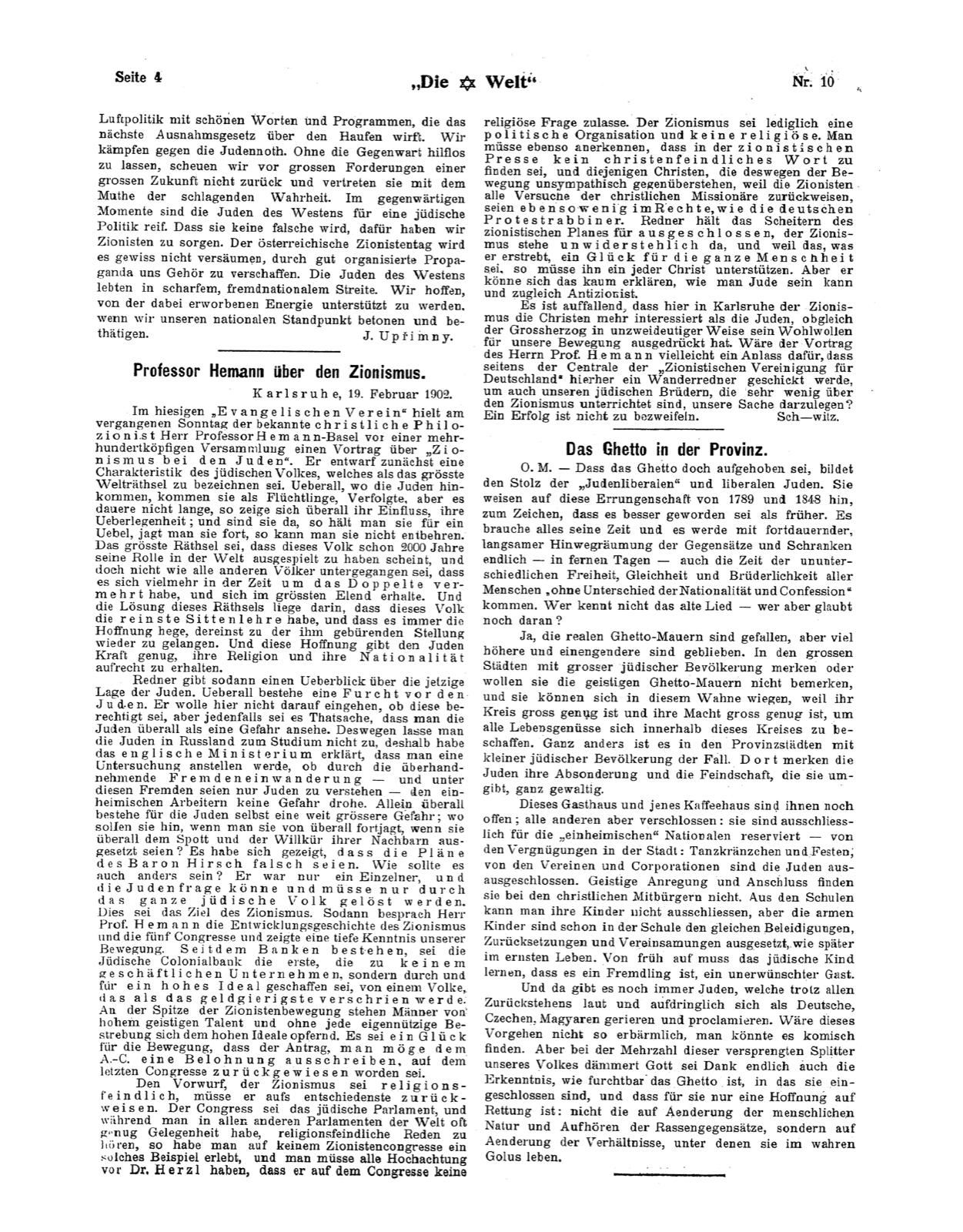
Page 4 — "Die Welt" — No. 10
(continued from page 3)
…politics of thin air, with fine words and programmes which the next exceptional law overthrows. We fight against Jewish distress. Without leaving the present helpless, we do not shrink from the great demands of a great future, and we champion them with the courage of convincing truth. At the present moment the Jews of the West are ripe for a Jewish policy. That it shall not be a false one, it is for us Zionists to see to. The Austrian Zionist Conference will assuredly not fail to gain us a hearing by well-organised propaganda. The Jews of the West have lived in sharp strife on behalf of alien nationalities. We hope to be supported by the energy thus acquired. when we emphasise and practise our national standpoint.
J. Upřimny.
Professor Hemann on Zionism.
Karlsruhe, 19th February 1902.
In the "Evangelical Union" here, last Sunday, the well-known Christian Philo-Zionist, Professor Hemann of Basle, delivered before a gathering several hundred strong a lecture on "Zionism among the Jews." He first drew a characterisation of the Jewish people, which might be described as the greatest riddle of the world. Wherever the Jews come, they come as fugitives, as the persecuted, but it is not long before their influence, their superiority, shows itself everywhere; and when they are there, they are held to be an evil; when they are driven away, they cannot be done without. The greatest riddle is that this people appears to have played out its part in the world already 2000 years ago, and yet has not perished like all other peoples, but has rather doubled in number in that time, and maintains itself in the direst misery. And the solution of this riddle lies in this, that this people possesses the purest moral teaching, and that it ever cherishes the hope of one day attaining once more the position due to it. And this hope gives the Jews strength enough to uphold their religion and their nationality.
The speaker then gave a survey of the present situation of the Jews. Everywhere there exists a fear of the Jews. He would not here enter into whether this is justified, but at all events it is a fact that the Jews are everywhere regarded as a danger. That is why the Jews are not admitted to study in Russia; that is why the English Ministry has declared that an inquiry will be instituted as to whether the growing immigration of aliens — and by these aliens only Jews are to be understood — threatens no danger to the native workmen. But everywhere there exists a far greater danger for the Jews themselves; where are they to go, if they are driven away from everywhere, if they are everywhere exposed to the mockery and the caprice of their neighbours? It has been shown that the plans of Baron Hirsch were mistaken. How indeed could it be otherwise? He was but a single individual, and the Jewish question can and must be solved only by the whole Jewish people. This is the aim of Zionism. Professor Hemann then discussed the history of the development of Zionism and the five Congresses, and displayed a profound knowledge of our movement. Since banks have existed, the Jewish Colonial Bank is the first to have been created not for any business undertaking, but through and for a lofty ideal, by a people decried as the most greedy of money. At the head of the Zionist movement stand men of high intellectual gifts, sacrificing themselves to the lofty ideal without any self-seeking aim. It was fortunate for the movement that the motion to vote a remuneration to the A.-C. was rejected at the last Congress.
The reproach that Zionism is hostile to religion he must repudiate most emphatically. The Congress is the Jewish Parliament, and whereas in all the other Parliaments of the world one has often enough occasion to hear speeches hostile to religion, at no Zionist Congress has one witnessed such an instance, and one must have every respect for Dr. Herzl in that he admits no religious question at the Congress. Zionism is purely a political organisation and not a religious one. One must likewise acknowledge that not a word hostile to Christians is to be found in the Zionist press, and those Christians who regard the movement unsympathetically because the Zionists reject all the attempts of the Christian missionaries are just as little in the right as the German Protest-Rabbis. The speaker considered the failure of the Zionist plan to be out of the question; Zionism stands irresistible, and because what it strives for would be a blessing for the whole of mankind, every Christian must support it. But he could scarcely explain to himself how one can be a Jew and at the same time an Anti-Zionist.
It is striking that here in Karlsruhe Zionism interests the Christians more than the Jews, although the Grand Duke has expressed in unequivocal fashion his goodwill towards our movement. Might Professor Hemann's lecture perhaps be an occasion for the Central Office of the "Zionist Federation for Germany" to send a travelling speaker here, in order to set forth our cause to our Jewish brethren also, who are very little informed about Zionism? Success is not to be doubted.
Sch–witz.
The Ghetto in the Provinces.
O. M. — That the Ghetto has after all been abolished is the pride of the "Jew-Liberals" and Liberal Jews. They point to this achievement of 1789 and 1848 as a sign that things have become better than before. Everything needs its time, and with the continued, slow clearing away of antagonisms and barriers there will at last come — in distant days — the time too of undifferentiated liberty, equality and fraternity of all men "without distinction of nationality and creed." Who does not know the old song — but who still believes in it?
Yes, the real Ghetto walls have fallen, but far higher and more confining ones have remained. In the great cities with a large Jewish population they do not notice, or will not notice, the spiritual Ghetto walls, and they can lull themselves in this delusion because their circle is large enough and their power great enough to procure all the enjoyments of life within this circle. Quite otherwise is the case in the provincial towns with a small Jewish population. There the Jews feel their isolation and the enmity that surrounds them most powerfully.
This inn and that coffee-house are still open to them; all the others, however, are closed: they are reserved exclusively for the "native" Nationals — from the amusements of the town: dancing-clubs and festivities; from the societies and corporations the Jews are excluded. Intellectual stimulus and fellowship they do not find among their Christian fellow-citizens. Their children cannot be excluded from the schools, but the poor children are already exposed at school to the same insults, slights and isolation as later in the serious business of life. From early on the Jewish child must learn that it is a stranger, an unwelcome guest.
And yet there are still Jews who, in spite of all rebuffs, loudly and obtrusively pose and proclaim themselves as Germans, Czechs, Magyars. Were this conduct not so pitiable, one might find it comic. But among the majority of these scattered splinters of our people there is, thank God, at last dawning the recognition of how terrible is the Ghetto in which they are shut up, and that for them there is only one hope of rescue: not the hope of a change in human nature and a cessation of racial antagonisms, but of a change in the conditions under which they live in the true Golus.