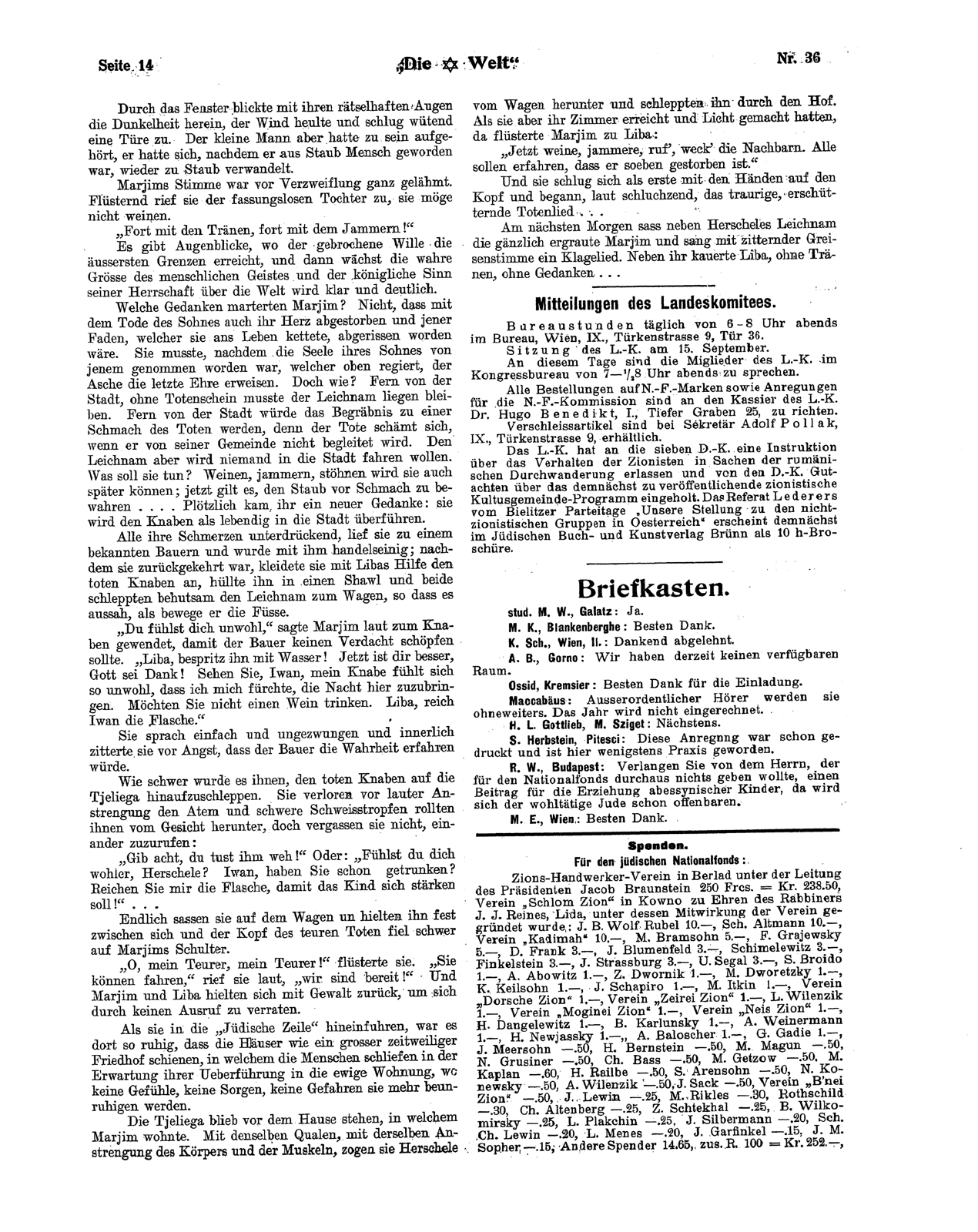
Page 14 — "Die Welt" — No. 36
Through the window the darkness looked in with its enigmatic eyes; the wind howled and furiously slammed a door. But the little man had ceased to be; having become man out of dust, he had turned to dust once more.
Marjim's voice was quite paralysed with despair. In a whisper she bade her distraught daughter not to weep.
"Away with tears, away with lamenting!"
There are moments when the broken will reaches its utmost limits, and then the true greatness of the human spirit grows, and the kingly meaning of its dominion over the world becomes clear and plain.
What thoughts were torturing Marjim? Not that with the death of her son her heart too had died and the thread that bound her to life had been snapped. Now that her son's soul had been taken by Him who rules above, she must pay the last honours to his ashes. But how? Far from the town, without a certificate of death, the body would have to lie where it was. Far from the town the burial would become a disgrace to the dead, for the dead is ashamed when he is not accompanied by his congregation. Yet no one would be willing to drive the body into the town. What was she to do? Weeping, lamenting, groaning she could do later as well; now the task was to save the dust from disgrace . . . . Suddenly a new thought came to her: she would convey the boy into the town as though he were alive.
Suppressing all her anguish, she ran to a peasant she knew and came to terms with him; when she had returned, with Liba's help she dressed the dead boy, wrapped him in a shawl, and both of them cautiously dragged the body to the cart, so that it looked as though he were moving his feet.
"You are feeling unwell," said Marjim aloud, turning to the boy, so that the peasant should not grow suspicious. "Liba, sprinkle him with water! Now you are better, thank God! You see, Iwan, my boy feels so unwell that I am afraid to spend the night here. Would you not like to drink some wine? Liba, hand Iwan the bottle."
She spoke simply and without constraint, while inwardly she trembled with fear lest the peasant should learn the truth.
How hard it was for them to drag the dead boy up on to the tjeliega! They lost their breath from sheer exertion, and heavy drops of sweat rolled down their faces, yet they did not forget to call out to one another:
"Take care, you are hurting him!" Or: "Do you feel better, Herschele? Iwan, have you had your drink yet? Hand me the bottle, so that the child may strengthen himself!" . . .
At last they were seated on the cart, holding him fast between them, and the head of the beloved dead fell heavily on Marjim's shoulder.
"Oh, my dear one, my dear one!" she whispered. "You may drive on," she called aloud, "we are ready!" And Marjim and Liba held themselves back by main force, lest they betray themselves by any cry.
When they drove into the "Jewish Row," it was so still there that the houses seemed like a great temporary graveyard, in which the people slept, awaiting their removal to the eternal dwelling, where no feelings, no cares, no dangers would trouble them any more.
The tjeliega stopped before the house in which Marjim lived. With the same torment, with the same straining of body and muscle, they drew Herschele down from the cart and dragged him across the yard. But when they had reached their room and struck a light, Marjim whispered to Liba:
"Now weep, lament, cry out, wake the neighbours. Let everyone learn that he has just died."
And she was the first to beat her head with her hands and begin, sobbing aloud, the sad and harrowing dirge . . .
Next morning, beside Herschele's body, sat Marjim, gone entirely grey, singing a lament in a trembling, aged voice. Beside her crouched Liba, without tears, without thoughts . . .
Communications of the Land Committee.
Office hours daily from 6 to 8 o'clock in the evening at the Bureau, Vienna, IX., Türkenstrasse 9, Door 36.
Meeting of the L.-K. on 15 September.
On that day the members of the L.-K. may be seen at the Congress Bureau from $7-1/2\ 8$ o'clock in the evening.
All orders for N.-F. stamps, as well as suggestions for the N.-F. Commission, are to be addressed to the Treasurer of the L.-K., Dr. Hugo Benedikt, I., Tiefer Graben 25.
Articles for sale may be obtained from the Secretary, Adolf Pollak, IX., Türkenstrasse 9.
The L.-K. has issued to the seven D.-K. an instruction concerning the conduct of Zionists in the matter of the Roumanian transmigration, and has obtained from the D.-K. opinions on the Zionist programme for the Jewish communities, shortly to be published. Lederer's address at the Bielitz Party Conference, "Our Attitude towards the Non-Zionist Groups in Austria," will shortly appear as a 10 h pamphlet from the Jüdischer Buch- und Kunstverlag, Bruenn.
Letter-Box.
stud. M. W., Galatz: Yes.
M. K., Blankenberghe: Many thanks.
K. Sch., Vienna, II.: Declined with thanks.
A. B., Gorno: We have no space available at present.
Ossid, Kremsier: Many thanks for the invitation.
Maccabäus: You will become an extraordinary auditor without further ado. The year is not counted.
H. L. Gottlieb, M. Sziget: Shortly.
S. Herbstein, Pitesci: This suggestion had already been printed, and here at least it has become practice.
R. W., Budapest: Ask the gentleman who would give absolutely nothing for the National Fund for a contribution towards the education of Abyssinian children; then the charitable Jew will soon reveal himself.
M. E., Vienna: Many thanks.
Donations. For the Jewish National Fund:
Zion Artisans' Society in Berlad, under the direction of its President Jacob Braunstein, 250 Frcs. = Kr. 238.50; Society "Schlom Zion" in Kovno, in honour of Rabbi J. J. Reines, Lida, with whose co-operation the Society was founded: J. B. Wolf Rubel 10.—, Sch. Altmann 10.—, Society "Kadimah" 10.—, M. Bramsohn 5.—, F. Grajewsky 5.—, D. Frank 3.—, J. Blumenfeld 3.—, Schimelewitz 3.—, Finkelstein 3.—, J. Strassburg 3.—, U. Segal 3.—, S. Broido 1.—, A. Abowitz 1.—, Z. Dwornik 1.—, M. Dworetzky 1.—, K. Keilsohn 1.—, J. Schapiro 1.—, M. Itkin 1.—, Society "Dorsche Zion" 1.—, Society "Zeirei Zion" 1.—, L. Wilenzik 1.—, Society "Moginei Zion" 1.—, Society "Neis Zion" 1.—, H. Dangelewitz 1.—, B. Karlunsky 1.—, A. Weinermann 1.—, H. Newjassky 1.—, A. Baloscher 1.—, G. Gadie 1.—, J. Meersohn —.50, H. Bernstein —.50, M. Magun —.50, N. Grusiner —.50, Ch. Bass —.50, M. Getzow —.50, M. Kaplan —.60, H. Railbe —.50, S. Arensohn —.50, N. Koneswky —.50, A. Wilenzik —.50, J. Sack —.50, Society "B'nei Zion" —.50, J. Lewin —.25, M. Rikles —.30, Rothschild —.30, Ch. Altenberg —.25, Z. Schtekhal —.25, B. Wilkomirsky —.25, L. Plakchin —.25, J. Silbermann —.20, Sch. Ch. Lewin —.20, L. Menes —.20, J. Garfinkel —.15, J. M. Sopher —.15; other donors 14.65, total R. 100 = Kr. 252.—,