Page 14 — Die Welt — No. 46
But several times a year Machlass gave her bridegroom an aragtchin, a gold-embroidered house-cap, in order to receive in return silver ear-pendants or stuff for a dress. To this all their relations were confined.
The arussa (bride), when she meets the bridegroom or his relatives, must at once sink down upon the ground and cover her face with her broad sleeve or with her handkerchief. The arass (bridegroom), too, must observe this ceremony.
"Do you know your bridegroom?" I asked Machlass through my guide Mahomad-Ogla.
"Why should I know him? All the other brides do not know their betrothed either. Such is the custom among us."
"How, then, do you know that you will be able to live happily with him?"
"How? He has three hundred he-goats and she-goats. On every holiday he will summon the surnatchi (bagpipers), and one will even be able to dance the whole night through. And even on weekdays there will be chinkal to eat at his house."
"What is chinkal?"
"A very tasty thing. You do not know chinkal? Oh, you poor man! Why, it is the best of dishes! . . ."
And with sincere pity she shook her head and stroked my cheeks, as though she wished to console me for having had the misfortune not to know chinkal. "And do you like kutum?" she asked me suddenly, with charming naïveté.
"What is that?"
"A delightful dish! What is better than kutum?" And she fell to musing. Then she cried out suddenly: "No, a silk cloak with gold buttons is better than kutum!" This unexpected confession the twelve-year-old child made with enchanting grace.
That I could not paint filled me with sincere vexation. The girl would have been the most rewarding subject for a picture. Every movement was so beautiful and graceful, all the more as it was unstudied. The lazy, purely cat-like stretching of the limbs, together with the gentle, so to speak truly womanly manners, lent her a peculiar charm — only to lapse presently, amid ceaseless childish laughter, into the frolics that so become every spoiled child.
(To be continued.)
Economic Section.
On the Inclusion of Economic Activity in the Zionist Programme.
Report of Dr. Ch. D. Gurewitsch at the Minsk Zionist Conference.
III.
Government of Podolia.
Year 1887. Total number of industrial establishments: all 3773, Jewish 759, percentage of Jewish industrial establishments 20; number of workmen: in all factories 25,055, in Jewish factories 4656, percentage of Jewish workmen 18,5; circulating capital in thousands of roubles: in all factories 24.000, in the Jewish factories 7000, percentage of Jewish circulating capital 29; number of workmen: in non-Jewish factories 67, in Jewish factories 6,3; average annual income: in non-Jewish factories 56400, in Jewish factories 9223.
Year 1897. Total number of industrial establishments: all 738, Jewish 157, percentage of Jewish industrial establishments 21,3; number of workmen: in all factories 24019, in Jewish factories 1492, percentage of Jewish workmen 6,2; circulating capital in thousands of roubles: in all factories 37.043, in Jewish factories 3055,5, percentage of Jewish circulating capital 8,2; number of workmen: in non-Jewish factories 39, in Jewish factories 9; average annual income: in non-Jewish factories 58.500, in Jewish factories 19.500.
Here too we observe a concentration and advancement of industry, which entailed the destruction of a great
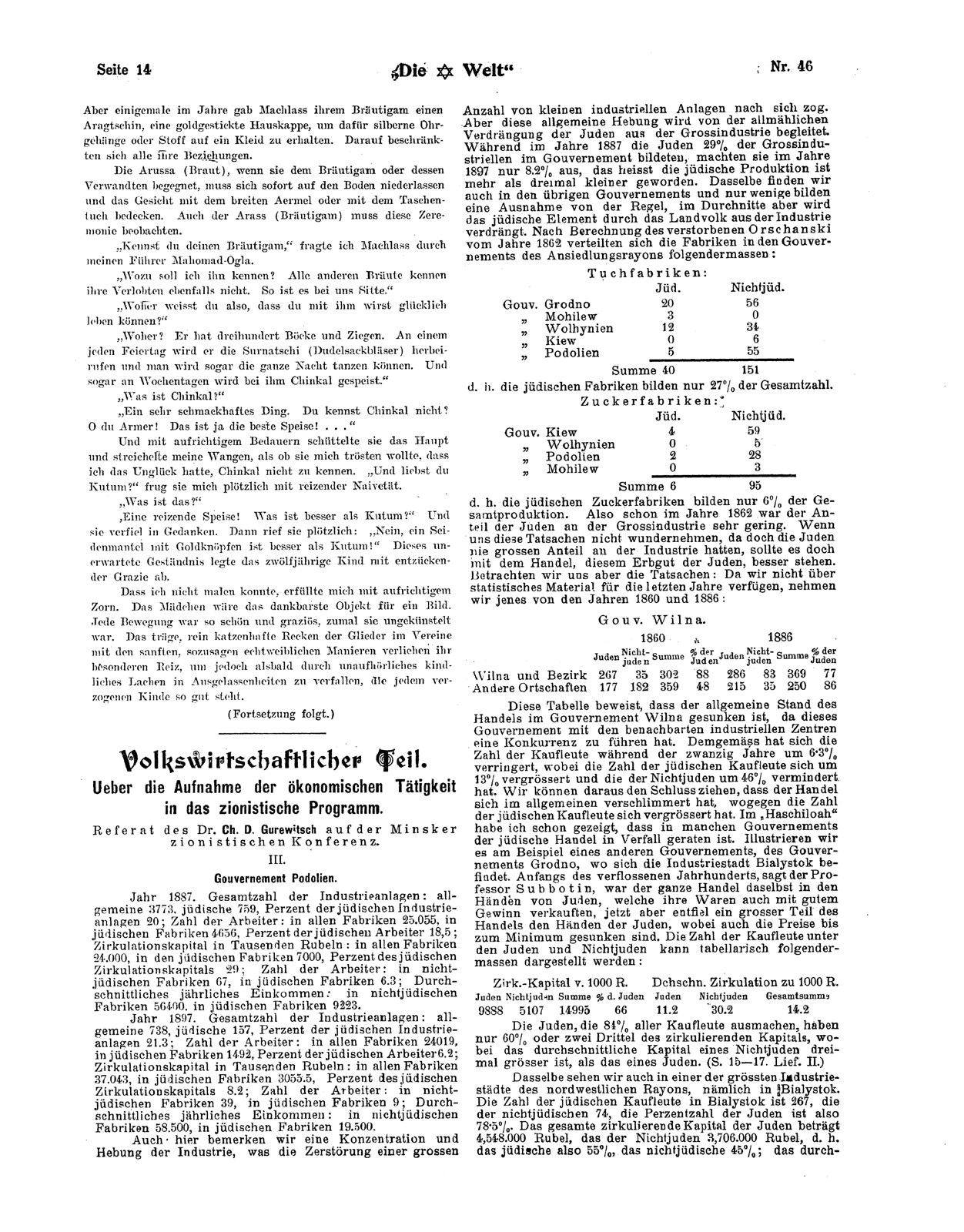
number of small industrial establishments. But this general advancement is accompanied by the gradual displacement of the Jews from large-scale industry. Whereas in the year 1887 the Jews formed 29% of the large industrialists in the Government, in the year 1897 they made up only 8,2%; that is to say, Jewish production has become more than three times smaller. We find the same in the remaining Governments too, and only a few form an exception to the rule; on the average, however, the Jewish element is being displaced from industry by the peasantry. According to the computation of the late Orschanski for the year 1862, the factories in the Governments of the Pale of Settlement were distributed as follows:
Cloth factories:
| Jew. | Non-Jew. | |
|---|---|---|
| Govt. Grodno | 20 | 56 |
| " Mohilev | 3 | 0 |
| " Volhynia | 12 | 34 |
| " Kieff | 0 | 6 |
| " Podolia | 5 | 55 |
| Total | 40 | 151 |
i.e., the Jewish factories form only 27% of the total number.
Sugar factories:
| Jew. | Non-Jew. | |
|---|---|---|
| Govt. Kieff | 4 | 59 |
| " Volhynia | 0 | 5 |
| " Podolia | 2 | 28 |
| " Mohilev | 0 | 3 |
| Total | 6 | 95 |
i.e., the Jewish sugar factories form only 6% of the total production. Thus already in the year 1862 the share of the Jews in large-scale industry was very small. If these facts do not astonish us, since the Jews never had a large share in industry, matters ought surely to stand better with trade, that heritage of the Jews. But let us consider the facts: as we have no statistical material at our disposal for recent years, we take that for the years 1860 and 1886:
Govt. Vilna.
| 1860 | 1886 | |||||||
|---|---|---|---|---|---|---|---|---|
| Jews | Non-Jews | Total | % of Jews | Jews | Non-Jews | Total | % of Jews | |
| Vilna and district | 267 | 35 | 302 | 88 | 286 | 83 | 369 | 77 |
| Other localities | 177 | 182 | 359 | 48 | 215 | 35 | 250 | 86 |
This table proves that the general state of trade in the Government of Vilna has declined, since this Government has to carry on competition with the neighbouring industrial centres. Accordingly the number of merchants has decreased during the twenty years by 6·3%, whereby the number of Jewish merchants has increased by 13% and that of non-Jews diminished by 46%. We may draw from this the conclusion that trade in general has grown worse, whereas the number of Jewish merchants has increased. In "Hashiloah" I have already shown that in some Governments Jewish trade has fallen into decay. Let us illustrate it by the example of another Government, the Government of Grodno, where the industrial town of Bialystok is situated. At the beginning of the past century, says Professor Subbotin, the whole of the trade there was in the hands of Jews, who also sold their wares at a good profit; now, however, a great part of the trade has slipped from the hands of the Jews, while prices too have sunk to the minimum. The number of merchants among Jews and non-Jews may be represented in tabular form as follows:
| Circ. capital per 1000 R. | Avg. circulation at 1000 R. | |||
|---|---|---|---|---|
| Jews | Non-Jews | Total | % of Jews | Jews |
| 9888 | 5107 | 14995 | 66 | 11.2 |
The Jews, who make up 84% of all merchants, have only 60%, or two-thirds, of the circulating capital, whereby the average capital of a non-Jew is three times greater than that of a Jew. (pp. 15-17. Part II.)
We see the same in one of the largest industrial towns of the north-western Pale, namely in Bialystok. The number of Jewish merchants in Bialystok is 267, that of non-Jewish 74; the percentage of Jews is thus 78·5%. The total circulating capital of the Jews amounts to 4,548.000 roubles, that of the non-Jews to 3,706.000 roubles, i.e., the Jewish thus 55%, the non-Jewish 45%; the aver-