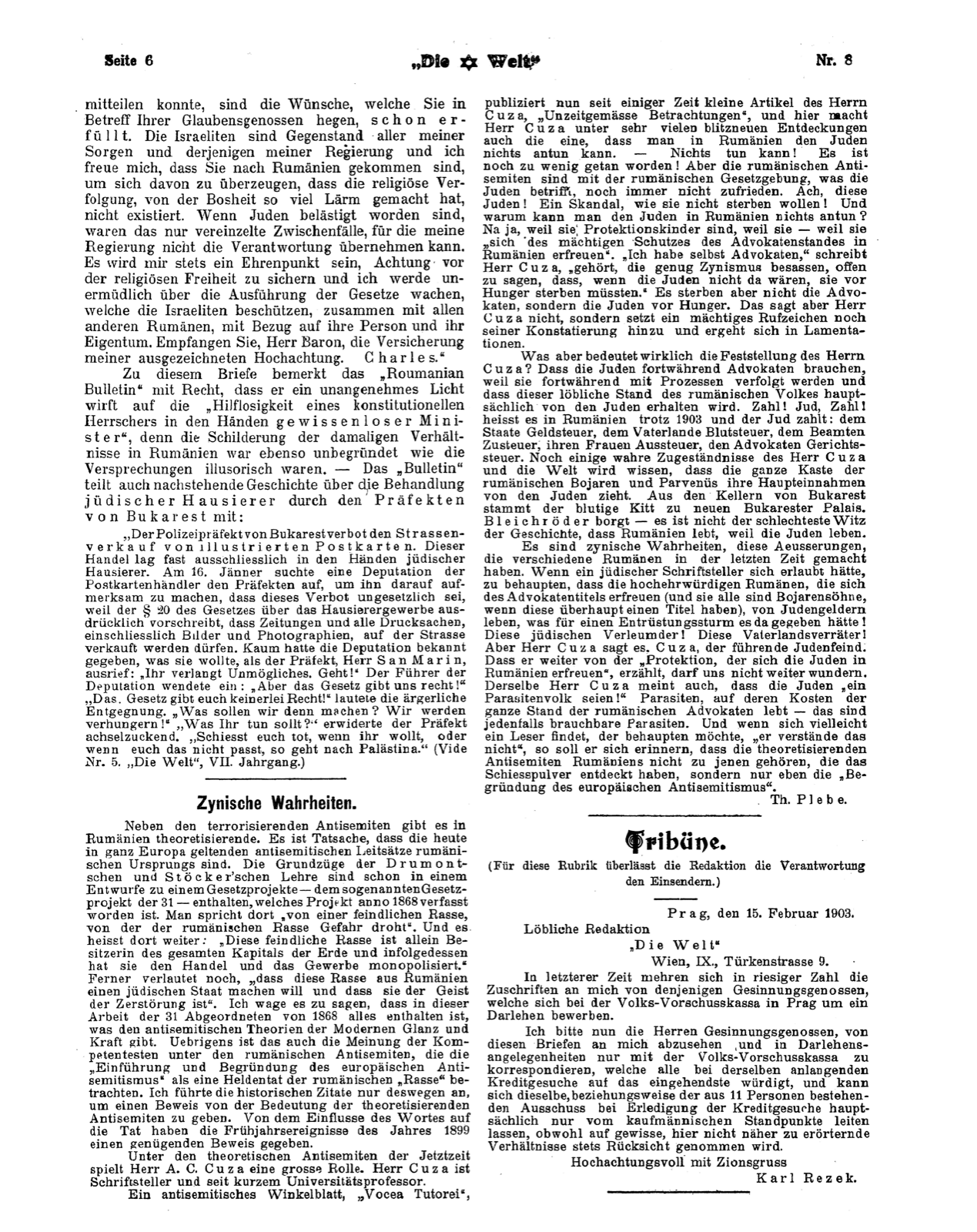
Page 6. — "Die Welt" — No. 8.
(continued from page 5)
…been able to tell you, the wishes which you cherish in regard to your co-religionists are already fulfilled. The Israelites are the object of all my cares and of those of my Government, and I am glad that you have come to Roumania to convince yourself that the religious persecution about which malice has made so much noise does not exist. If Jews have been molested, those were only isolated incidents for which my Government cannot accept responsibility. It will always be a point of honour with me to secure respect for religious liberty, and I shall watch untiringly over the execution of the laws which protect the Israelites, together with all other Roumanians, in respect of their persons and their property. Accept, Baron, the assurance of my most distinguished esteem. Charles."
On this letter the "Roumanian Bulletin" rightly remarks that it throws an unpleasant light on the "helplessness of a constitutional ruler in the hands of unscrupulous ministers," for the picture of the conditions then prevailing in Roumania was as unfounded as the promises were illusory. — The "Bulletin" also relates the following story about the treatment of Jewish pedlars by the Prefect of Bucharest:
"The Police Prefect of Bucharest forbade the street sale of picture postcards. This trade lay almost exclusively in the hands of Jewish pedlars. On 16 January a deputation of the postcard dealers called upon the Prefect in order to point out to him that this prohibition was illegal, since § 20 of the law on the pedlar's trade expressly provides that newspapers and all printed matter, including pictures and photographs, may be sold in the street. Scarcely had the deputation made known what it wanted when the Prefect, Mr. San Marin, exclaimed: 'You are asking the impossible. Go!' The leader of the deputation objected: 'But the law is on our side!' 'The law gives you no right whatever!' was the angry rejoinder. 'What are we to do, then? We shall starve!' 'What you are to do?' replied the Prefect with a shrug of the shoulders. 'Shoot yourselves, if you like, or if that does not suit you, go to Palestine.'" (Vide No. 5, "Die Welt," Volume VII.)
Cynical Truths.
Besides the terrorising antisemites there are in Roumania theorising ones. It is a fact that the antisemitic principles current today throughout Europe are of Roumanian origin. The essentials of the doctrine of Drumont and of Stöcker are already contained in a draft for a bill — the so-called Bill of the 31 — which bill was drawn up in the year 1868. There one speaks "of a hostile race, from which danger threatens the Roumanian race." And it goes on to say: "This hostile race is the sole possessor of the entire capital of the earth, and in consequence it has monopolised trade and industry." Further it is declared "that this race wishes to make of Roumania a Jewish state, and that it is the spirit of destruction." I venture to say that in this work of the 31 deputies of 1868 there is contained everything that gives lustre and force to the antisemitic theories of the moderns. This, moreover, is also the opinion of the most competent among the Roumanian antisemites, who regard the "introduction and foundation of European antisemitism" as a heroic deed of the Roumanian "race." I cited the historical quotations only in order to give a proof of the importance of the theorising antisemites. Of the influence of the word upon the deed, the events of the spring of the year 1899 have given sufficient proof.
Among the theoretical antisemites of the present day Mr. A. C. Cuza plays a great part. Mr. Cuza is an author and, since recently, a university professor.
An obscure antisemitic sheet, "Vocea Tutorei," has now for some time been publishing little articles by Mr. Cuza, "Untimely Meditations," and here Mr. Cuza, among a great many brand-new discoveries, makes this one too: that in Roumania one can do nothing to the Jews. — Can do nothing! Too little has been done yet! But the Roumanian antisemites are still not satisfied with Roumanian legislation so far as the Jews are concerned. Ah, these Jews! A scandal, how they will not die! And why can one do nothing to the Jews in Roumania? Why, because they are favourites under protection, because they — because they "enjoy the powerful protection of the legal profession in Roumania." "I have myself heard advocates," writes Mr. Cuza, "who possessed cynicism enough to say openly that if the Jews were not there, they would have to die of hunger." But it is not the advocates who die of hunger, it is the Jews. That, however, Mr. Cuza does not say; instead he adds a mighty exclamation mark to his finding and indulges in lamentations.
But what does Mr. Cuza's finding really signify? That the Jews constantly need advocates because they are constantly persecuted with lawsuits, and that this laudable estate of the Roumanian people is chiefly maintained by the Jews. Pay! Jew, pay! is the cry in Roumania in spite of 1903, and the Jew pays: to the State the money-tax, to the fatherland the blood-tax, to the official the extra tax, to their wives the dowry, to the advocates the court-tax. A few more true admissions from Mr. Cuza, and the world will know that the whole caste of Roumanian boyars and parvenus draws its chief income from the Jews. From the cellars of Bucharest comes the bloody mortar for new Bucharest palaces. Bleichröder lends — it is not the worst joke of history that Roumania lives because the Jews live.
They are cynical truths, these utterances which various Roumanians have made of late. Had a Jewish writer ventured to assert that the most reverend Roumanians who enjoy the title of advocate (and they are all sons of boyars, if these have any title at all) live on Jewish money, what a storm of indignation there would have been! These Jewish slanderers! These traitors to their country! But Mr. Cuza says it. Cuza, the leading enemy of the Jews. That he goes on to speak of the "protection which the Jews enjoy in Roumania" need not surprise us further. The same Mr. Cuza also holds that the Jews "are a parasite people!" Parasites at whose expense the whole estate of Roumanian advocates lives — those are at any rate useful parasites. And if perhaps some reader should be found who would maintain that "he does not understand this," let him remember that the theorising antisemites of Roumania are not among those who discovered gunpowder, but only, precisely, the "foundation of European antisemitism."
Th. Plebe.
Tribune.
(For this column the Editors leave the responsibility to the contributors.)
Prague, 15 February 1903.
To the Honourable Editors of "Die Welt," Vienna, IX, Türkenstrasse 9.
Of late the letters addressed to me by those fellow Zionists who are applying to the People's Loan Bank in Prague for a loan have been multiplying in enormous numbers.
I therefore beg the gentlemen, my fellow Zionists, to refrain from these letters to me and in matters of loans to correspond only with the People's Loan Bank, which gives the most thorough consideration to all applications for credit reaching it; and in dealing with the applications for credit the Bank, or rather its committee of 11 persons, can be guided chiefly only by the commercial point of view, although certain circumstances, which need not be discussed more closely here, are always taken into account.
Respectfully, with Zion's greeting,
Karl Rezek.