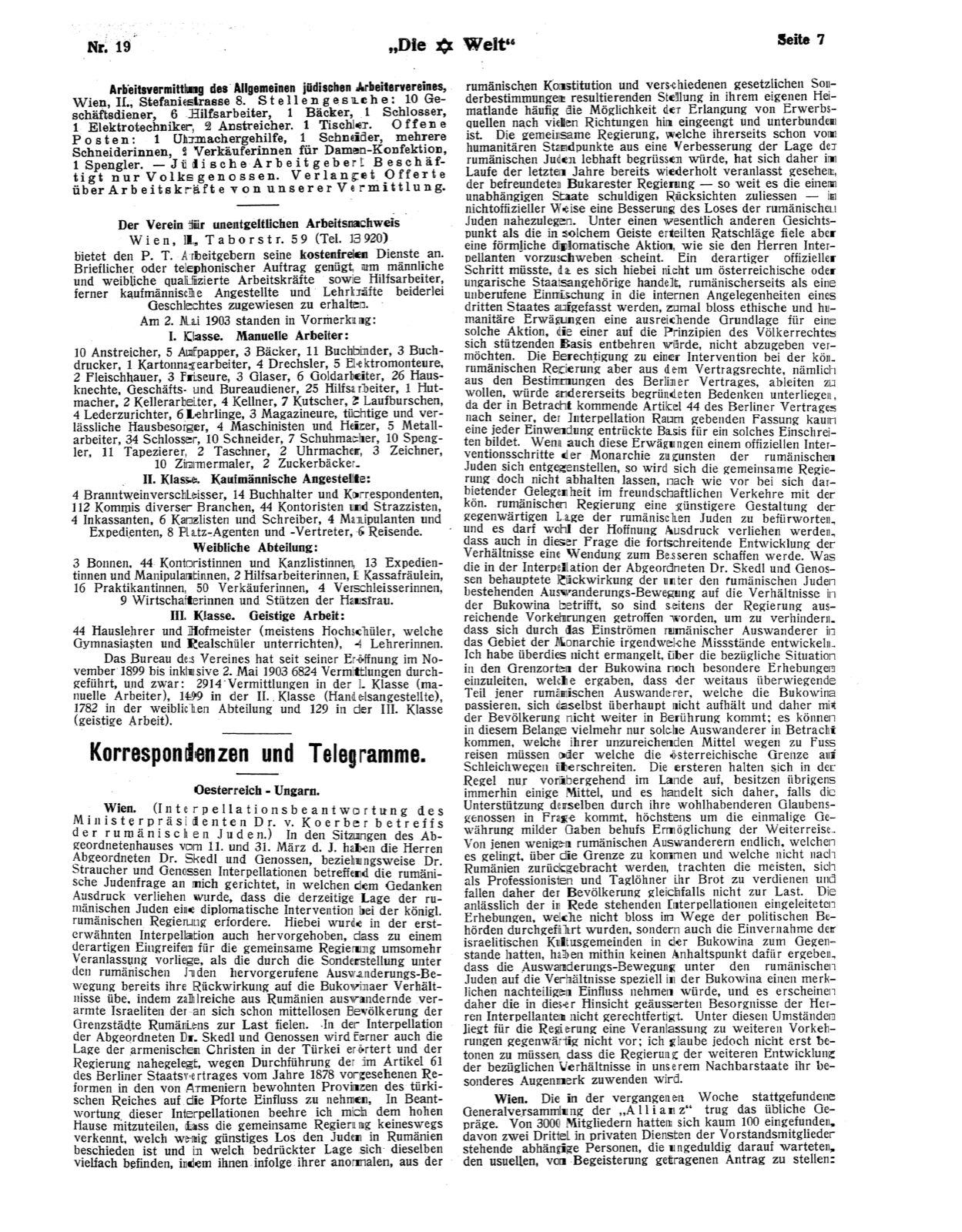
No. 19. — "Die Welt" — Page 7.
Labour Exchange of the General Jewish Workers' Society, Vienna, II., Stefaniestrasse 8. Situations wanted: 10 shop porters, 6 labourers, 1 baker, 1 locksmith, 1 electrician, 2 house-painters, 1 joiner. Vacancies: 1 watchmaker's assistant, 1 tailor, several seamstresses, 2 saleswomen for ladies' ready-made clothing, 1 tinsmith. — Jewish employers! Employ only your own people. Ask our exchange for offers of labour.
The Society for Free Labour Registry, Vienna, II., Taborstrasse 59 (Tel. 13 920), offers its services free of charge to P. T. employers. An order by letter or telephone suffices to have qualified workers, male and female, as well as labourers, and further commercial employees and teachers of both sexes, assigned to them.
On the 2nd of May 1903 the following were on the register:
Class I. Manual workers: 10 house-painters, 5 pasters, 3 bakers, 11 bookbinders, 3 printers, 1 cardboard-box maker, 4 turners, 5 electrical fitters, 2 butchers, 3 hairdressers, 3 glaziers, 6 goldsmiths, 26 porters, shop and office servants, 25 labourers, 1 hatter, 2 cellarmen, 4 waiters, 7 coachmen, 2 errand-boys, 4 leather-dressers, 6 apprentices, 3 warehousemen, capable and reliable house-porters, 4 engine-men and stokers, 5 metal-workers, 34 locksmiths, 10 tailors, 7 shoemakers, 10 tinsmiths, 11 upholsterers, 2 bag-makers, 2 watchmakers, 3 draughtsmen, 10 room-painters, 2 confectioners.
Class II. Commercial employees: 4 spirit-retailers, 14 book-keepers and correspondence clerks, 112 shop assistants of various branches, 44 counting-house and day-book clerks, 4 collectors, 6 office clerks and copyists, 4 handling and dispatch clerks, 8 local agents and representatives, 6 commercial travellers.
Women's Department: 3 nursery governesses, 44 counting-house and office clerks, 13 dispatch and handling clerks, 2 women labourers, 1 cashier, 16 probationers, 50 saleswomen, 4 retail saleswomen, 9 housekeepers and lady-helps.
Class III. Intellectual work: 44 private tutors and tutor-governors (mostly university students, who teach pupils of the Gymnasia and Realschulen), 4 women teachers.
Since its opening in November 1899, up to and including the 2nd of May 1903, the Society's bureau has effected 6824 placings, namely: 2914 placings in Class I (manual workers), 1499 in Class II (commercial employees), 1782 in the Women's Department, and 129 in Class III (intellectual work).
Correspondence and Telegrams.
Austria-Hungary.
Vienna. (Reply of the Premier, Dr. v. Koerber, to the interpellation concerning the Roumanian Jews.) At the sittings of the Chamber of Deputies of the 11th and 31st of March of this year, the Deputies Dr. Skedl and associates, and Dr. Straucher and associates, respectively, addressed to me interpellations concerning the Roumanian Jewish question, in which expression was given to the view that the present situation of the Roumanian Jews calls for diplomatic intervention with the Royal Roumanian Government. In the first-mentioned interpellation it was further emphasised that there was all the more occasion for such interference on the part of the Joint Government, since the emigration movement called forth among the Roumanian Jews by their exceptional position was already reacting upon conditions in the Bukovina, numerous impoverished Israelites emigrating from Roumania falling as a burden upon the already destitute population of the frontier towns of Roumania. In the interpellation of Deputy Dr. Skedl and associates, the situation of the Armenian Christians in Turkey is also discussed, and the Government is urged to use its influence with the Porte for the carrying out of the reforms provided for in Article 61 of the Berlin Treaty of 1878 in the provinces of the Turkish Empire inhabited by Armenians. In answer to these interpellations I have the honour to inform the House that the Joint Government by no means fails to recognise how unfavourable a lot has fallen to the Jews in Roumania, and in what an oppressed situation they frequently find themselves, since in consequence of their anomalous position, resulting from the Roumanian Constitution and various special legal provisions, the possibility of obtaining a livelihood is often restricted and cut off for them in many directions in their own native land. The Joint Government, which for its part, from the humanitarian standpoint alone, would warmly welcome an improvement in the position of the Roumanian Jews, has therefore in the course of recent years already repeatedly seen occasion to urge upon the friendly Government at Bucharest, in unofficial fashion — so far as the consideration due to an independent State permitted — an improvement of the lot of the Roumanian Jews. A formal diplomatic action, however, such as the honourable interpellants appear to have in mind, would fall under an essentially different point of view from counsels given in such a spirit. Such an official step, since it does not concern Austrian or Hungarian subjects, would necessarily be regarded on the Roumanian side as an unwarranted interference in the internal affairs of a third State, especially as merely ethical and humanitarian considerations could not furnish a sufficient ground for such an action, which would lack any basis resting upon the principles of international law. On the other hand, to seek to derive the right to an intervention with the Royal Roumanian Government from treaty law, namely from the provisions of the Berlin Treaty, would be open to well-founded objections, since Article 44 of the Berlin Treaty, which is the article in question, in its wording, which leaves room for interpretation, hardly forms a basis for such a proceeding that is beyond every objection. Although these considerations stand in the way of an official step of intervention by the Monarchy on behalf of the Roumanian Jews, the Joint Government will nevertheless not be deterred from continuing, as heretofore, when occasion offers in its friendly intercourse with the Royal Roumanian Government, to advocate a more favourable shaping of the present situation of the Roumanian Jews, and expression may well be given to the hope that in this question too the progressive development of conditions will bring about a turn for the better. As regards the reaction, asserted in the interpellation of Deputy Dr. Skedl and associates, of the emigration movement existing among the Roumanian Jews upon conditions in the Bukovina, sufficient precautions have been taken by the Government to prevent any abuses from developing through the influx of Roumanian emigrants into the territory of the Monarchy. I have, moreover, not failed to institute special inquiries into the situation in question in the frontier places of the Bukovina, which showed that by far the greater part of those Roumanian emigrants who pass through the Bukovina do not stay there at all and therefore come into no further contact with the population; in this respect, rather, only those emigrants can come into consideration who, by reason of their insufficient means, must travel on foot, or who cross the Austrian frontier by secret paths. The former as a rule stay in the country only temporarily, and moreover do possess some means, so that, should their support by their more prosperous co-religionists come in question, it is at most a matter of a single grant of alms to enable them to continue their journey. Finally, of those few Roumanian emigrants who succeed in getting across the frontier and are not taken back to Roumania, most endeavour to earn their bread as tradesmen and day-labourers, and therefore likewise are no burden upon the population. The inquiries instituted on the occasion of the interpellations under discussion, which were carried out not merely through the political authorities but also included the hearing of the Israelite communities in the Bukovina, have accordingly yielded no ground for supposing that the emigration movement among the Roumanian Jews would exercise any noticeable detrimental influence upon conditions in the Bukovina in particular, and the apprehensions expressed in this regard by the honourable interpellants therefore do not appear justified. In these circumstances there is at present no occasion for the Government to take further measures; I believe, however, that I need hardly emphasise that the Government will devote its special attention to the further development of the conditions in question in our neighbouring State.
Vienna. The general meeting of the "Alliance," held last week, bore its customary stamp. Of 3000 members scarcely 100 had appeared, two-thirds of them dependent persons in the private employ of members of the Board, who were waiting impatiently to put the usual motion, borne along on enthusiasm: