No. 46. — "Die ✡ Welt" — Page 3.
(continued from page 2)
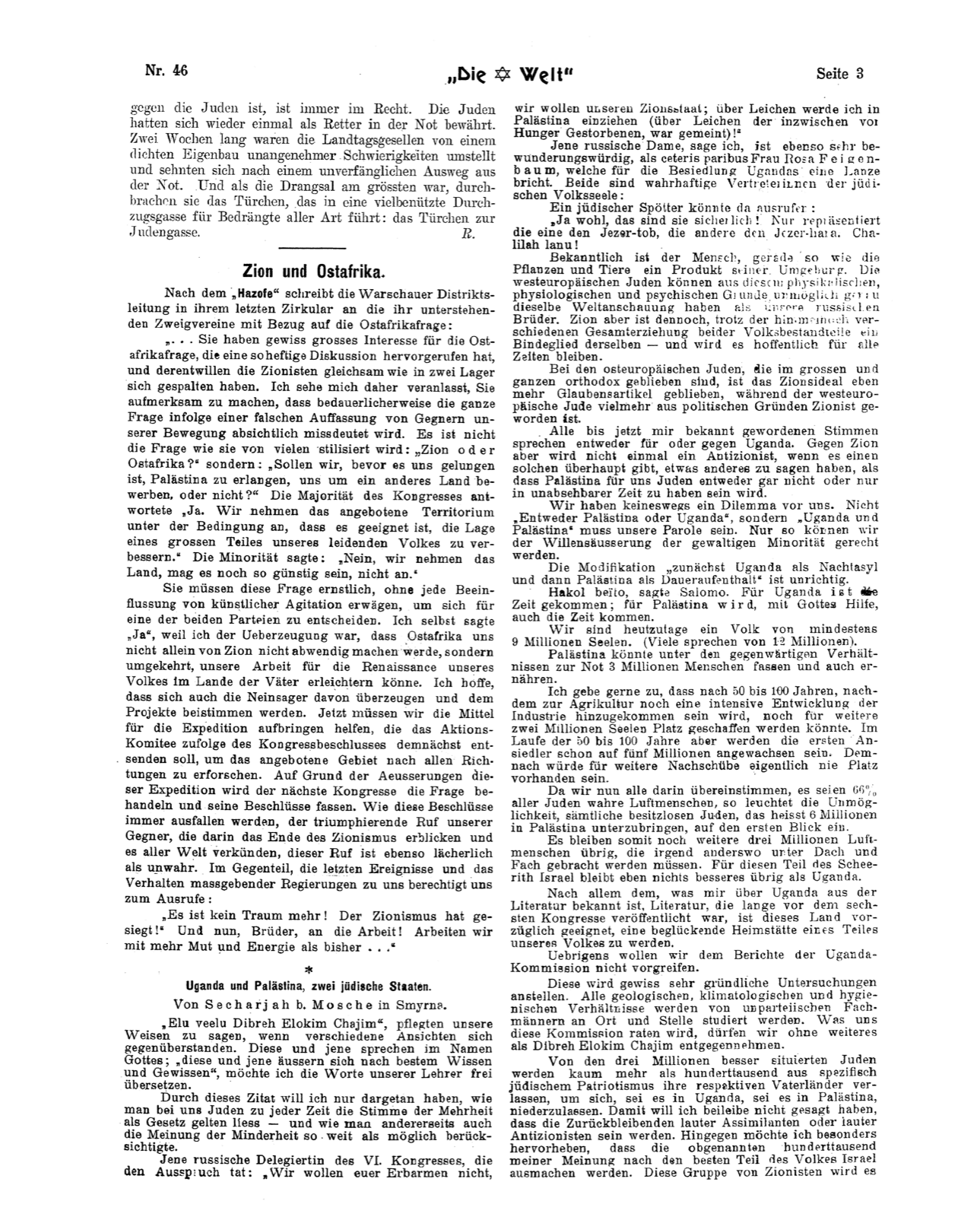
…is against the Jews is always in the right. The Jews had once again proved themselves rescuers in need. For two weeks the fellows of the Diet had been hemmed in by a dense growth of their own making of disagreeable difficulties, and longed for an unsuspicious way out of their distress. And when the tribulation was greatest, they broke through the little gate which leads into a much-frequented thoroughfare for the hard-pressed of every sort: the little gate to the Jews' Lane. R.
Zion and East Africa.
According to "Hazofe," the Warsaw District Committee writes as follows, with reference to the East Africa question, in its last circular to the branch societies under its authority:
" . . . You surely take great interest in the East Africa question, which has called forth so vehement a discussion, and on account of which the Zionists have split, as it were, into two camps. I therefore feel obliged to draw your attention to the fact that, regrettably, the whole question is being deliberately misrepresented by opponents of our movement through a false conception of it. The question is not, as many phrase it: 'Zion or East Africa?' but: 'Shall we, before we have succeeded in obtaining Palestine, sue for another land, or not?' The majority of the Congress answered: 'Yes. We accept the territory offered on condition that it is suited to improve the situation of a great part of our suffering people.' The minority said: 'No, we do not accept the land, however favourable it may be.'
You must weigh this question earnestly, free from any influence of artificial agitation, in order to decide for one of the two parties. I myself said 'Yes,' because I was convinced that East Africa would not only not estrange us from Zion, but, on the contrary, could lighten our work for the renaissance of our people in the land of the fathers. I hope that the Nay-sayers too will convince themselves of this and will assent to the project. We must now help to raise the means for the expedition which the Actions Committee, in accordance with the resolution of the Congress, is shortly to send out in order to explore the territory offered in every direction. On the basis of the statements of this expedition the next Congress will deal with the question and take its resolutions. However these resolutions may turn out, the triumphant cry of our opponents, who see in it the end of Zionism and proclaim it to all the world — this cry is as ridiculous as it is untrue. On the contrary, the latest events and the attitude of authoritative Governments towards us entitle us to the exclamation:
'It is no longer a dream! Zionism has conquered!' And now, brethren, to work! Let us work with more courage and energy than hitherto . . ."
*
Uganda and Palestine, Two Jewish States. By Secharjah b. Mosche in Smyrna.
"Elu veelu Dibreh Elokim Chajim," our Sages were wont to say when differing opinions stood opposed to one another. These and those speak in the name of God; "these and those express themselves according to their best knowledge and conscience," as I should like to translate freely the words of our teachers.
By this quotation I only wish to have shown how among us Jews the voice of the majority was at all times allowed to stand as law — and how, on the other hand, the opinion of the minority was also taken into account as far as possible.
That Russian lady delegate to the Sixth Congress who made the utterance: "We do not want your pity, we want our Zion-State; over corpses shall I enter Palestine (over the corpses of those who have meanwhile died of hunger, was meant)!"
That Russian lady, I say, is just as much to be admired as, ceteris paribus, Mrs. Rosa Feigenbaum, who breaks a lance for the settlement of Uganda. Both are true representatives of the Jewish national soul:
A Jewish scoffer might here exclaim:
"Yes indeed, that they certainly are! Only the one represents the Jezer-tob, the other the Jezer-hara. Chalilah lanu!
As is well known, man, just like plants and animals, is a product of his surroundings. The Western European Jews cannot possibly, for these physical, physiological and psychical reasons, have precisely the same view of the world as our Russian brethren. Yet Zion, in spite of the utterly different general upbringing of the two sections of the people, is a bond between them — and will, it is to be hoped, remain so for all time.
With the Eastern European Jews, who on the whole have remained orthodox, the ideal of Zion has remained more an article of faith, whereas the Western European Jew has become a Zionist rather for political reasons.
All the voices that have so far become known to me speak either for or against Uganda. But against Zion not even an anti-Zionist, if such a one exists at all, will have anything else to say than that Palestine will be obtainable for us Jews either not at all or only at some incalculably distant time.
We have by no means a dilemma before us. Not "Either Palestine or Uganda," but "Uganda and Palestine" must be our watchword. Only thus can we do justice to the expressed will of the mighty minority.
The modification "Uganda first as a night-shelter, and then Palestine as a permanent abode" is incorrect.
Hakol beito, said Solomon. For Uganda the time has come; for Palestine too, with God's help, the time will come.
We are to-day a people of at least 9 millions of souls. (Many speak of 12 millions.)
Palestine, under present conditions, could at a pinch hold and also feed 3 millions of people.
I readily admit that after 50 to 100 years, when an intensive development of industry shall have been added to agriculture, room could be made for a further two millions of souls. But in the course of those 50 to 100 years the first settlers will already have grown to five millions. Accordingly there would in fact never be room for further reinforcements.
Since we all agree that 66% of all Jews are veritable Luftmenschen, the impossibility of accommodating all the propertyless Jews, that is to say 6 millions, in Palestine is evident at the first glance.
There thus remain a further three millions of Luftmenschen who must be brought under roof and shelter somewhere else. For this part of the Scheerith Israel nothing better remains than Uganda.
According to all that is known to me about Uganda from the literature — literature which was published long before the Sixth Congress — this land is excellently suited to become a happy home for a part of our people.
For the rest, let us not anticipate the report of the Uganda Commission.
It will certainly undertake very thorough investigations. All the geological, climatological and hygienic conditions will be studied on the spot by impartial experts. What this Commission advises us we may accept without further ado as Dibreh Elokim Chajim.
Of the three millions of better-situated Jews, hardly more than a hundred thousand will leave their respective fatherlands out of specifically Jewish patriotism in order to settle, be it in Uganda, be it in Palestine. By this I by no means wish to have said that those who remain behind will be nothing but assimilationists or nothing but anti-Zionists. On the other hand I should like to emphasise particularly that the above-mentioned hundred thousand will, in my opinion, constitute the best part of the people of Israel. This group of Zionists will