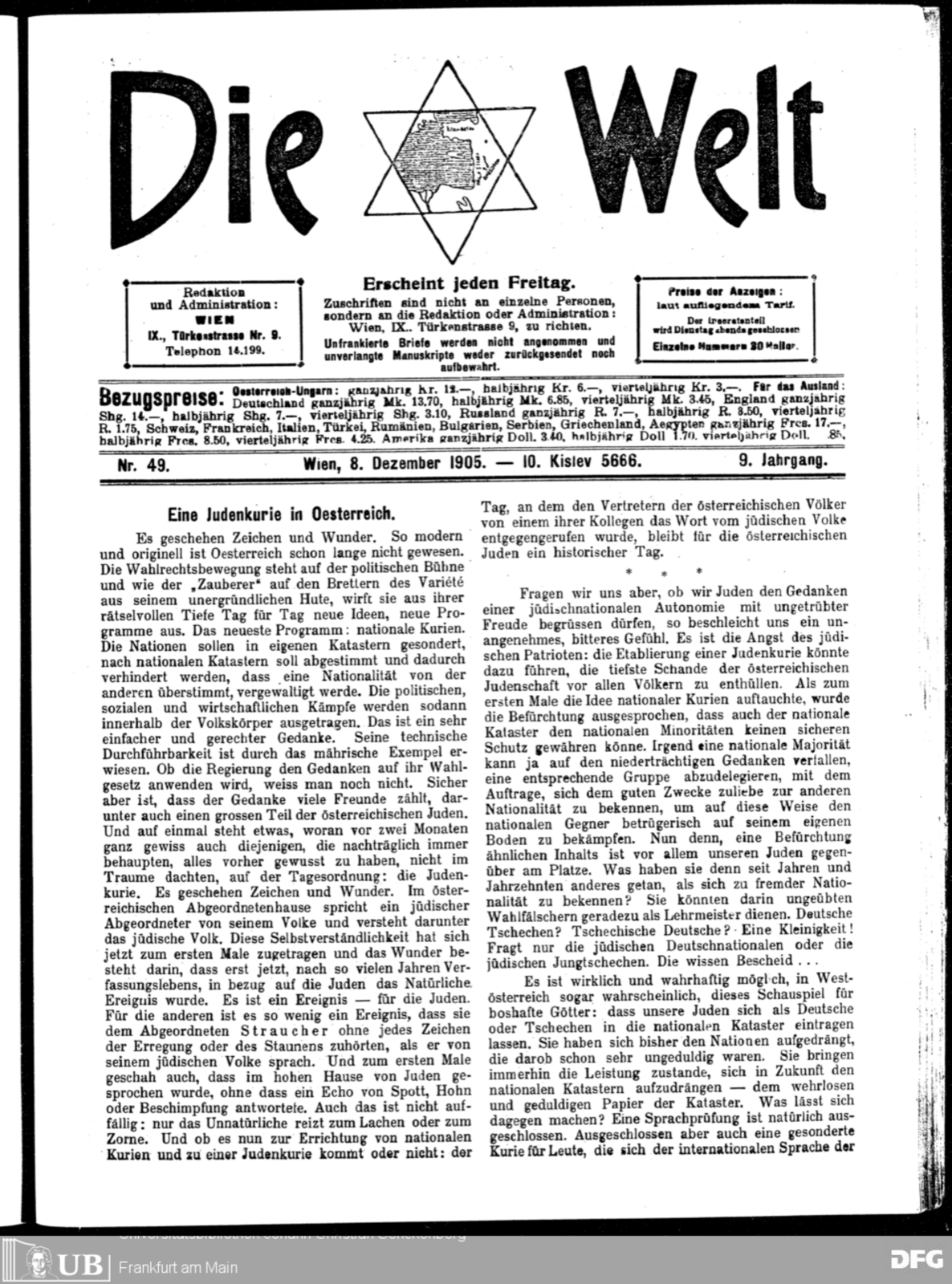
Die Welt
Editorial Office and Administration: Vienna, IX., Türkenstrasse No. 9; Telephone 14.199. Appears every Friday. Correspondence is to be addressed not to individual persons but to the Editorial Office or the Administration: Vienna, IX.. Türkenstrasse 9. Unstamped letters are not accepted, and unsolicited manuscripts are neither returned nor kept. Advertising rates: according to the tariff on display; the advertisement section closes on Tuesday evening. Single numbers 20 Heller.
Subscription prices: Austria-Hungary: yearly Kr. 12.—, half-yearly Kr. 6.—, quarterly Kr. 3.—. Abroad: Germany yearly Mk. 13.70, half-yearly Mk. 6.85, quarterly Mk. 3.45; England yearly Shg. 14.—, half-yearly Shg. 7.—, quarterly Shg. 3.10; Russia yearly R. 7.—, half-yearly R. 3.50, quarterly R. 1.75; Switzerland, France, Italy, Turkey, Roumania, Bulgaria, Servia, Greece, Egypt yearly Frcs. 17.—, half-yearly Frcs. 8.50, quarterly Frcs. 4.25; America yearly Doll. 3.40, half-yearly Doll 1.70, quarterly Doll. —.85.
No. 49. — Vienna, 8 December 1905. — 10 Kislev 5666. — 9th Year.
A Jewish Curia in Austria.
Signs and wonders are come to pass. Austria has not been so modern and so original for a long while. The franchise movement holds the political stage, and like the "conjurer" on the boards of the variety theatre with his unfathomable hat, it casts up from its mysterious depths, day after day, new ideas and new programmes. The newest programme: national curiae. The nations are to be kept apart in registers of their own; voting is to proceed by national registers, and it is thereby to be prevented that one nationality be outvoted and overborne by another. The political, social and economic struggles will then be fought out within the bodies of the several peoples. That is a very simple and a very just idea. Its technical practicability has been proved by the Moravian example. Whether the Government will apply the idea to its franchise bill is not yet known. Certain it is, however, that the idea counts many friends, among them a great part of the Austrian Jews. And all at once something stands upon the order of the day of which, two months ago, even those who always maintain after the event that they knew everything beforehand most certainly never dreamt: the Jewish curia. Signs and wonders are come to pass. In the Austrian House of Deputies a Jewish deputy speaks of his people and means by it the Jewish people. This matter of course has now come about for the first time, and the wonder lies in this, that only now, after so many years of constitutional life, has the natural, where the Jews are concerned, become an event. It is an event — for the Jews. For the others it is so little of an event that they listened to Deputy Straucher without any sign of excitement or astonishment when he spoke of his Jewish people. And for the first time, too, it happened that Jews were spoken of in the High House without an echo of mockery, scorn or abuse in answer. Nor is that remarkable: only the unnatural provokes laughter or wrath. And whether it comes to the establishment of national curiae and of a Jewish curia or not: the day on which the representatives of the Austrian peoples heard the words "the Jewish people" called out to them by one of their colleagues remains for the Austrian Jews a historic day.
* * *
But if we ask ourselves whether we Jews may greet the idea of a Jewish national autonomy with unclouded joy, an unpleasant, bitter feeling steals over us. It is the dread of the Jewish patriot: the establishment of a Jewish curia might lead to laying bare before all the nations the deepest shame of Austrian Jewry. When the idea of national curiae first emerged, the fear was expressed that even the national register could afford the national minorities no sure protection. Some national majority or other might, after all, hit upon the base idea of detaching a suitable group, with the commission to profess, for the sake of the good cause, the other nationality, and in this way to fight the national adversary fraudulently on his own ground. Well then, a fear of a similar kind is in place above all with regard to our Jews. What else have they done for years and decades but profess an alien nationality? In this they could serve unpractised falsifiers of elections as veritable masters. German Czechs? Czech Germans? A trifle! Only ask the Jewish German Nationalists or the Jewish Young Czechs. They know all about it . . .
It is really and truly possible, in Western Austria even probable — this spectacle for malicious gods: that our Jews will have themselves entered in the national registers as Germans or as Czechs. Hitherto they have thrust themselves upon the nations, who were already very impatient on that account. They will at any rate manage the feat of thrusting themselves in future upon the national registers — upon the defenceless and patient paper of the registers. What can be done against it? A language test is of course out of the question. Out of the question too, however, is a separate curia for people who, of the international language of