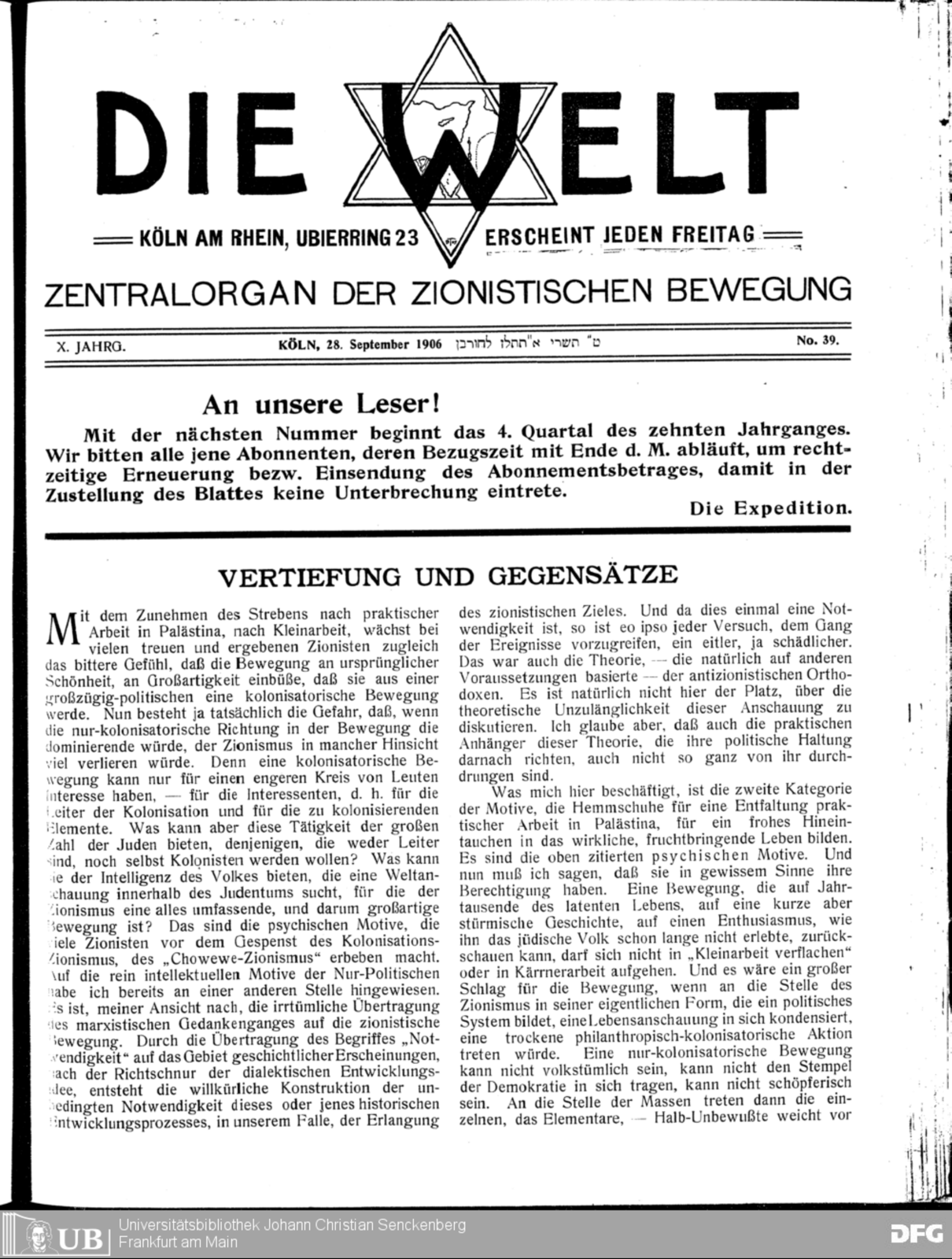
DIE WELT
=== COLOGNE-ON-RHINE, UBIERRING 23 === PUBLISHED EVERY FRIDAY ===
CENTRAL ORGAN OF THE ZIONIST MOVEMENT
Vol. X. COLOGNE, 28 September 1906 ט" תשרי א" התחלו לחורבן No. 39.
To Our Readers!
With the next number the fourth quarter of the tenth volume begins. We ask all those subscribers whose subscription period expires at the end of this month to renew in good time, or to remit the subscription amount, so that there may be no interruption in the delivery of the paper.
The Publishing Office.
DEEPENING AND ANTITHESES
As the striving after practical work in Palestine, after small-scale work, increases, there grows at the same time among many loyal and devoted Zionists the bitter feeling that the movement is losing its original beauty, its grandeur; that from a broad-minded political movement it is becoming a colonising one. Now there is in fact the danger that, were the purely colonising tendency to become the dominant one in the movement, Zionism would in many respects lose a great deal. For a colonising movement can hold interest only for a narrower circle of people, — for the parties concerned, that is, for the directors of the colonisation and for the elements to be colonised. But what can this activity offer the great number of Jews, those who are neither directors nor wish to become colonists themselves? What can it offer the educated class of the people, which seeks a view of the world within Judaism, and for which Zionism is an all-embracing, and therefore a grand, movement? These are the psychological motives which make many Zionists tremble before the spectre of colonisation-Zionism, of "Chowewe-Zionism." To the purely intellectual motives of the political-only men I have already pointed elsewhere. It is, in my opinion, the mistaken transfer of the Marxist train of thought to the Zionist movement. Through the transfer of the concept of "necessity" to the domain of historical phenomena, after the guiding line of the dialectical idea of development, there arises the arbitrary construction of the unconditional necessity of this or that process of historical development, in our case, of the attainment of the Zionist goal. And since this is once and for all a necessity, every attempt to anticipate the course of events is eo ipso a vain, nay, a harmful one. That was also the theory, — based, of course, upon other premises — of the anti-Zionist Orthodox. This is naturally not the place to discuss the theoretical inadequacy of this view. I believe, however, that even the practical adherents of this theory, who order their political conduct according to it, are not altogether thoroughly imbued with it either.
What concerns me here is the second category of motives, which form drags upon the unfolding of practical work in Palestine, upon a glad plunge into real and fruitful life. They are the psychological motives cited above. And now I must say that in a certain sense they have their justification. A movement which can look back upon thousands of years of latent life, upon a short but stormy history, upon an enthusiasm such as the Jewish people has not known for a long time, must not "grow shallow in small work" nor lose itself in carter's drudgery. And it would be a heavy blow to the movement if, in place of Zionism in its proper form, which constitutes a political system and condenses within itself a view of life, there were to step a dry philanthropic-colonising action. A purely colonising movement cannot be popular, cannot bear within itself the stamp of democracy, cannot be creative. In place of the masses there then step the individuals; the elemental, — the half-unconscious gives way before