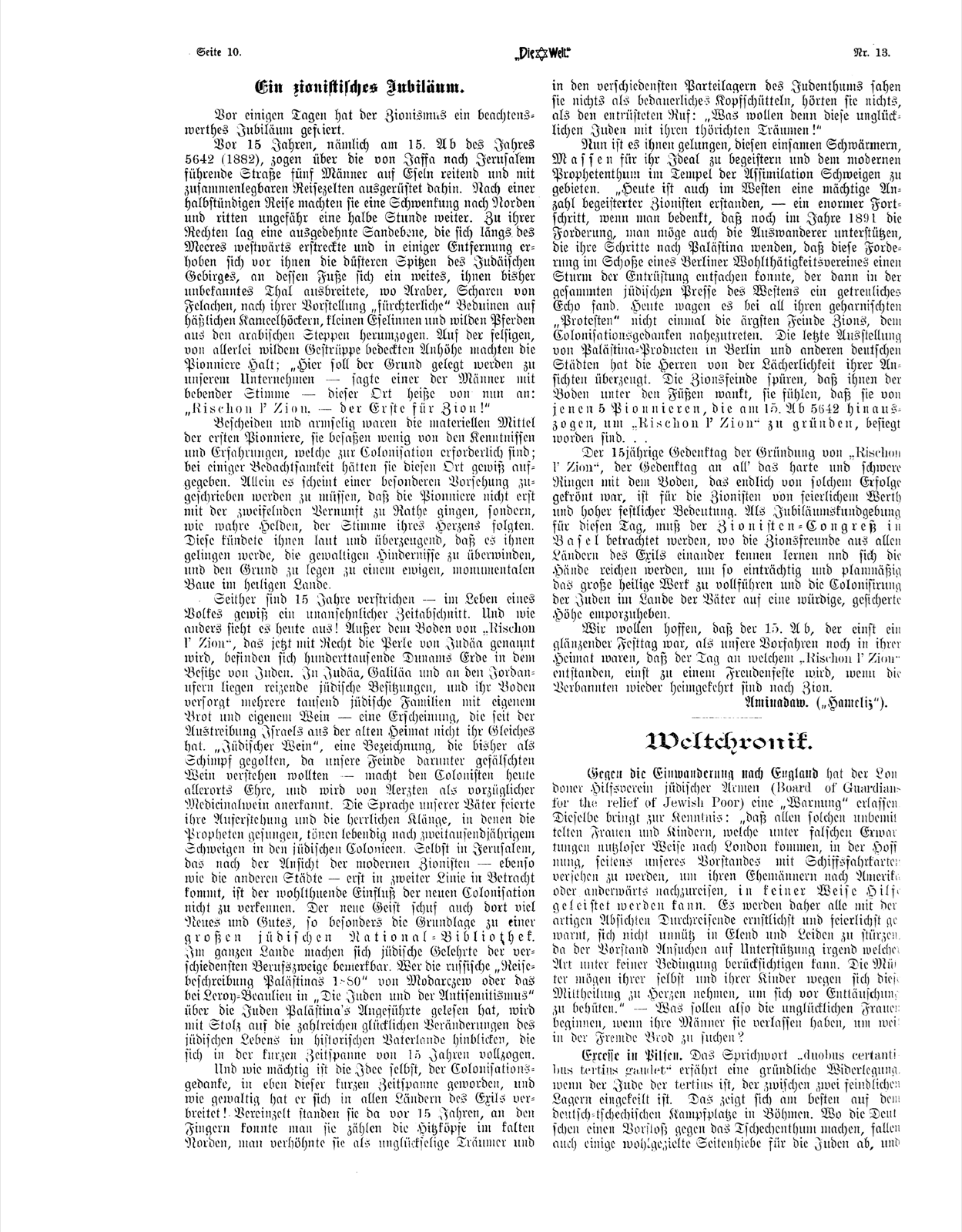
Page 10. — "Die Welt." — No. 13.
A Zionist Jubilee.
A few days ago Zionism celebrated a noteworthy jubilee.
Fifteen years ago, namely on the 15th of Ab of the year 5642 (1882), five men made their way along the road leading from Jaffa to Jerusalem, mounted upon asses and equipped with folding travelling tents. After half an hour's journey they turned northward and rode on for about another half hour. To their right lay a wide plain of sand, stretching westward along the sea, and at some distance before them rose the sombre peaks of the Judean range, at whose foot there spread a broad valley, until then unknown to them, where Arabs, throngs of fellahin, and — to their imagination — "fearsome" Bedouins roved about upon ugly camel-humps, little she-asses, and wild horses out of the Arabian steppes. Upon the rocky rise, covered with all manner of wild scrub, the pioneers halted; "Here shall the foundation be laid for our undertaking" — said one of the men with trembling voice — "let this place be called from now on: 'Rischon l'Zion — the First for Zion!'"
Modest and meagre were the material means of the first pioneers; they possessed little of the knowledge and experience which colonisation requires; had they used any measure of prudence they would assuredly have given up this place. Yet it seems that it must be ascribed to a special Providence that the pioneers did not first take counsel of doubting reason, but, like true heroes, followed the voice of their heart. That voice proclaimed to them loudly and convincingly that they would succeed in overcoming the tremendous obstacles, and in laying the foundation for an eternal, monumental edifice in the Holy Land.
Fifteen years have since gone by — in the life of a people assuredly an inconsiderable span. And how different is the aspect of things to-day! Besides the soil of "Rischon l'Zion," which is now with justice called the pearl of Judea, hundreds of thousands of dunams of earth are in the possession of Jews. In Judea, in Galilee, and along the banks of the Jordan lie charming Jewish holdings, and their soil supplies several thousand Jewish families with their own bread and their own wine — a phenomenon that has had no like since the expulsion of Israel from the ancient homeland. "Jewish wine," a designation which hitherto passed for a reproach, since our enemies chose to understand by it adulterated wine, to-day does the colonists honour everywhere, and is acknowledged by physicians as an excellent medicinal wine. The language of our fathers has celebrated its resurrection, and the glorious tones in which the prophets sang resound alive, after two thousand years of silence, in the Jewish colonies. Even in Jerusalem, which in the view of the modern Zionists — just as the other towns — comes only in the second line of consideration, the beneficent influence of the new colonisation is not to be mistaken. The new spirit created much there too that is new and good, and above all the foundation of a great Jewish National Library. Throughout the whole land Jewish scholars of the most various callings make themselves felt. Whoever has read the Russian "Description of a Journey through Palestine, 1880" by Modarczew, or what is set forth concerning the Jews of Palestine in Leroy-Beaulieu's "The Jews and Antisemitism," will look with pride upon the numerous happy changes in Jewish life in the historic fatherland which have been accomplished in the short span of fifteen years.
And how mighty has the idea itself become, the thought of colonisation, in this same short span, and how powerfully has it spread through all the lands of the exile! Isolated they stood there fifteen years ago; on the fingers one could count them, the hotheads in the cold North; they were derided as hapless dreamers, and
in the most various party camps of Jewry they saw nothing but a regrettable shaking of heads, they heard nothing but the indignant cry: "What do these unfortunate Jews want with their foolish dreams!"
Now they have succeeded, these lonely enthusiasts, in kindling the masses for their ideal and in bidding the modern prophethood in the temple of Assimilation be silent. "To-day there has arisen in the West also a mighty number of enthusiastic Zionists — an enormous advance, when one considers that so late as the year 1891 the demand that support should be extended also to those emigrants who turn their steps towards Palestine — that this demand could kindle a storm of indignation in the bosom of a Berlin charitable society, which then found a faithful echo in the entire Jewish press of the West. To-day, for all their mailed "protests," not even the bitterest enemies of Zion venture to assail the thought of colonisation. The recent exhibition of Palestine products in Berlin and other German towns has convinced these gentlemen of the absurdity of their views. The foes of Zion perceive that the ground is giving way beneath their feet; they feel that they have been vanquished by those five pioneers who went forth on the 15th of Ab 5642 to found "Rischon l'Zion". . .
The fifteenth anniversary of the founding of "Rischon l'Zion," the memorial day of all that hard and heavy wrestling with the soil, which at last was crowned with such success, is for the Zionists of solemn worth and of high festal significance. As the jubilee manifestation for this day must be regarded the Zionist Congress at Basle, where the friends of Zion out of all the lands of the exile will come to know one another and will join hands, so as in concord and by settled plan to carry through the great and holy work, and to raise the colonisation of the Jews in the land of the fathers to a worthy and assured height.
We will hope that the 15th of Ab, which once was a brilliant day of festival, when our forefathers were still in their homeland — that the day on which "Rischon l'Zion" came into being will one day become a feast of joy, when the banished have returned home again to Zion.
Aminadaw. ("Hameliz").
World Chronicle.
Against immigration into England the London relief society for the Jewish poor (Board of Guardians for the relief of Jewish Poor) has issued a "warning." It brings to public knowledge "that to all such unprovided women and children as come to London to no purpose under false expectations, in the hope of being furnished by our Board with steamship tickets in order to follow their husbands to America or elsewhere, no assistance whatever can be rendered. All travellers passing through with intentions of this kind are therefore most earnestly and most solemnly warned not to plunge themselves needlessly into misery and suffering, since the Board can under no condition entertain applications for support of any kind. Let the mothers, for their own sake and for their children's, take this communication to heart, that they may guard themselves against disappointment." — What, then, are the unhappy women to do, when their husbands have left them to seek bread far away in foreign parts?
Excesses in Pilsen. The proverb "duobus certantibus tertius gaudet" meets with a thorough refutation when the Jew is the tertius who is wedged in between two hostile camps. This is shown best of all upon the German-Czech field of battle in Bohemia. Wherever the Germans make a thrust against Czechdom, a few well-aimed side-blows fall to the Jews as well, and