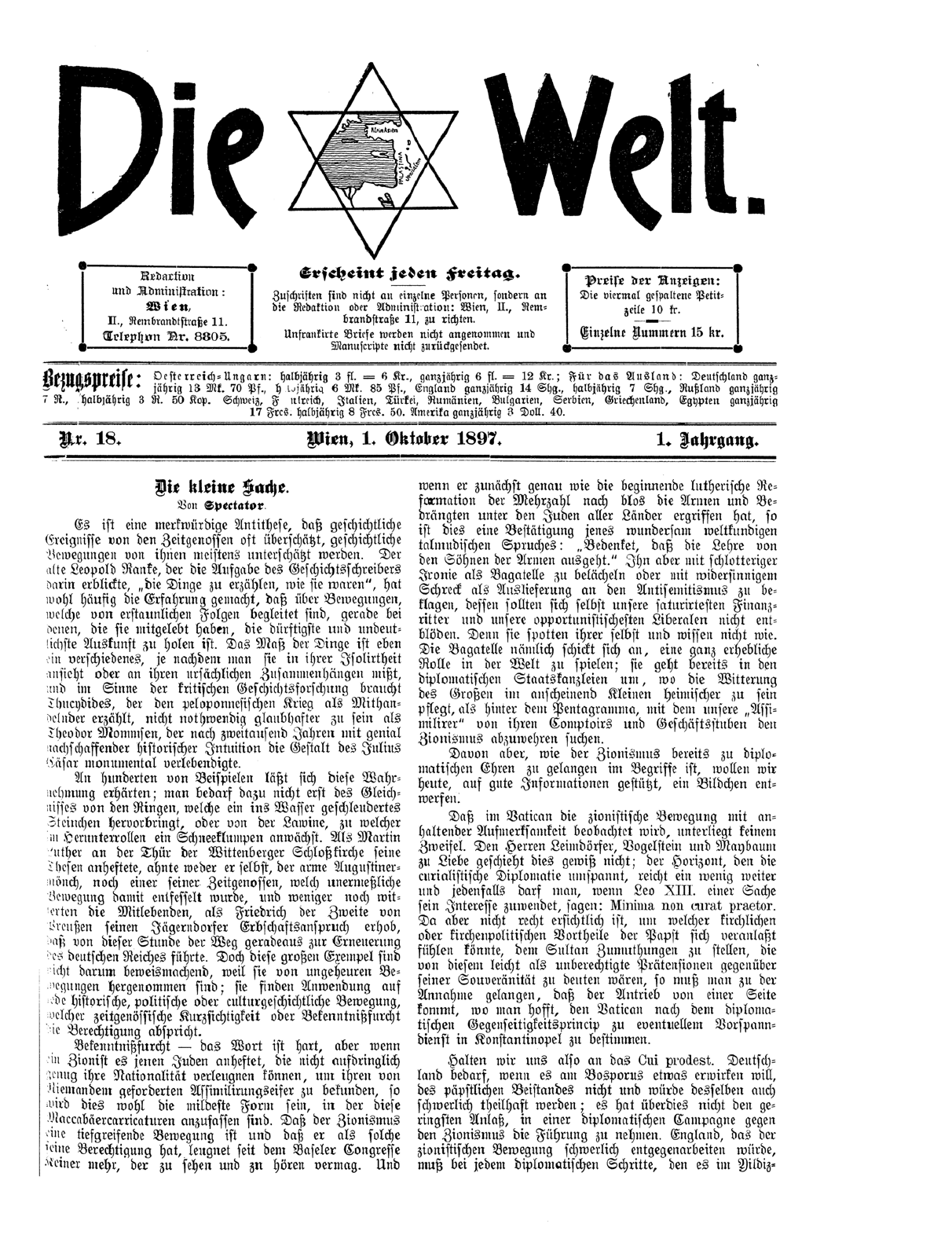
Die Welt.
Editorial Office and Administration: VIENNA, II., Rembrandtstrasse 11. Telephone No. 8805.
Appears every Friday. Communications are to be addressed not to individual persons, but to the Editorial Office or the Administration: Vienna, II., Rembrandtstrasse 11. Unstamped letters will not be accepted, and manuscripts will not be returned.
Advertising rates: The quadruple-column petit line, 10 kr. Single numbers 15 kr.
Subscription rates: Austria-Hungary: half-yearly 3 fl. = 6 Kr., yearly 6 fl. = 12 Kr.; For abroad: Germany yearly 13 Mk. 70 Pf., half-yearly 6 Mk. 85 Pf.; England yearly 14 Shg., half-yearly 7 Shg.; Russia yearly 7 R., half-yearly 3 R. 50 Kop. Switzerland, France, Italy, Turkey, Roumania, Bulgaria, Servia, Greece, Egypt yearly 17 Frcs., half-yearly 8 Frcs. 50. America yearly 3 Doll. 40.
No. 18. Vienna, 1 October 1897. Year I.
The Little Matter.
By Spectator.
It is a curious antithesis that historical events are often overrated by contemporaries, while historical movements are for the most part underrated by them. Old Leopold Ranke, who saw the historian's task as being "to tell things as they were," must often have found that concerning movements attended by astonishing consequences the scantiest and most indistinct information is to be had precisely from those who lived through them. The measure of things is simply a different one according as one regards them in their isolation or gauges them by their causal connections; and in the sense of critical historical research, Thucydides, who relates the Peloponnesian War as one who took part in the action, need not necessarily be more credible than Theodor Mommsen, who after two thousand years, with an inspired and re-creative historical intuition, brought the figure of Julius Caesar monumentally to life again.
This observation may be corroborated by hundreds of examples; one has no need for that of the parable of the rings which a pebble flung into the water calls forth, or of the avalanche into which a lump of snow grows as it rolls downward. When Martin Luther nailed his theses to the door of the Castle Church at Wittenberg, neither he himself, the poor Augustinian monk, nor any one of his contemporaries divined what immeasurable movement was thereby unloosed; and still less did those then living scent, when Frederick the Second of Prussia advanced his claim to the Jägerndorf inheritance, that from that hour the road ran straight to the renewal of the German Empire. Yet these great examples are not conclusive because they are drawn from prodigious movements; they find application to every historical, political, or cultural movement whose justification is denied by contemporary short-sightedness or by fear of avowal.
Fear of avowal — the word is a hard one; but when a Zionist fastens it upon those Jews who cannot disavow their nationality obtrusively enough to give proof of an assimilating zeal that nobody has demanded of them, it will surely be the mildest form in which these caricatures of Maccabees are to be handled. That Zionism is a far-reaching movement, and that as such it has its justification, no one who is able to see and to hear has denied since the Basle Congress. And if at the outset, exactly like the incipient Lutheran Reformation, it has laid hold for the most part merely upon the poor and the hard-pressed among the Jews of all lands, this is a confirmation of that wondrously worldly-wise Talmudic saying: "Take heed that the teaching goeth forth from the sons of the poor." But to smile at it with slack irony as a bagatelle, or to bewail it with preposterous alarm as a surrender to anti-Semitism — of that even our most sated knights of finance and our most opportunist Liberals ought not to be so shameless. For they mock themselves and know not how. The bagatelle, forsooth, is preparing to play a quite considerable part in the world; it already walks abroad in the diplomatic chancelleries, where the scent for the great in the seemingly small is wont to be more at home than behind the pentagram with which our "assimilators" seek to ward off Zionism from their counting-houses and offices.
Of the manner, however, in which Zionism is already on the point of attaining to diplomatic honours, we mean to sketch a little picture to-day, resting upon good information.
That the Zionist movement is observed in the Vatican with sustained attention admits of no doubt. It is assuredly not for love of Messrs. Leimdörfer, Vogelstein, and Maybaum that this happens; the horizon which curial diplomacy embraces reaches a little further, and in any case, when Leo XIII. turns his interest to a matter, one may say: Minima non curat praetor. But since it is not readily apparent for the sake of what ecclesiastical or church-political advantages the Pope could feel himself moved to lay before the Sultan demands which the latter might easily construe as unwarranted pretensions against his sovereignty, one must arrive at the assumption that the impulse comes from a quarter where it is hoped, on the diplomatic principle of reciprocity, to determine the Vatican to eventual auxiliary service at Constantinople.
Let us hold, then, to the Cui prodest. Germany, if it would obtain anything on the Bosphorus, has no need of papal assistance and would hardly be vouchsafed it; it has moreover not the slightest occasion to take the lead in a diplomatic campaign against Zionism. England, which would hardly work counter to the Zionist movement, must, with every diplomatic step it takes in the Yildiz-