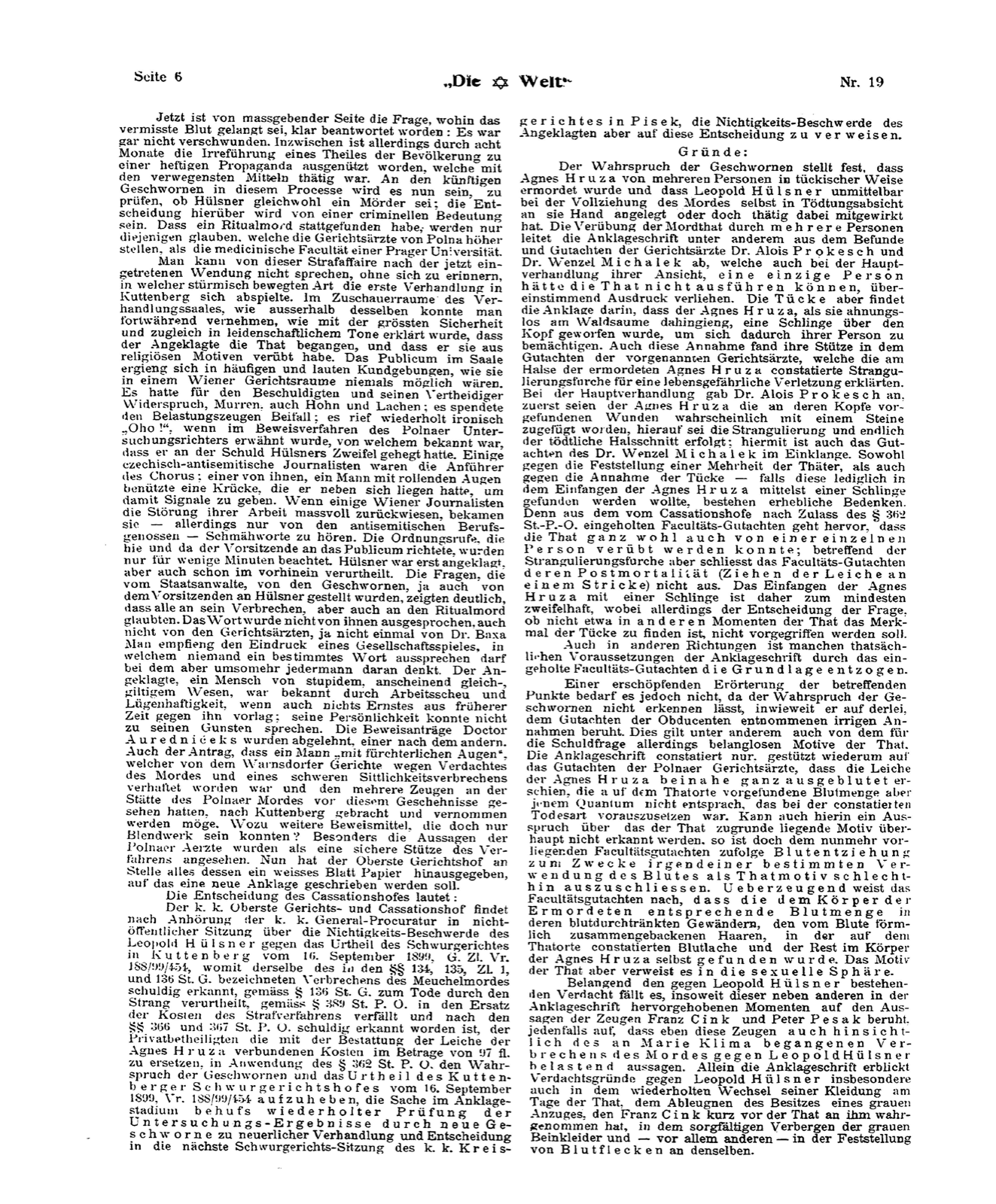
Page 6 — "Die Welt" — No. 19
Now the question whither the missing blood had gone has been clearly answered from an authoritative quarter: it had not vanished at all. In the meantime, indeed, the misleading of a part of the population has for eight months been exploited for a vehement propaganda which was active with the most audacious means. It will now be for the future jurors in this trial to examine whether Hülsner is nevertheless a murderer; the decision upon this will be of a criminal significance. That a ritual murder has taken place will be believed only by those who place the court physicians of Polna higher than the medical Faculty of a Prague University.
One cannot speak of this criminal affair, after the turn which has now come about, without recalling in what a stormily agitated fashion the first hearing at Kuttenberg ran its course. In the spectators' space of the court-room, as well as outside it, one could continually hear how, with the greatest assurance and at the same time in a passionate tone, it was declared that the accused had committed the deed, and that he had perpetrated it from religious motives. The public in the hall indulged in frequent and loud demonstrations such as would never be possible in a Vienna court-room. It had for the accused and his counsel contradiction, murmuring, scorn and laughter as well; it bestowed applause upon the witnesses for the prosecution; it repeatedly cried ironically "Oho!" when in the taking of evidence mention was made of the Polna examining magistrate, of whom it was known that he had entertained doubts of Hülsner's guilt. Some Czech-antisemitic journalists were the leaders of the chorus; one of them, a man with rolling eyes, made use of a crutch which he had lying beside him in order to give signals therewith. When some Vienna journalists moderately repelled the disturbance of their work, they got to hear abusive words — only from their antisemitic fellows of the profession, it is true. The calls to order which the presiding judge now and then addressed to the public were heeded only for a few minutes. Hülsner was as yet but accused, yet already condemned beforehand. The questions which were put to Hülsner by the public prosecutor, by the jurors, nay, by the presiding judge as well, showed plainly that all believed in his crime, but in the ritual murder also. The word was not uttered by them, nor by the court physicians, nay, not even by Dr. Baxa. One received the impression of a parlour game in which no one may pronounce a particular word, but in which every one thinks of it all the more. The accused, a man of stupid, seemingly indifferent nature, was known for shyness of work and for mendacity, even though nothing serious from an earlier time lay against him; his personality could not speak in his favour. Doctor Auredniček's motions for evidence were rejected, one after another. The motion also that a man "with terrible eyes," who had been arrested by the Warnsdorf court on suspicion of murder and of a grave offence against morality, and whom several witnesses had seen at the place of the Polna murder before this occurrence, should be brought to Kuttenberg and examined, to what end further means of proof, which after all could be nothing but delusion? The depositions of the Polna physicians in particular were regarded as a sure support of the proceedings. Now the Supreme Court has, in place of all this, given out a white sheet of paper, upon which a new indictment is to be written.
The decision of the Court of Cassation runs:
The Imperial-Royal Supreme Court of Justice and of Cassation finds, after hearing the Imperial-Royal Attorney-General's department in non-public sitting upon the plea of nullity of Leopold Hülsner against the judgment of the jury court at Kuttenberg of the 16th September 1899, G. No. Vr. 188/99/454, whereby the same was found guilty of the crime of assassination designated in §§ 134, 135, No. 1, and 136 of the Penal Code, was sentenced pursuant to § 136 of the Penal Code to death by the rope, was condemned pursuant to § 389 of the Code of Criminal Procedure to the payment of the costs of the criminal proceedings, and was, under §§ 366 and 367 of the Code of Criminal Procedure, held bound to make good to the private parties the costs connected with the interment of the body of Agnes Hruza in the amount of 97 fl., that, in application of § 362 of the Code of Criminal Procedure, the verdict of the jurors and the judgment of the Kuttenberg jury court of the 16th September 1899, Vr. 188/99/454, be annulled, that the case, in the stage of indictment, be for the purpose of a repeated examination of the results of the investigation by new jurors referred for fresh hearing and decision to the next jury sitting of the Imperial-Royal District Court at Pisek, but that the accused's plea of nullity be referred to this decision.
Grounds:
The verdict of the jurors establishes that Agnes Hruza was murdered by several persons in an insidious manner, and that Leopold Hülsner, immediately upon the execution of the murder itself, laid hands upon her with intent to kill, or at any rate actively co-operated therein. The perpetration of the murderous deed by several persons the indictment deduces, among other things, from the finding and opinion of the court physicians Dr. Alois Prokesch and Dr. Wenzel Michalek, who at the principal hearing also gave concordant expression to their view that a single person could not have carried out the deed. The insidiousness, however, the prosecution finds in this, that a noose was thrown over the head of Agnes Hruza as she was going unsuspectingly along the edge of the wood, in order thereby to get her person into their power. This assumption too found its support in the opinion of the aforesaid court physicians, who declared the furrow of strangulation ascertained upon the neck of the murdered Agnes Hruza to be an injury dangerous to life. At the principal hearing Dr. Alois Prokesch stated that first the wounds found upon her head had probably been inflicted upon Agnes Hruza with a stone, that thereupon the strangulation and finally the fatal cut in the throat had followed; with this the opinion of Dr. Wenzel Michalek is likewise in accord. Both against the finding of a plurality of perpetrators and against the assumption of insidiousness — if this were to be found merely in the catching of Agnes Hruza by means of a noose — there exist considerable doubts. For from the Faculty's opinion, obtained by the Court of Cassation under the permission of § 362 of the Code of Criminal Procedure, it appears that the deed might quite well have been perpetrated by a single person also; as regards the furrow of strangulation, however, the Faculty's opinion does not exclude its post-mortal origin (the dragging of the corpse by a rope). The catching of Agnes Hruza with a noose is therefore at the least doubtful, whereby, however, the decision of the question whether the mark of insidiousness is not perhaps to be found in other features of the deed is not to be anticipated.
In other directions also the foundation has been withdrawn from many factual presuppositions of the indictment by the Faculty's opinion obtained.
An exhaustive discussion of the points in question is, however, not needed, since the verdict of the jurors does not allow it to be discerned how far it rests upon such erroneous assumptions taken from the opinion of the physicians who performed the autopsy. This holds good, among other things, of the motive of the deed also, which is, indeed, of no import for the question of guilt. The indictment merely establishes, supported again upon the opinion of the Polna court physicians, that the body of Agnes Hruza appeared almost entirely drained of blood, but that the quantity of blood found at the place of the deed did not correspond to that quantity which was to be presupposed in the case of the ascertained manner of death. Even though no pronouncement whatever upon the motive underlying the deed can be discerned in this, yet according to the Faculty's opinion now before us the withdrawal of blood for the purpose of any particular employment of the blood is absolutely to be excluded as the motive of the deed. Convincingly does the Faculty's opinion prove that the quantity of blood corresponding to the body of the murdered girl was found in her blood-soaked garments, in the hair fairly baked together by the blood, in the pool of blood ascertained at the place of the deed, and the remainder in the body of Agnes Hruza herself. The motive of the deed, however, it refers to the sexual sphere.
As concerns the suspicion existing against Leopold Hülsner, in so far as this rests, beside other features brought forward in the indictment, upon the depositions of the witnesses Franz Cink and Peter Pesak, it is at all events striking that these very witnesses also give evidence incriminating Leopold Hülsner in respect of the crime of murder committed upon Marie Klima. Yet the indictment perceives grounds of suspicion against Leopold Hülsner in particular also in the repeated change of his clothing on the day of the deed, in the denial of the possession of a grey suit which Franz Cink had observed upon him shortly before the deed, in the careful concealment of the grey trousers, and — before all else — in the ascertaining of spots of blood upon the same.