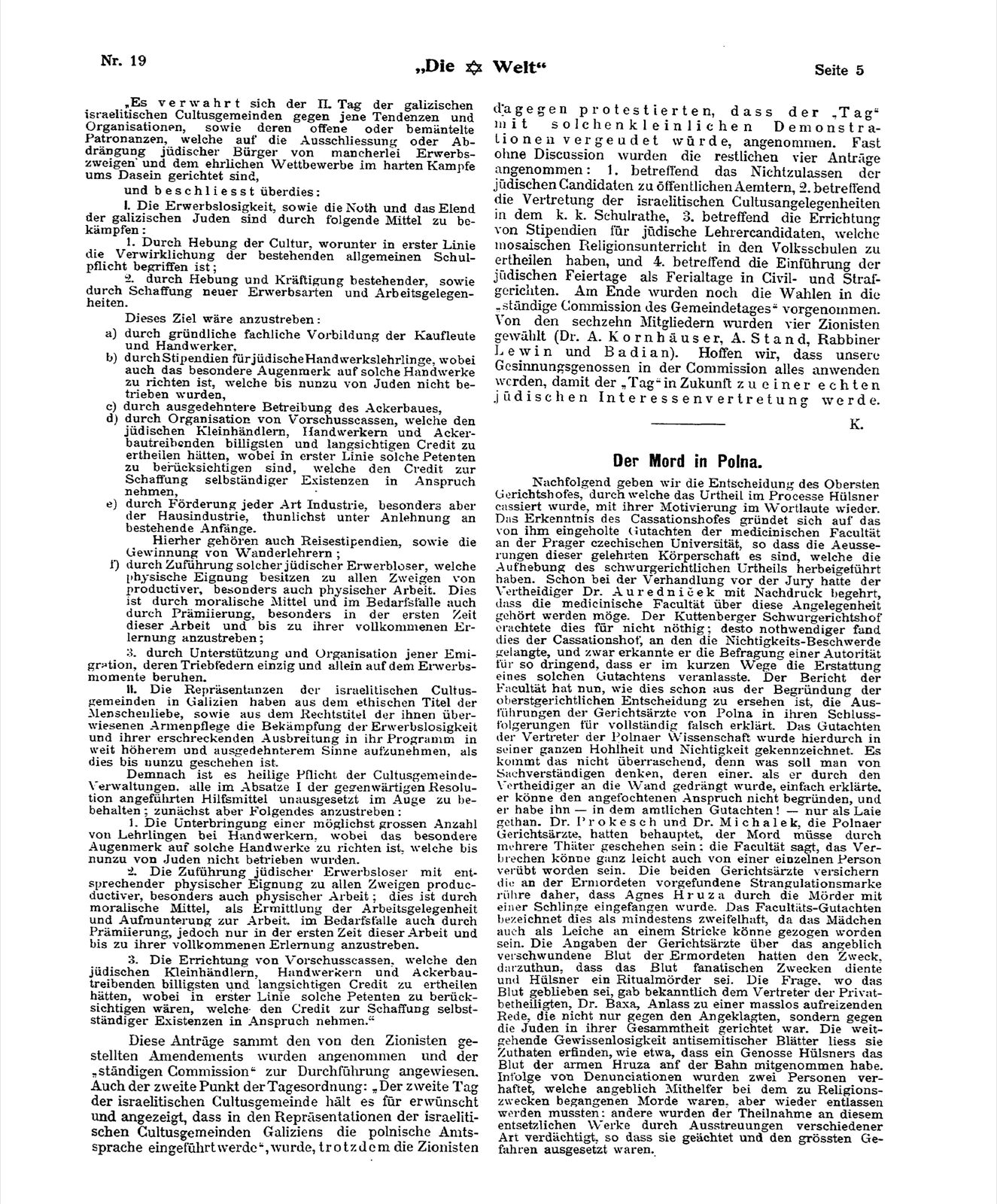
No. 19 — "Die Welt" — Page 5
"The Second Day of the Galician Israelitish Congregations enters its protest against those tendencies and organisations, as well as against their open or cloaked patronages, which are directed to the exclusion or the crowding out of Jewish citizens from divers branches of livelihood and from honest competition in the hard struggle for existence,
and resolves furthermore:
I. Lack of employment, as well as the want and the misery of the Galician Jews, are to be combated by the following means:
-
By the raising of culture, under which is comprised in the first place the realisation of the existing universal obligation of school attendance;
-
by the raising and strengthening of existing, as well as by the creation of new, modes of gaining a livelihood and opportunities of work.
This aim would be striven for:
a) by a thorough technical training of merchants and artisans, b) by stipends for Jewish apprentices to handicrafts, whereby particular attention is also to be directed to such handicrafts as have hitherto not been carried on by Jews, c) by a more extended pursuit of agriculture, d) by the organisation of loan banks, which should grant to the Jewish small traders, artisans and tillers of the soil the cheapest and longest-dated credit, whereby in the first place those petitioners are to be considered who claim the credit for the creation of independent existences, e) by the furtherance of every kind of industry, but especially of the domestic industry, so far as practicable in attachment to existing beginnings. Hither belong also travelling stipends, as well as the securing of itinerant teachers; f) by the conducting of such unemployed Jews as possess physical fitness to all branches of productive, and especially also of physical, labour. This is to be striven for by moral means and, in case of need, also by the granting of premiums, especially in the first period of this labour and until it has been completely learnt;
- by the support and organisation of that emigration whose mainsprings rest solely and alone upon the motive of gaining a livelihood.
II. The representative bodies of the Israelitish congregations in Galicia have, upon the ethical title of the love of mankind, as well as upon the legal title of the care of the poor committed to them, to take up into their programme the combating of unemployment and of its appalling spread in a far higher and more extended sense than has hitherto been done.
Accordingly it is the sacred duty of the congregational administrations to keep unremittingly in view all the means of assistance adduced in section I of the present resolution; but in the first instance to strive after the following:
-
The placing of the greatest possible number of apprentices with artisans, whereby particular attention is to be directed to such handicrafts as have hitherto not been carried on by Jews.
-
The conducting of unemployed Jews possessed of the requisite physical fitness to all branches of productive, and especially also of physical, labour; this is to be striven for by moral means, such as the ascertaining of opportunities of work and encouragement to labour, in case of need also by the granting of premiums, yet only in the first period of this labour and until it has been completely learnt.
-
The establishment of loan banks, which should grant to the Jewish small traders, artisans and tillers of the soil the cheapest and longest-dated credit, whereby in the first place those petitioners would be considered who claim the credit for the creation of independent existences."
These motions, together with the amendments moved by the Zionists, were adopted and referred to the "standing Commission" for execution. The second point of the order of the day also: "The Second Day of the Israelitish Congregation holds it to be desirable and expedient that in the representative bodies of the Israelitish congregations of Galicia the Polish official language be introduced," was adopted, notwithstanding that the Zionists protested against the "Day" being squandered upon such petty demonstrations. Almost without discussion the remaining four motions were adopted: 1, concerning the non-admission of Jewish candidates to public offices; 2, concerning the representation of Israelitish congregational affairs in the Imperial-Royal School Council; 3, concerning the establishment of stipends for Jewish candidates for the teaching office who have to impart Mosaic religious instruction in the elementary schools; and 4, concerning the introduction of the Jewish festivals as days of vacation in the civil and criminal courts. At the close the elections to the "standing Commission of the Congregational Day" were further proceeded with. Of the sixteen members four Zionists were elected (Dr. A. Kornhäuser, A. Stand, Rabbi Lewin and Badian). Let us hope that our fellow-partisans in the Commission will apply every means, so that the "Day" may in future become a genuine representation of Jewish interests.
K.
The Murder at Polna.
We reproduce below, in its literal wording, the decision of the Supreme Court by which the judgment in the Hilsner trial was quashed, together with its grounds. The finding of the Court of Cassation rests upon the opinion, obtained by it, of the medical Faculty of the Czech University at Prague, so that it is the utterances of this learned body which have brought about the annulment of the verdict of the jury court. Already at the hearing before the jury the counsel for the defence, Dr. Auredniček, had emphatically demanded that the medical Faculty should be heard upon this matter. The Kuttenberg jury court held this to be unnecessary; the more necessary did the Court of Cassation, to which the plea of nullity came, find it, and indeed it recognised the questioning of an authority to be so urgent that it caused such an opinion to be rendered by the shortest way. The report of the Faculty has now, as is already to be seen from the grounds of the decision of the Supreme Court, declared the expositions of the court physicians of Polna to be, in their conclusions, completely false. The opinion of the representatives of Polna science was hereby marked in all its hollowness and nullity. This does not come as a surprise, for what is one to think of experts, one of whom, when he was pressed to the wall by the counsel for the defence, simply declared that he could not substantiate the impugned assertion, and that he had made it — in the official opinion! — only as a layman. Dr. Prokesch and Dr. Michalek, the Polna court physicians, had maintained that the murder must have been done by several perpetrators; the Faculty says that the crime might quite easily have been committed by a single person as well. The two court physicians assert that the mark of strangulation found upon the murdered girl arises from the fact that Agnes Hruza was caught by the murderers with a noose. The Faculty's opinion designates this as at least doubtful, since the girl may also have been dragged by a rope as a corpse. The statements of the court physicians concerning the allegedly vanished blood of the murdered girl had the purpose of showing that the blood served fanatical ends and that Hülsner was a ritual murderer. The question what had become of the blood gave, as is known, the representative of the private parties, Dr. Baxa, occasion for a boundlessly inflammatory speech which was directed not only against the accused, but against the Jews in their totality. The far-reaching unscrupulousness of antisemitic papers led them to invent additions, as for instance that a comrade of Hülsner's had carried away the blood of the poor Hruza girl by rail. In consequence of denunciations two persons were arrested who were alleged to have been accomplices in the murder committed for religious ends, but who had to be released again; others were suspected, through rumours of various kinds, of participation in this frightful work, so that they were outlawed and exposed to the greatest dangers.