No. 41. — "Die Welt" — Page 9.
(continued from page 8)
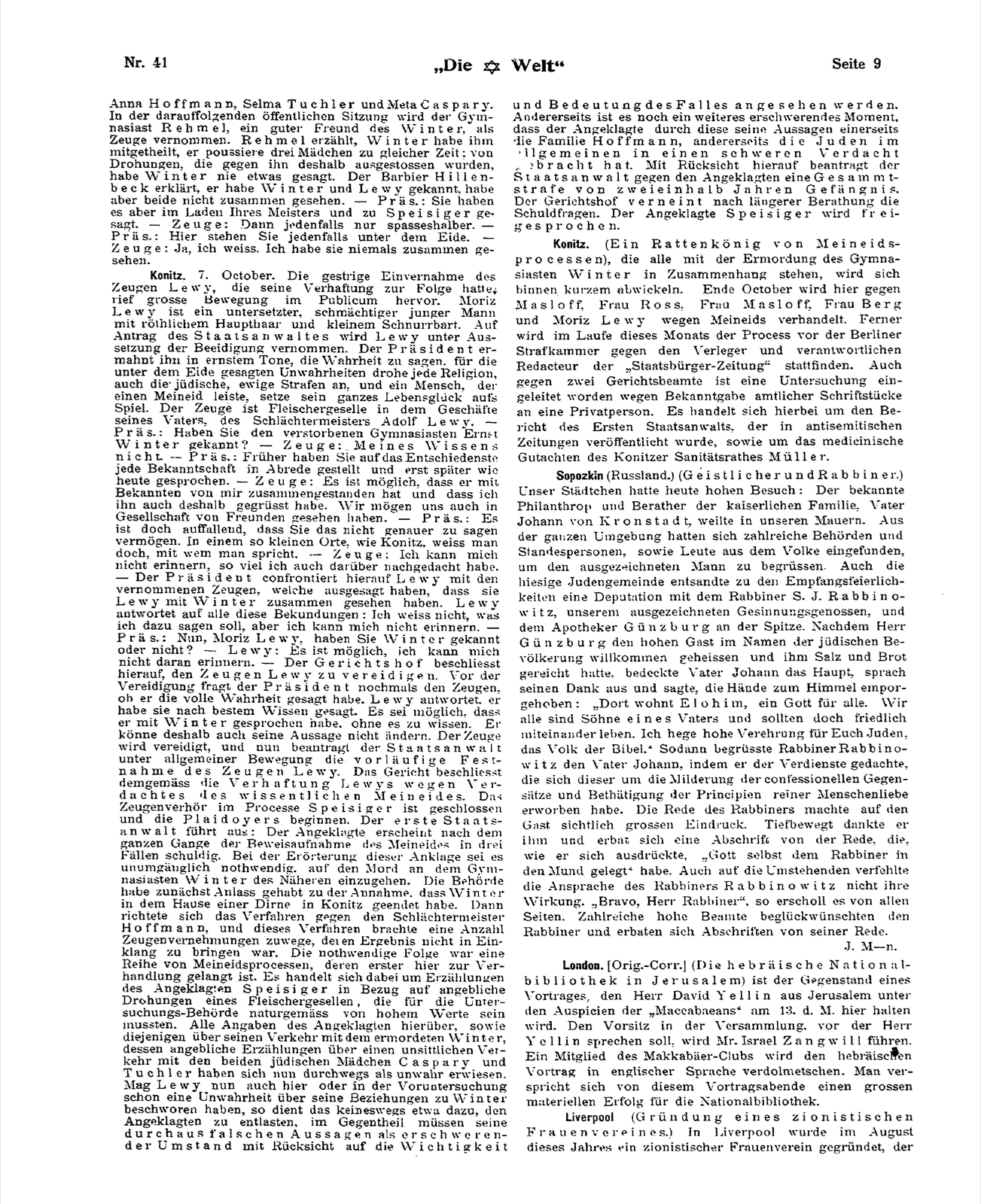
…Anna Hoffmann, Selma Tuchler and Meta Caspary. At the public sitting which followed, the Gymnasium pupil Rehmel, a good friend of Winter's, was examined as a witness. Rehmel relates that Winter had told him he was courting three girls at one and the same time; of threats uttered against him on that account Winter had never said anything. The barber Hillenbeck declares that he had known Winter and Lewy, but had not seen the two together. — Pres.: But you said so in your master's shop and to Speisiger. — Witness: Then in any case only in jest. — Pres.: Here, at all events, you stand under oath. — Witness: Yes, I know. I never saw them together.
Konitz, October 7. Yesterday's examination of the witness Lewy, which had his arrest for its consequence, called forth great excitement among the public. Moriz Lewy is a thick-set, slender young man with reddish hair and a small moustache. Upon the motion of the public prosecutor, Lewy is examined with the administration of the oath deferred. The president admonishes him in a grave tone to speak the truth; for untruths spoken under oath every religion, the Jewish also, threatens eternal punishment, and a man who commits perjury stakes upon it the whole happiness of his life. The witness is a butcher's journeyman in the business of his father, the master butcher Adolf Lewy. — Pres.: Did you know the deceased Gymnasium pupil Ernst Winter? — Witness: Not to my knowledge. — Pres.: Formerly you denied any acquaintance in the most decided manner, and only later spoke as you do to-day. — Witness: It is possible that he stood together with acquaintances of mine and that I greeted him on that account. We may also have seen one another in the company of friends. — Pres.: It is nevertheless striking that you are not able to say this more precisely. In so small a place as Konitz one surely knows with whom one is speaking. — Witness: I cannot remember, however much I have thought about it. — The president thereupon confronts Lewy with the witnesses examined, who have deposed that they saw Lewy together with Winter. To all these depositions Lewy answers: I do not know what I am to say to it, but I cannot remember. — Pres.: Now, Moriz Lewy, did you know Winter or not? — Lewy: It is possible; I cannot remember it. — The court thereupon resolves to put the witness Lewy upon his oath. Before the swearing the president asks the witness once more whether he has spoken the full truth. Lewy answers that he has spoken it to the best of his knowledge. It is possible that he spoke with Winter without knowing it. He cannot therefore alter his deposition either. The witness is sworn, and now the public prosecutor moves, amid general commotion, for the provisional apprehension of the witness Lewy. The court accordingly resolves upon the arrest of Lewy on suspicion of wilful perjury. The examination of witnesses in the Speisiger trial is closed, and the pleadings begin. The first public prosecutor sets forth: According to the whole course of the taking of evidence the accused appears guilty of perjury in three instances. In the discussion of this charge it is indispensably necessary to enter more closely into the murder of the Gymnasium pupil Winter. The authorities had at first had occasion to assume that Winter had met his end in the house of a woman of the town in Konitz. Then the proceedings were directed against the master butcher Hoffmann, and these proceedings brought about a number of examinations of witnesses, the results of which could not be brought into agreement. The necessary consequence was a series of perjury trials, the first of which has here come to hearing. The matter turns upon the accounts given by the accused Speisiger with regard to alleged threats of a butcher's journeyman, which must naturally have been of high value to the investigating authority. All the statements of the accused upon this head, as well as those concerning his intercourse with the murdered Winter and the latter's alleged accounts of an immoral intercourse with the two Jewish girls Caspary and Tuchler, have now proved throughout to be untrue. Even though Lewy may here, or already in the preliminary investigation, have sworn to an untruth concerning his relations with Winter, that in no way serves to exonerate the accused; on the contrary, his thoroughly false depositions must be regarded as an aggravating circumstance, having regard to the importance and significance of the case. On the other hand it is a further aggravating factor that the accused has by these depositions of his brought the Hoffmann family on the one hand, and the Jews in general on the other, under a grave suspicion. In view of this the public prosecutor moves for a total sentence of two and a half years' imprisonment against the accused. After lengthy deliberation the court answers the questions of guilt in the negative. The accused Speisiger is acquitted.
Konitz. (A rat-king of perjury trials), all of which stand in connexion with the murder of the Gymnasium pupil Winter, will be unravelled within a short time. At the end of October proceedings for perjury will be taken here against Masloff, Mrs. Ross, Mrs. Masloff, Mrs. Berg and Moriz Lewy. Further, in the course of this month the trial will take place before the Berlin criminal court against the publisher and responsible editor of the "Staatsbürger-Zeitung." An investigation has likewise been instituted against two officers of the court for the communication of official documents to a private person. The matter concerns the report of the First Public Prosecutor which was published in anti-Semitic newspapers, as well as the medical opinion of the Konitz medical councillor Müller.
Sopozkin (Russia.) (A clergyman and a rabbi.) Our little town had a lofty visit to-day: the well-known philanthropist and adviser of the imperial family, Father John of Kronstadt, tarried within our walls. From the whole neighbourhood numerous officials and persons of rank, as well as people of the common sort, had assembled to greet the distinguished man. The Jewish community here also sent to the reception festivities a deputation headed by the Rabbi S. J. Rabbinowitz, our excellent fellow-adherent, and the apothecary Günzburg. After Mr. Günzburg had bidden the exalted guest welcome in the name of the Jewish population and had presented him with salt and bread, Father John covered his head, expressed his thanks and said, raising his hands towards heaven: "There dwells Elohim, one God for all. We are all sons of one father and ought surely to live peaceably with one another. I cherish a high veneration for you Jews, the people of the Bible." Thereupon Rabbi Rabbinowitz greeted Father John, recalling the merits he had won in the mitigation of confessional antagonisms and in the practice of the principles of pure love of mankind. The rabbi's address visibly made a great impression upon the guest. Deeply moved, he thanked him and begged for a copy of the address which, as he expressed it, "God Himself had laid in the rabbi's mouth." Nor did the address of Rabbi Rabbinowitz fail of its effect upon the bystanders. "Bravo, Rabbi," so it resounded from every side. Numerous high officials congratulated the rabbi and asked of him copies of his address. J. M—n.
London. [Orig. Corr.] (The Hebrew National Library in Jerusalem) is the subject of a lecture which Mr. David Yellin of Jerusalem will deliver here on the 13th inst. under the auspices of the "Maccabaeans." The chair at the meeting before which Mr. Yellin is to speak will be taken by Mr. Israel Zangwill. A member of the Maccabaean Club will interpret the Hebrew lecture in the English tongue. A great material success for the National Library is looked for from this lecture evening.
Liverpool (Foundation of a Zionist women's society.) In Liverpool, in August of this year, a Zionist women's society was founded, which