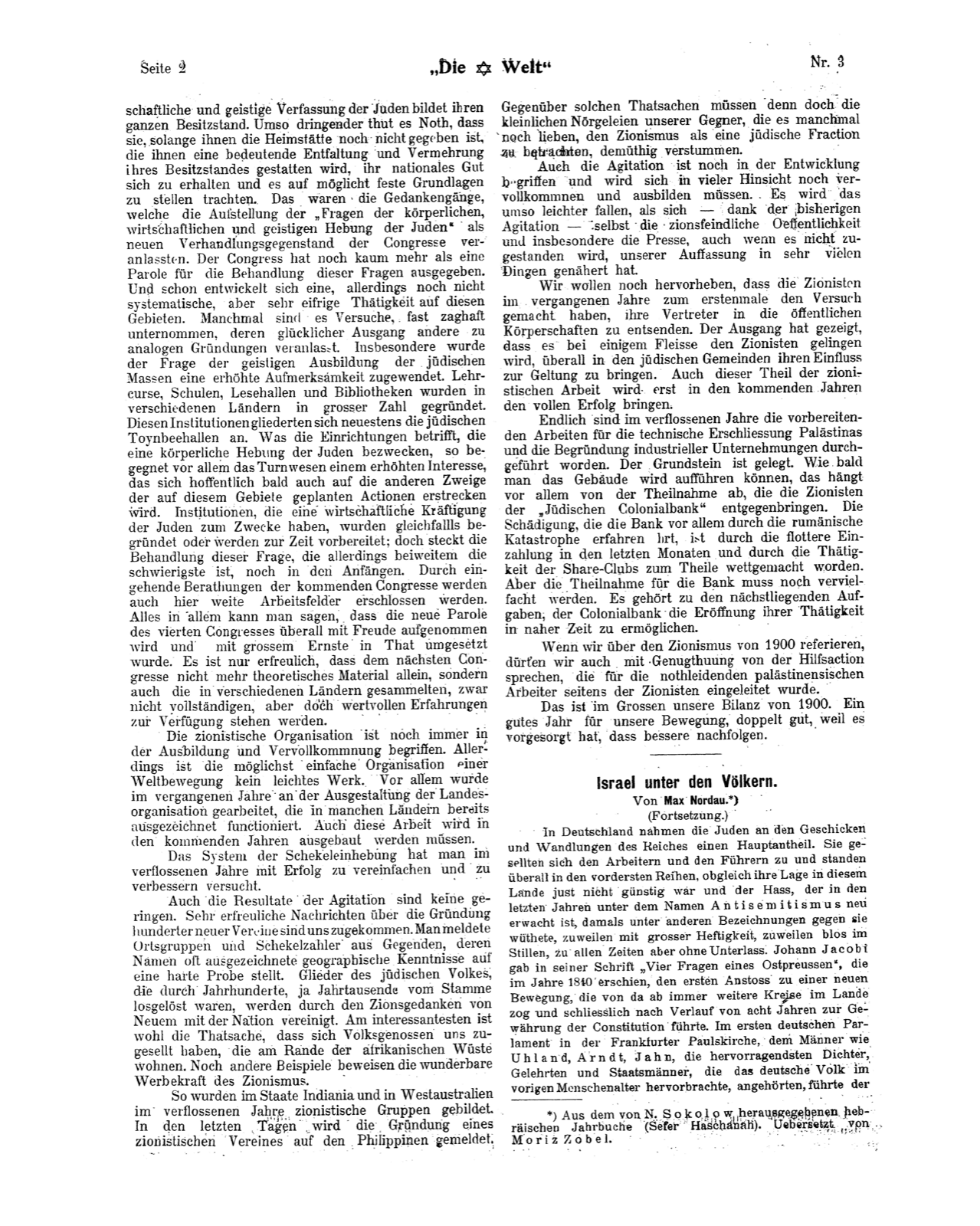
Page 2 — "Die Welt" — No. 3
(continued from page 1)
…mic and intellectual constitution of the Jews forms their whole estate. So much the more urgently is it needful that, so long as the home is not yet given them which will permit them a considerable unfolding and increase of their estate, they should seek to preserve their national possession and to place it upon the firmest possible foundations. Such were the trains of thought which occasioned the setting up of the "questions of the physical, economic, and intellectual raising of the Jews" as a new subject of deliberation for the Congresses. The Congress has as yet hardly done more than issue a watchword for the treatment of these questions. And already there is developing an activity in these fields which, though not yet systematic, is very zealous. Sometimes they are attempts undertaken almost timidly, whose happy issue moves others to analogous foundations. In particular, a heightened attention has been turned to the question of the intellectual training of the Jewish masses. Courses of instruction, schools, reading-halls, and libraries have been founded in great number in various countries. To these institutions the Jewish Toynbee Halls have of late attached themselves. As regards the arrangements which aim at a physical raising of the Jews, it is above all gymnastics that meets with a heightened interest, which will, it is to be hoped, soon extend to the other branches of the actions planned in this field. Institutions which have as their object an economic strengthening of the Jews have likewise been founded, or are at present in preparation; but the treatment of this question, which is by far the most difficult, is still in its beginnings. Through searching deliberations of the coming Congresses wide fields of work will be opened up here also. All in all, one may say that the new watchword of the fourth Congress is everywhere received with joy and has been turned into deed with great earnestness. It is only gratifying that the next Congress will have at its disposal no longer theoretical material alone, but also the experience gathered in various countries — incomplete, it is true, yet nevertheless valuable.
The Zionist organisation is still in course of formation and perfecting. To be sure, the organisation of a world-movement upon the simplest possible lines is no light work. Above all, there was laboured in the past year at the shaping of the national organisation, which in some countries already functions excellently. This work, too, will have to be built further in the coming years.
The system of collecting the shekel was in the year now past successfully sought to be simplified and improved.
The results of the agitation, too, are no small ones. Very gratifying news has reached us of the founding of hundreds of new societies. Local groups and shekel-payers have been reported from regions whose names often put an excellent geographical knowledge to a hard test. Members of the Jewish people who through centuries, nay through thousands of years, had been severed from the stock are through the thought of Zion united anew with the nation. Most interesting of all is surely the fact that fellow-countrymen who dwell upon the edge of the African desert have joined themselves to us. Yet other examples prove the wonderful recruiting power of Zionism.
Thus in the State of Indiana and in Western Australia Zionist groups were formed in the year now past. In these last days the founding of a Zionist society in the Philippines is reported.
In the face of such facts the petty cavillings of our opponents, who sometimes still love to regard Zionism as a Jewish faction, must after all humbly fall silent.
The agitation, too, is still in course of development and will in many respects have to perfect and form itself further. This will fall the more easily since — thanks to the agitation hitherto — even the public hostile to Zion, and in particular the press, has in very many things drawn nearer to our conception, even if it be not admitted.
We wish further to bring out that the Zionists in the past year for the first time made the attempt to send their representatives into the public bodies. The issue has shown that with some diligence the Zionists will succeed in making their influence tell everywhere in the Jewish communities. This part of the Zionist work, too, will bring its full success only in the years to come.
Finally, in the year now past the preparatory labours for the technical opening-up of Palestine and for the establishment of industrial undertakings have been carried through. The foundation-stone is laid. How soon the building can be raised depends above all upon the participation which the Zionists accord to the "Jewish Colonial Bank." The injury which the Bank has suffered, above all through the Roumanian catastrophe, has been in part made good by the brisker payment of the last months and by the activity of the Share Clubs. But the participation in the Bank must be multiplied yet further. It belongs among the most immediate tasks to make it possible for the Colonial Bank to open its operations at an early date.
When we report upon the Zionism of 1900, we may also speak with satisfaction of the relief action which was set on foot by the Zionists on behalf of the distressed Palestinian labourers.
Such, in the large, is our balance-sheet of 1900. A good year for our movement; doubly good, because it has made provision that better ones shall follow.
Israel among the Nations.
By Max Nordau.*) (Continuation.)
In Germany the Jews took a principal part in the destinies and transformations of the Empire. They joined themselves to the workers and to the leaders and stood everywhere in the foremost ranks, although their position in this country was just then not a favourable one and the hatred which in recent years has awakened anew under the name of Antisemitism raged against them at that time under other designations, sometimes with great vehemence, sometimes merely in secret, but at all times without cease. Johann Jacobi, in his tract "Four Questions of an East Prussian," which appeared in the year 1840, gave the first impulse to a new movement which from that time drew ever wider circles in the land and finally, after the lapse of eight years, led to the granting of the Constitution. In the first German parliament in the Paulskirche at Frankfort, to which belonged men such as Uhland, Arndt, Jahn, the most eminent poets, scholars, and statesmen whom the German people brought forth in the last generation, the
*) From the Hebrew year-book (Sefer Haschanah) edited by N. Sokolow. Translated by Moriz Zobel.