— 18 —
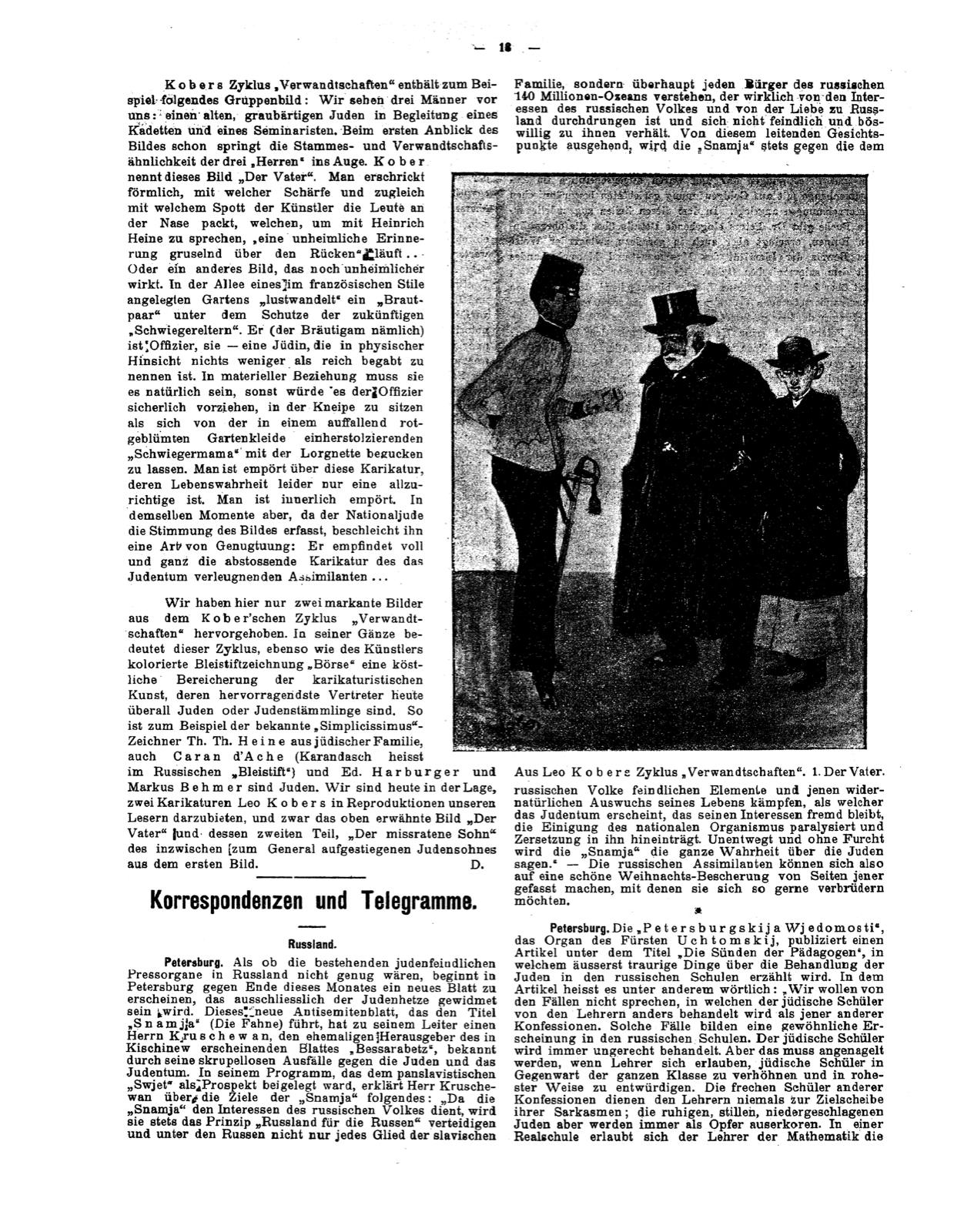
Kober's cycle "Relations" contains, for example, the following group picture: we see three men before us: an old, grey-bearded Jew in the company of a cadet and a seminarist. At the very first sight of the picture the family and tribal likeness of the three "gentlemen" leaps to the eye. Kober calls this picture "The Father." One is positively startled at the sharpness, and at the same time the mockery, with which the artist takes these people by the nose — people down whose backs, to speak with Heinrich Heine, "an uncanny remembrance runs shuddering"… Or another picture, which has a still more uncanny effect. In the avenue of a garden laid out in the French style an "engaged couple" is "promenading" under the protection of the future "parents-in-law." He (the bridegroom, that is) is an officer; she — a Jewess who in physical respects can be called anything but richly endowed. In material respects she must of course be so, otherwise the officer would certainly prefer to sit in the tavern rather than let himself be quizzed through the lorgnette by the "mamma-in-law," who struts along in a conspicuously red-flowered garden gown. One is indignant at this caricature, whose truth to life is unhappily only all too accurate. One is inwardly indignant. But in the same moment in which the national Jew grasps the mood of the picture, a kind of satisfaction steals over him: he feels fully and wholly the repellent caricature of the assimilationist who disowns Judaism…
We have here singled out only two striking pictures from Kober's cycle "Relations." In its entirety this cycle, like the artist's coloured pencil drawing "The Bourse," signifies a delightful enrichment of the art of caricature, whose most eminent representatives to-day are everywhere Jews or of Jewish descent. Thus, for example, the well-known "Simplicissimus" draughtsman Th. Th. Heine is of a Jewish family; Caran d'Ache too (Karandash means "pencil" in Russian), and Ed. Harburger and Markus Behmer are Jews. We are to-day in a position to offer our readers two caricatures of Leo Kober in reproduction, namely the above-mentioned picture "The Father" and its second part, "The Degenerate Son," of the Jew's son of the first picture, who has meanwhile risen to be a general. D.
Correspondence and Telegrams.
Russia.
St. Petersburg. As though the existing anti-Jewish organs of the press in Russia were not enough, a new paper, which will be devoted exclusively to agitation against the Jews, begins to appear in St. Petersburg towards the end of this month. This new anti-Semitic paper, which bears the title "Znamya" (The Banner), has as its director a Mr. Krushevan, the former publisher of the paper "Bessarabetz" appearing in Kischinew, known for his unscrupulous attacks upon the Jews and Judaism. In his programme, which was enclosed as a prospectus with the Panslavist "Svyet," Mr. Krushevan declares the following concerning the aims of the "Znamya": "Since the 'Znamya' serves the interests of the Russian people, it will always defend the principle 'Russia for the Russians,' and will understand by Russians not only every member of the Slavonic family, but in general every citizen of the Russian ocean of 140 millions who is truly imbued with the interests of the Russian people and with love for Russia, and does not conduct himself in a hostile and malevolent manner towards them. Proceeding from this guiding point of view, the 'Znamya' will always fight against the elements hostile to the
From Leo Kober's cycle "Relations." 1. The Father.
Russian people, and against that unnatural excrescence of its life which Judaism appears to be, which remains alien to its interests, paralyses the unification of the national organism, and carries decomposition into it. Unswervingly and without fear the 'Znamya' will tell the whole truth about the Jews." — The Russian assimilationists may therefore prepare themselves for a fine Christmas present from those with whom they would so gladly fraternise.
St. Petersburg. The "Peterburgskiya Vyedomosti," the organ of Prince Ukhtomsky, publishes an article under the title "The Sins of the Pedagogues," in which exceedingly sad things are told about the treatment of the Jews in the Russian schools. The article says, among other things, verbatim: "We will not speak of the cases in which the Jewish pupil is treated by the teachers differently from those of other confessions. Such cases are an ordinary phenomenon in the Russian schools. The Jewish pupil is always treated unjustly. But it must be nailed to the pillory when teachers permit themselves to deride Jewish pupils in the presence of the whole class and to degrade them in the coarsest manner. The impudent pupils of other confessions never serve the teachers as a target for their sarcasms; but the quiet, silent, downcast Jews are always singled out as victims. In one Realschule the teacher of mathematics permits himself the