Page 2 — "Die ✡ Welt" — No. 44
(continued from page 1)
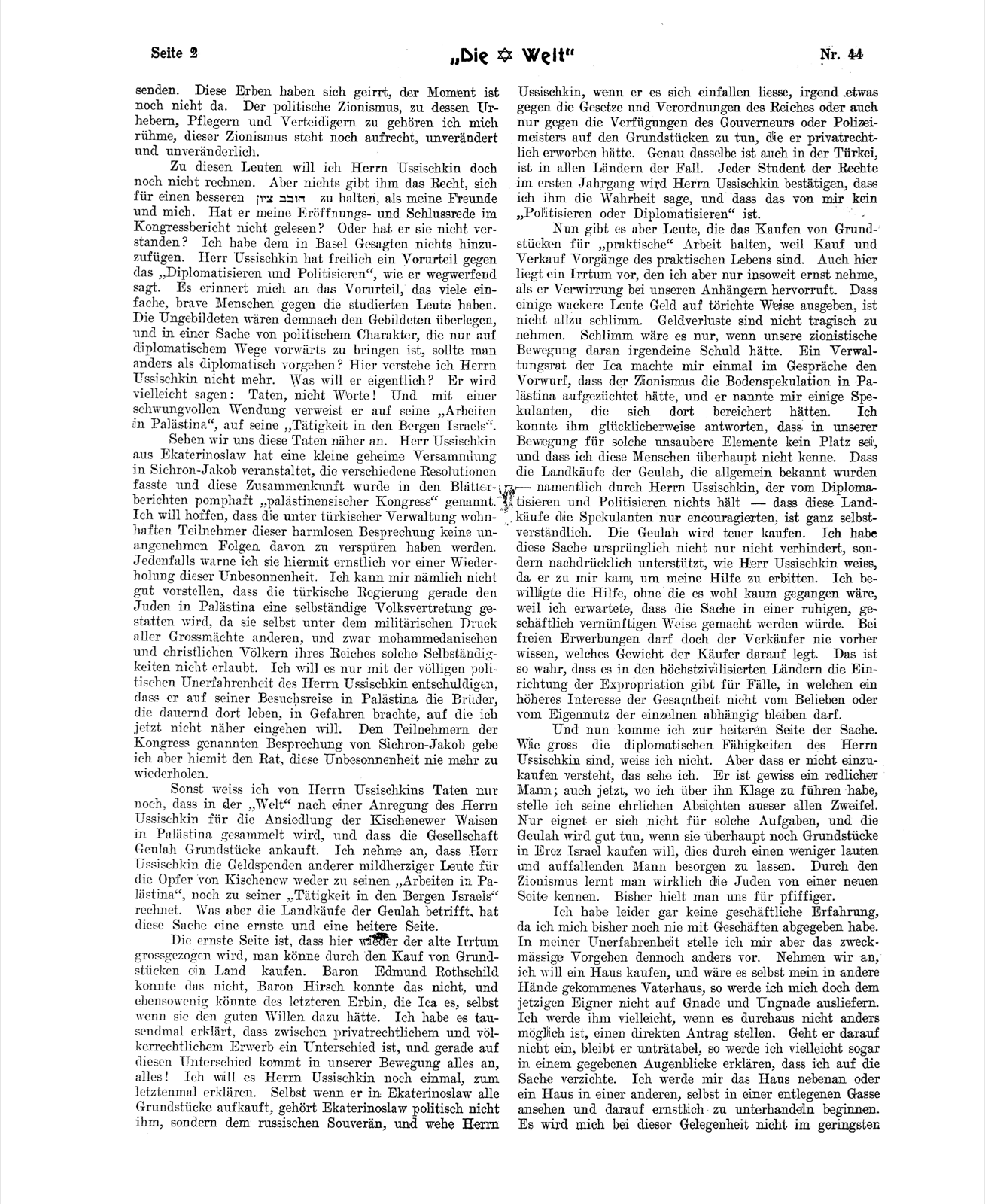
...patch. These heirs have been mistaken; the moment has not yet come. Political Zionism, among whose originators, fosterers and defenders I pride myself on being counted, this Zionism still stands upright, unchanged and unchangeable.
Among these people I will not yet reckon Mr. Ussischkin. But nothing gives him the right to consider himself a better חובב ציון than my friends and myself. Has he not read my opening and closing addresses in the report of the Congress? Or has he not understood them? I have nothing to add to what was said at Basle. Mr. Ussischkin, to be sure, has a prejudice against "diplomatising and politicising," as he disparagingly puts it. It reminds me of the prejudice which many simple, worthy folk entertain against educated men. The uneducated would, on this showing, be superior to the educated, and in an affair of political character, which can be advanced only by diplomatic means, one ought to proceed otherwise than diplomatically? Here I cease to understand Mr. Ussischkin. What does he really want? He will perhaps say: Deeds, not words! And with a sweeping gesture he points to his "work in Palestine," to his "activity upon the mountains of Israel."
Let us look more closely at these deeds. Mr. Ussischkin of Ekaterinoslaw arranged a small secret meeting at Sichron-Jakob, which passed various resolutions, and this gathering was pompously styled a "Palestinian Congress" in the newspaper reports. I will hope that those participants in this harmless conference who reside under Turkish administration will suffer no unpleasant consequences from it. In any case I hereby earnestly warn them against any repetition of this imprudence. For I cannot well imagine that the Turkish Government will grant to the Jews in Palestine, of all people, an independent popular representation, when, even under the military pressure of all the Great Powers, it does not permit such independence to other peoples of its Empire, Mohammedan and Christian ones at that. I will excuse it only by Mr. Ussischkin's complete political inexperience that on his visiting journey in Palestine he brought the brethren who live there permanently into dangers upon which I will not now enlarge. To the participants in the conference at Sichron-Jakob that was called a Congress, however, I hereby give the advice never again to repeat this imprudence.
Beyond this, I know of Mr. Ussischkin's deeds only that, at Mr. Ussischkin's suggestion, a collection is being made in "Die Welt" for the settlement of the Kischenew orphans in Palestine, and that the Geulah society is buying land. I assume that Mr. Ussischkin counts the money contributions of other charitable persons for the victims of Kischenew neither among his "work in Palestine" nor among his "activity upon the mountains of Israel." But as regards the land purchases of the Geulah, this matter has a serious side and a comic side.
The serious side is that here the old error is once more being fostered, that one can buy a country by the purchase of parcels of land. Baron Edmund Rothschild could not do it, Baron Hirsch could not do it, and just as little could the latter's heir, the Ica, even if it had the good will to do so. I have explained a thousand times that there is a difference between acquisition under private law and acquisition under the law of nations, and it is precisely upon this difference that everything in our movement depends, everything! I will explain it to Mr. Ussischkin once more, for the last time. Even if he were to buy up all the land in Ekaterinoslaw, Ekaterinoslaw would politically belong not to him but to the Russian Sovereign, and woe to Mr. Ussischkin should it occur to him to do anything against the laws and ordinances of the Empire, or even merely against the orders of the Governor or the chief of police, upon the lands he had acquired under private law. Precisely the same is the case in Turkey, and in all countries. Any first-year student of law will confirm to Mr. Ussischkin that I am telling him the truth, and that this on my part is no "politicising or diplomatising."
Now there are, however, people who regard the buying of land as "practical" work, because buying and selling are transactions of practical life. Here too there is an error, which I take seriously, however, only in so far as it causes confusion among our adherents. That some worthy people spend money in a foolish manner is not so very bad. Losses of money are not to be taken tragically. It would be bad only if our Zionist movement bore any blame for it. A director of the Ica once reproached me in conversation that Zionism had bred land speculation in Palestine, and he named to me several speculators who had enriched themselves there. Fortunately I was able to answer him that in our movement there is no room for such unclean elements, and that I did not know these persons at all. That the land purchases of the Geulah, which became generally known — notably through Mr. Ussischkin, who holds diplomatising and politicising of no account — that these land purchases only encouraged the speculators, is entirely self-evident. The Geulah will buy dear. Originally I not only did not hinder this affair but emphatically supported it, as Mr. Ussischkin knows, since he came to me to beg my help. I granted the help, without which it could scarcely have gone forward, because I expected that the matter would be conducted in a quiet, commercially sensible manner. In free acquisitions, surely, the seller must never know beforehand what weight the buyer attaches to the purchase. This is so true that in the most highly civilised countries there exists the institution of expropriation for cases in which a higher interest of the community may not be left dependent on the caprice or the self-interest of individuals.
And now I come to the comic side of the matter. How great Mr. Ussischkin's diplomatic abilities are, I do not know. But that he does not understand how to buy, that I can see. He is certainly an upright man; even now, when I have complaint to make against him, I place his honest intentions beyond all doubt. Only he is not suited to such tasks, and the Geulah will do well, if it still wishes to buy land in Erez Israel at all, to have this done by a less noisy and conspicuous man. Through Zionism one truly comes to know the Jews from a new side. Hitherto we were held to be shrewder.
Unfortunately I have no business experience whatever, since I have never hitherto concerned myself with business. In my inexperience, however, I nevertheless picture the expedient course differently. Suppose I wish to buy a house, and were it even the house of my fathers that had passed into other hands, I should surely not deliver myself up to the present owner at his mercy. I might perhaps, if it were absolutely impossible otherwise, make him a direct offer. If he would not entertain it, if he remained intractable, I might perhaps even, at a given moment, declare that I renounced the matter. I should look at the house next door, or at a house in another, even a remote, street, and begin to negotiate seriously for it. On this occasion it will not in the least