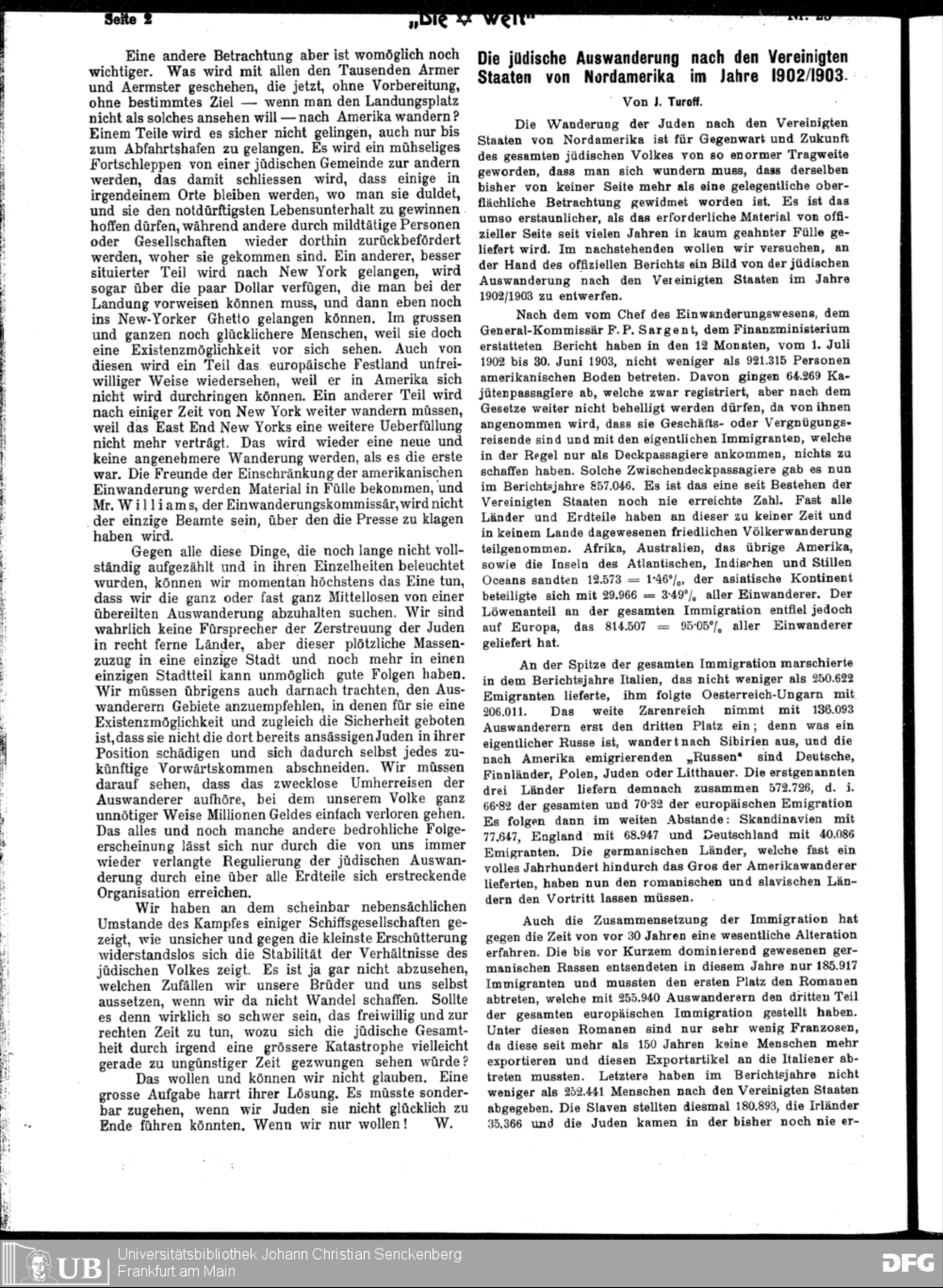
Page 2 — "Die Welt" — No. 25
The Jewish Emigration to the United States of North America in the Year 1902/1903.
By J. Turoff.
The migration of the Jews to the United States of North America has become of such enormous consequence for the present and the future of the whole Jewish people that one cannot but wonder that it has hitherto received from no quarter more than an occasional and superficial consideration. This is all the more astonishing since the requisite material has for many years been furnished from official sources in an abundance scarcely imagined. In what follows we shall attempt, on the basis of the official report, to draw a picture of the Jewish emigration to the United States in the year 1902/1903.
According to the report rendered to the Treasury by the head of the immigration service, Commissioner-General F. P. Sargent, no fewer than 921.315 persons set foot on American soil in the twelve months from 1 July 1902 to 30 June 1903. From these must be deducted 64.269 cabin passengers, who are indeed registered but may not by law be further molested, since it is presumed that they are travellers on business or pleasure and have nothing to do with the immigrants proper, who as a rule arrive only as deck passengers. Of such steerage passengers there were in the year under report 857.046. This is a figure never before reached since the United States came into being. Almost all countries and continents took part in this peaceful migration of peoples, unexampled in any age or any land. Africa, Australia, the rest of America, and the islands of the Atlantic, Indian and Pacific Oceans sent 12.573 = 1.46% of the total; the Asiatic continent contributed 29.966 = 3.49% of all immigrants. The lion's share of the whole immigration, however, fell to Europe, which furnished 814.507 = 95.05% of all immigrants.
At the head of the whole immigration in the year under report marched Italy, which furnished no fewer than 230.622 emigrants; it was followed by Austria-Hungary with 206.011. The vast empire of the Tsar, with 136.093 emigrants, takes only third place; for the Russian proper emigrates to Siberia, and the "Russians" emigrating to America are Germans, Finlanders, Poles, Jews or Lithuanians. The three countries first named thus furnish together 572.726, i.e. 66.82 of the total and 70.32 of the European emigration. Then follow, at a wide interval: Scandinavia with 77.647, England with 68.947 and Germany with 40.086 emigrants. The Germanic countries, which for almost a full century furnished the bulk of those migrating to America, have now had to yield precedence to the Romance and Slavonic countries.
The composition of the immigration, too, has undergone an essential alteration as compared with thirty years ago. The Germanic races, dominant until quite recently, sent this year only 185.917 immigrants and had to yield first place to the Latin peoples, who with 255.940 emigrants supplied a third of the whole European immigration. Among these Latins there are very few Frenchmen, since the French have for more than 150 years exported no more human beings and have had to cede this article of export to the Italians. The latter gave up to the United States in the year under report no fewer than 232.441 persons. The Slavs this time furnished 180.893, the Irish 35.366, and the Jews came in the hitherto never at-
Another consideration, however, is perhaps still more important. What will become of all the thousands of the poor and the poorest who are now migrating to America without preparation, without a definite goal — unless the landing-place be regarded as such? One part will assuredly not succeed in reaching even the port of embarkation. It will be a toilsome dragging of themselves from one Jewish community to the next, which will end in some remaining in whatever place they are tolerated and may hope to earn the barest livelihood, while others will be conveyed back by charitable persons or societies whence they came. Another, better-situated part will reach New York, will even possess the few dollars one must be able to show on landing, and will then just manage to get into the New York ghetto. On the whole, happier people still, since they at least see before them a possibility of existence. Of these, too, a part will involuntarily see the European mainland again, because it will not be able to struggle through in America. Another part will have to wander on from New York after some time, because the East End of New York can bear no further overcrowding. That will again be a new wandering, and no pleasanter one than the first. The friends of the restriction of American immigration will receive material in abundance, and Mr. Williams, the Commissioner of Immigration, will not be the only official of whom the press will have cause to complain.
Against all these things, which are far from having been completely enumerated and illuminated in their details, we can for the moment do at most this one thing: endeavour to restrain the wholly or almost wholly destitute from over-hasty emigration. We are truly no advocates of the dispersion of the Jews into very distant lands, but this sudden mass influx into a single city, and still more into a single quarter of a city, cannot possibly have good consequences. We must, moreover, strive to recommend to the emigrants territories in which a possibility of existence is offered them, together with the assurance that they will not injure the position of the Jews already settled there and thereby cut themselves off from all future advancement. We must see to it that the aimless travelling about of the emigrants ceases, in which millions of money are quite needlessly lost to our people. All this, and many another threatening consequence, can be achieved only by that regulation of Jewish emigration, through an organisation extending over all continents, which we have demanded again and again.
We have shown, by the seemingly trivial circumstance of the struggle among a few shipping companies, how insecure and how defenceless against the slightest shock the stability of the conditions of the Jewish people proves to be. There is no foreseeing to what accidents we expose our brethren and ourselves if we do not bring about a change. Should it really be so difficult to do voluntarily and in good time that which the Jewish community as a whole might be compelled to do by some greater catastrophe, perhaps at the most unfavourable moment?
That we will not and cannot believe. A great task awaits its solution. It would be strange indeed if we Jews could not bring it to a happy conclusion. If only we will! W.