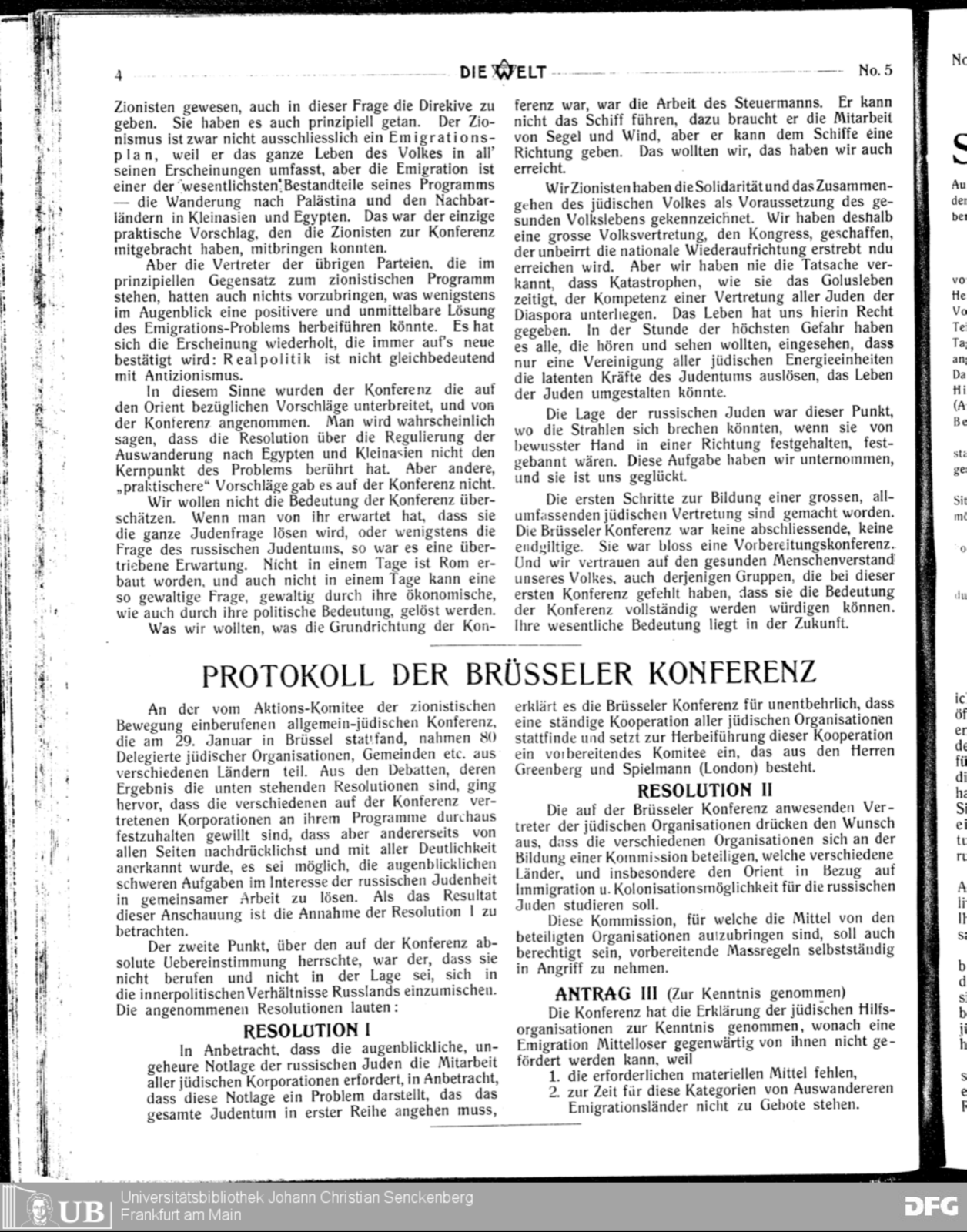
Page 4 — "Die Welt" — No. 5
(continued from page 3)
…Zionists have been, to give the direction in this question also. And in principle they have done so. Zionism is not, it is true, exclusively a plan of emigration, since it embraces the whole life of the people in all its manifestations; but emigration is one of the most essential parts of its programme — the migration to Palestine and the neighbouring lands in Asia Minor and Egypt. That was the only practical proposal which the Zionists brought to the Conference, the only one they could bring.
But the representatives of the other parties, who stand in opposition in principle to the Zionist programme, had likewise nothing to put forward that could bring about, at least for the moment, a more positive and immediate solution of the problem of emigration. The phenomenon has repeated itself which is confirmed ever anew: practical politics is not synonymous with anti-Zionism.
It was in this sense that the proposals relating to the East were submitted to the Conference and adopted by it. It will probably be said that the resolution concerning the regulation of emigration to Egypt and Asia Minor did not touch the heart of the problem. But other, "more practical," proposals there were none at the Conference.
We do not wish to overrate the importance of the Conference. If it was expected to solve the whole Jewish question, or at least the question of Russian Jewry, the expectation was an exaggerated one. Rome was not built in a day, and neither can so tremendous a question — tremendous alike in its economic and in its political significance — be solved in a day.
What we desired, what the fundamental direction of the Conference was, was the work of the helmsman. He cannot drive the ship forward — for that he needs the co-operation of sail and wind — but he can give the ship a direction. That is what we desired, and that we have also attained.
We Zionists have marked out the solidarity and the united action of the Jewish people as the precondition of a healthy national life. We have therefore created a great representative body of the people, the Congress, which unswervingly strives for the national restoration and will attain it. But we have never failed to recognise the fact that catastrophes such as the life of the Golus brings forth fall within the competence of a representation of all the Jews of the Diaspora. Life has proved us right in this. In the hour of supreme danger all who were willing to hear and to see have perceived that only a union of all the units of Jewish energy could release the latent forces of Jewry and transform the life of the Jews.
The situation of the Russian Jews was that point at which the rays might be refracted, if they were held fast, fixed fast, in one direction by a conscious hand. This task we undertook, and we have succeeded in it.
The first steps towards the formation of a great, all-embracing Jewish representation have been taken. The Brussels Conference was no concluding one, no final one. It was merely a preparatory conference. And we trust to the sound common sense of our people, including those groups which were absent from this first Conference, that they will come to appreciate the significance of the Conference to the full. Its essential significance lies in the future.
MINUTES OF THE BRUSSELS CONFERENCE
The general Jewish Conference convened by the Actions Committee of the Zionist movement, which took place at Brussels on the 29th of January, was attended by 80 delegates of Jewish organisations, communities, etc., from various countries. From the debates, the outcome of which is the resolutions printed below, it emerged that the various corporations represented at the Conference are wholly resolved to hold fast to their own programmes, but that on the other hand it was acknowledged on all sides, most emphatically and with all clearness, that it was possible to accomplish the present grave tasks in the interest of Russian Jewry by common labour. The adoption of Resolution I is to be regarded as the result of this view.
The second point upon which absolute agreement prevailed at the Conference was that it was neither called upon nor in a position to interfere in the internal political affairs of Russia. The resolutions adopted read as follows:
RESOLUTION I
Considering that the present enormous distress of the Russian Jews demands the co-operation of all Jewish corporations, and considering that this distress constitutes a problem which must concern the whole of Jewry in the first instance, the Brussels Conference declares it indispensable that a permanent co-operation of all Jewish organisations should take place, and, for the bringing about of this co-operation, appoints a preparatory committee consisting of Messrs. Greenberg and Spielmann (London).
RESOLUTION II
The representatives of the Jewish organisations present at the Brussels Conference express the wish that the various organisations should take part in the formation of a commission which shall study various countries, and in particular the East, with regard to the possibilities of immigration and colonisation for the Russian Jews.
This commission, the means for which are to be raised by the participating organisations, shall also be entitled to undertake preparatory measures on its own initiative.
MOTION III (Taken note of)
The Conference has taken note of the declaration of the Jewish relief organisations, according to which an emigration of persons without means cannot at present be furthered by them, because
- the necessary material means are lacking,
- no countries of emigration are at present available for these categories of emigrants.