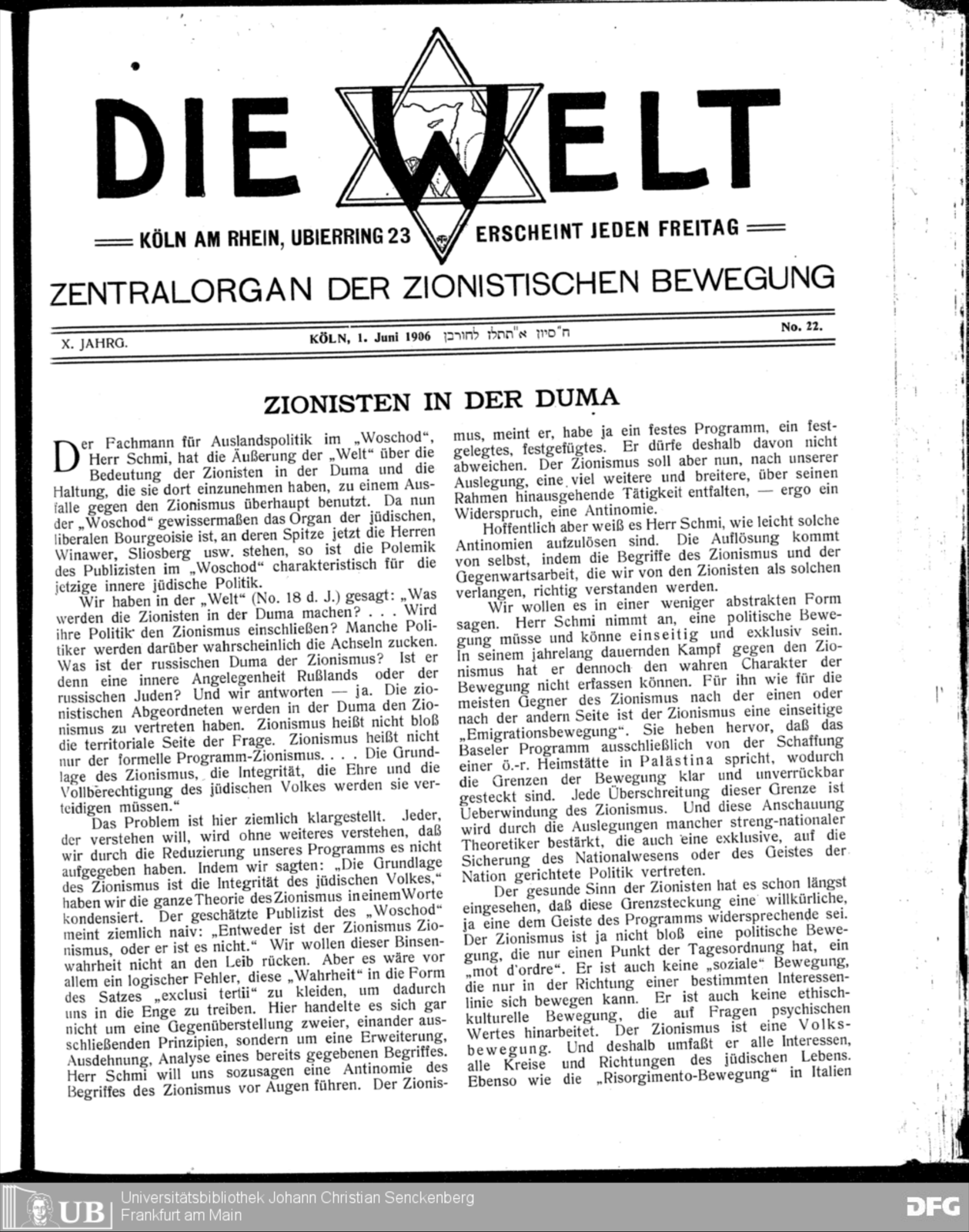
DIE WELT
=== COLOGNE-ON-RHINE, UBIERRING 23 / APPEARS EVERY FRIDAY ===
CENTRAL ORGAN OF THE ZIONIST MOVEMENT
10th YEAR / COLOGNE, 1 June 1906 ח"סיון א'התחלז לחורבן / No. 22.
ZIONISTS IN THE DUMA
The specialist in foreign politics of the "Woschod," Herr Schmi, has made the remarks of "Die Welt" on the significance of the Zionists in the Duma, and on the attitude they are to adopt there, the occasion for an attack upon Zionism as a whole. Since the "Woschod" is, in a manner of speaking, the organ of the Jewish liberal bourgeoisie, at whose head now stand Messrs. Winawer, Sliosberg, and others, the polemic of this publicist of the "Woschod" is characteristic of present Jewish domestic politics.
We said in "Die Welt" (No. 18 of this year): "What will the Zionists do in the Duma? . . . Will their policy include Zionism? Many politicians will probably shrug their shoulders at the question. What is Zionism to the Russian Duma? Is it, then, a domestic concern of Russia, or of the Russian Jews? And we answer — yes. The Zionist deputies will have to represent Zionism in the Duma. Zionism does not mean merely the territorial side of the question. Zionism does not mean only the formal Zionism of the programme. . . . The foundation of Zionism, the integrity, the honour and the full equality of rights of the Jewish people, they will have to defend."
The problem is here made fairly clear. Anyone who wishes to understand will understand without further ado that in reducing our programme we have not abandoned it. In saying, "The foundation of Zionism is the integrity of the Jewish people," we condensed the whole theory of Zionism into a single phrase. The esteemed publicist of the "Woschod" observes rather naïvely: "Either Zionism is Zionism, or it is not." We do not wish to lay hands upon this truism. But it would be, above all, a logical error to clothe this "truth" in the form of the principle exclusi tertii in order thereby to drive us into a corner. The matter here was not at all one of opposing two mutually exclusive principles, but of the enlargement, extension and analysis of a concept already given. Herr Schmi wishes, so to speak, to set before our eyes an antinomy in the concept of Zionism. Zionism, he says, has a fixed programme, one settled and firmly framed. It may therefore not depart from it. Yet Zionism, according to our interpretation, is now to unfold a far wider and broader activity reaching beyond its own bounds, — ergo a contradiction, an antinomy.
We hope, however, that Herr Schmi knows how easily such antinomies are resolved. The resolution comes of itself, once the concepts of Zionism and of the work in the present which we demand of the Zionists as such are rightly understood.
Let us put it in a less abstract form. Herr Schmi assumes that a political movement must be, and can be, one-sided and exclusive. In his struggle against Zionism, lasting for years, he has nevertheless been unable to grasp the true character of the movement. For him, as for most opponents of Zionism on the one side or the other, Zionism is a one-sided "emigration movement." They emphasize that the Basle Programme speaks exclusively of the creation of a publicly and legally secured home in Palestine, whereby the bounds of the movement are clearly and immovably fixed. Every overstepping of this boundary is an overcoming of Zionism. And this view is strengthened by the interpretations of certain strictly national theorists, who likewise advocate an exclusive policy directed toward safeguarding the national being or the spirit of the nation.
The sound sense of the Zionists perceived long ago that this fixing of boundaries is an arbitrary one, indeed one contrary to the spirit of the programme. Zionism is not merely a political movement having but one point on its order of the day, a mot d'ordre. Nor is it a "social" movement, which can move only along the line of a particular set of interests. Nor is it an ethical-cultural movement working toward questions of psychic value. Zionism is a popular movement. And therefore it embraces all the interests, all the circles and tendencies of Jewish life. Just as the "Risorgimento movement" in Italy