No. 37 — "Die Welt" — 7.
From Morocco
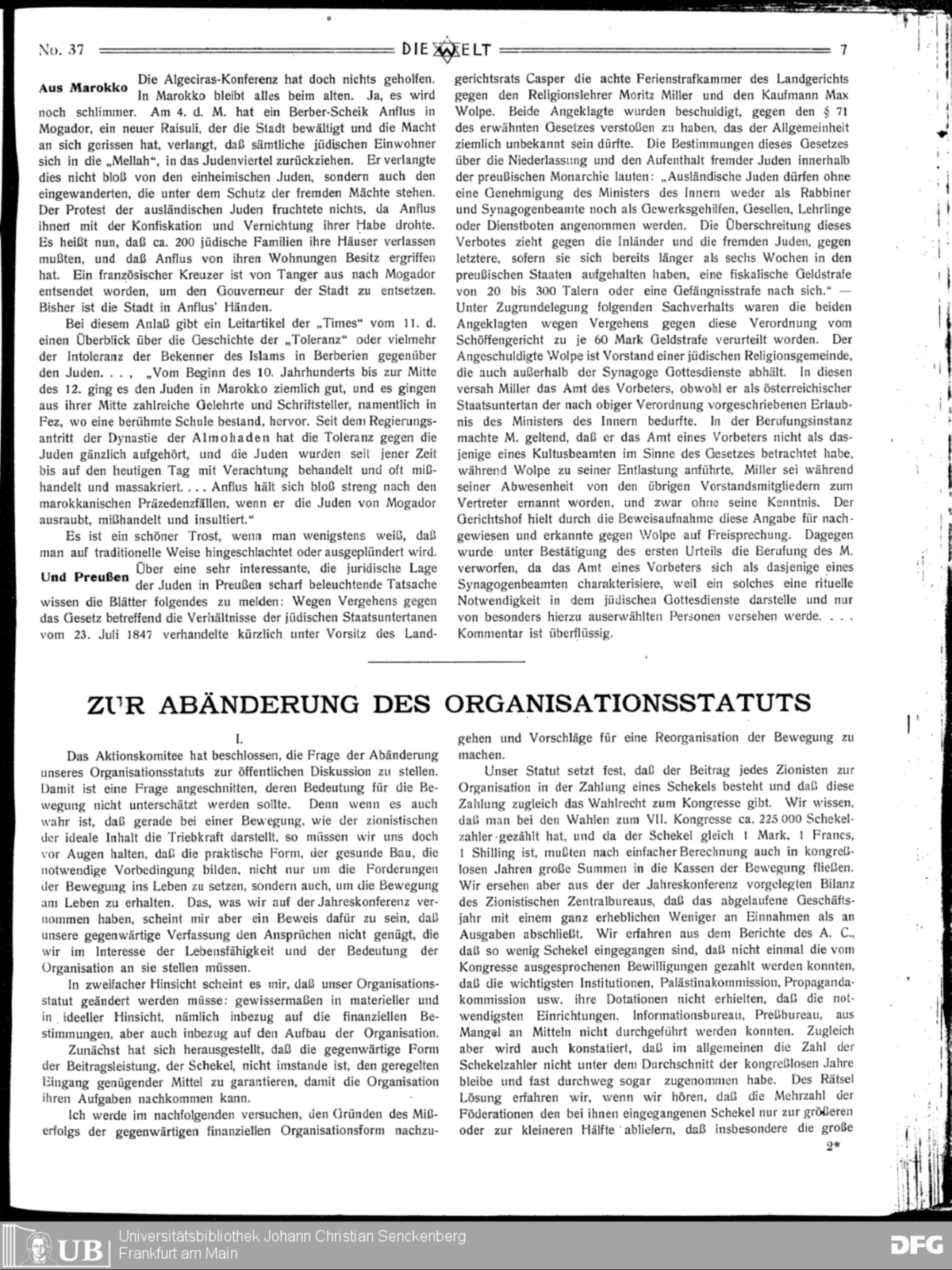
The Algeciras Conference has, after all, done no good. In Morocco everything remains as of old. Indeed, it is growing still worse. On the 4th inst. a Berber sheikh, Anflus, at Mogador, a new Raisuli who has overpowered the town and seized power for himself, demanded that all the Jewish inhabitants withdraw into the "Mellah," the Jewish quarter. He demanded this not only of the native Jews but also of the immigrant ones, who stand under the protection of the foreign Powers. The protest of the foreign Jews availed nothing, as Anflus threatened them with the confiscation and destruction of their property. It is now reported that some 200 Jewish families were obliged to leave their houses, and that Anflus has taken possession of their dwellings. A French cruiser has been dispatched from Tangier to Mogador in order to relieve the governor of the town. So far the town remains in Anflus' hands.
On this occasion a leading article in the "Times" of the 11th inst. gives a survey of the history of the "tolerance," or rather the intolerance, of the professors of Islam in Barbary towards the Jews. . . . "From the beginning of the 10th century to the middle of the 12th the Jews in Morocco fared fairly well, and numerous scholars and writers came forth from their midst, particularly in Fez, where a famous school existed. Since the accession of the dynasty of the Almohades, tolerance towards the Jews has ceased altogether, and from that time down to the present day the Jews have been treated with contempt and often ill-used and massacred. . . . Anflus is merely keeping strictly to the Moroccan precedents when he robs, ill-treats and insults the Jews of Mogador."
It is a fine consolation at least to know that one is being butchered or plundered in the traditional manner.
And Prussia
Concerning a very interesting fact, one that throws a sharp light on the legal position of the Jews in Prussia, the papers have the following to report: For an offence against the law concerning the conditions of the Jewish subjects of the State, of 23 July 1847, the eighth vacation criminal chamber of the Regional Court, under the presidency of Judge Casper of the Regional Court, recently heard the case against the religious teacher Moritz Miller and the merchant Max Wolpe. Both defendants were charged with having contravened § 71 of the said law, which is likely to be fairly unknown to the general public. The provisions of this law concerning the settlement and residence of foreign Jews within the Prussian monarchy read: "Foreign Jews may not, without a permit from the Minister of the Interior, be engaged either as rabbis and synagogue officials or as trade assistants, journeymen, apprentices or servants. Transgression of this prohibition entails, against the natives and the foreign Jews (against the latter in so far as they have already resided longer than six weeks in the Prussian States), a fiscal fine of from 20 to 300 thalers or a term of imprisonment." — On the basis of the following facts the two defendants had been sentenced by the lay-assessors' court, for an offence against this ordinance, to a fine of 60 marks each. The accused Wolpe is president of a Jewish religious congregation which also holds services outside the synagogue. At these Miller performed the office of precentor, although, as an Austrian subject, he required the permission of the Minister of the Interior prescribed by the above ordinance. In the court of appeal M. pleaded that he had not regarded the office of precentor as that of a religious official within the meaning of the law, while Wolpe stated in his defence that Miller had been appointed as substitute by the other members of the board during his absence, and indeed without his knowledge. The court held this statement to be proved by the evidence taken and pronounced Wolpe's acquittal. On the other hand, the first judgment being confirmed, the appeal of M. was dismissed, since the office of precentor is to be characterized as that of a synagogue official, because such an office represents a ritual necessity in Jewish divine service and is performed only by persons specially chosen for it. . . . Comment is superfluous.
ON THE AMENDMENT OF THE ORGANIZATION STATUTE
I.
The Actions Committee has resolved to submit the question of amending our Organization Statute to public discussion. A question is thereby broached whose importance for the movement ought not to be underestimated. For even if it is true that, precisely in a movement such as the Zionist one, the ideal content constitutes the driving force, we must nevertheless bear in mind that the practical form, the sound structure, is the necessary precondition, not only for bringing the demands of the movement into being, but also for keeping the movement alive. What we heard at the Annual Conference, however, seems to me a proof that our present constitution does not satisfy the demands which, in the interest of the vitality and the importance of the Organization, we must make of it.
In two respects, it seems to me, our Organization Statute must be altered: in a material and in an ideal respect, so to speak, namely as regards the financial provisions, but also as regards the structure of the Organization.
In the first place it has become evident that the present form of contribution, the shekel, is not capable of guaranteeing the regular receipt of sufficient means for the Organization to fulfil its tasks.
In what follows I shall attempt to trace the causes of the failure of the present financial form of the Organization and to make proposals for a reorganization of the movement.
Our Statute lays down that the contribution of every Zionist to the Organization consists in the payment of a shekel, and that this payment at the same time confers the right to vote for the Congress. We know that at the elections to the VIIth Congress some 225,000 shekel-payers were counted, and since the shekel is equal to 1 mark, 1 francs, 1 shilling, large sums ought, by simple reckoning, to have flowed into the coffers of the movement even in years without a Congress. We see, however, from the balance-sheet of the Zionist Central Bureau laid before the Annual Conference, that the past business year closes with a very considerable deficit of receipts against expenditure. We learn from the report of the A. C. that so few shekels came in that not even the grants voted by the Congress could be paid; that the most important institutions, the Palestine Commission, the Propaganda Commission, etc., did not receive their endowments; that the most necessary arrangements, the Information Bureau and the Press Bureau, could not be carried out for lack of means. At the same time, however, it is also stated that in general the number of shekel-payers has not fallen below the average of the years without a Congress, and has almost everywhere even increased. The solution of the riddle we learn when we hear that the majority of the federations hand over only the greater or the smaller half of the shekels received by them; that in particular the great
2*