"Die Welt"
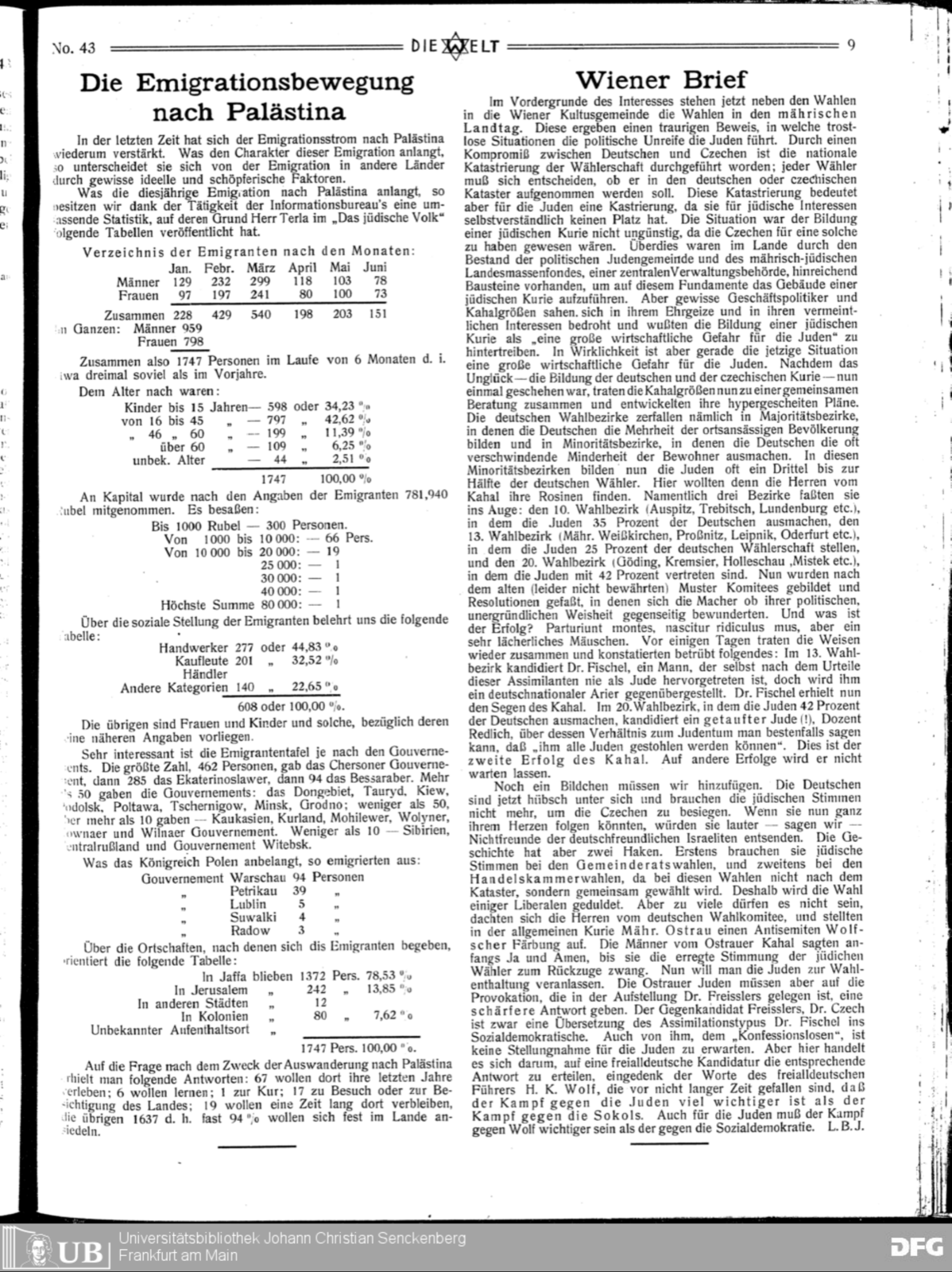
The Emigration Movement to Palestine
Of late the stream of emigration to Palestine has again grown stronger. As regards the character of this emigration, it is distinguished from emigration to other countries by certain ideal and creative factors.
As regards this year's emigration to Palestine, we possess, thanks to the activity of the Information Bureaus, a comprehensive statistic, on the basis of which Mr. Terla has published the following tables in "Das jüdische Volk."
List of the emigrants by months:
| Jan. | Feb. | March | April | May | June | |
|---|---|---|---|---|---|---|
| Men | 129 | 232 | 299 | 118 | 103 | 78 |
| Women | 97 | 197 | 241 | 80 | 100 | 73 |
| Together | 228 | 429 | 540 | 198 | 203 | 151 |
In all:
- Men 959
- Women 798
Together, therefore, 1747 persons in the course of 6 months, i.e. about three times as many as in the previous year.
By age there were:
- Children up to 15 years — 598 or 34,23 %
- from 16 to 45 " — 797 " 42,62 %
- " 46 " 60 " — 199 " 11,39 %
- " over 60 " — 109 " 6,25 %
- age unknown " — 44 " 2,51 %
- Together: 1747 or 100,00 %
According to the statements of the emigrants, 781,940 roubles in capital were taken along. There possessed:
- Up to 1000 roubles — 300 persons.
- From 1000 to 10 000: — 66 pers.
- From 10 000 to 20 000: — 19 "
- " 25 000: — 1 "
- " 30 000: — 1 "
- " 40 000: — 1 "
- Highest sum 80 000: — 1 "
The following table informs us of the social position of the emigrants:
- Artisans 277 or 44,83 %
- Merchants 201 " 32,52 %
- Traders —
- Other categories 140 " 22,65 %
- Together: 608 or 100,00 %.
The rest are women and children and those regarding whom no closer particulars are available.
Very interesting is the table of emigrants according to Governments. The largest number, 462 persons, was furnished by the Government of Kherson, then 285 by that of Ekaterinoslav, then 94 by that of Bessarabia. More than 50 were furnished by the Governments: the Don Territory, Tauryd, Kieff, Podolsk, Poltava, Chernigov, Minsk, Grodno; fewer than 50 but more than 10 — the Caucasus, Courland, and the Governments of Mohilev, Volhynia, Kovno and Vilna. Fewer than 10 — Siberia, Central Russia and the Government of Vitebsk.
As regards the Kingdom of Poland, there emigrated from:
- Government of Warsaw 94 persons
- " Petrikau 39 "
- " Lublin 5 "
- " Suwalki 4 "
- " Radow 3 "
The following table gives information on the places to which the emigrants betake themselves:
- In Jaffa remained 1372 pers. 78,53 %
- In Jerusalem " 242 " 13,85 %
- In other towns " 12 "
- In colonies " 80 " 7,62 %
- Place of residence unknown " —
- Together: 1747 pers. 100,00 %.
To the question as to the purpose of the emigration to Palestine the following answers were received: 67 wish to spend their last years there; 6 wish to study; 1 for a cure; 17 on a visit or to view the country; 19 wish to remain there for a time; the remaining 1637, i.e. almost 94 %, wish to settle permanently in the land.
Vienna Letter
In the foreground of interest there now stand, beside the elections to the Vienna Jewish Community, the elections to the Moravian Diet. These furnish a melancholy proof of the hopeless situations into which political immaturity leads the Jews. By a compromise between Germans and Czechs the national cadastration of the electorate has been carried out; every elector must decide whether he is to be entered in the German or the Czech register. This cadastration, however, means for the Jews a castration, since it naturally has no room for Jewish interests. The situation was not unfavourable to the formation of a Jewish curia, since the Czechs would have been willing to have one. Moreover, through the existence of the political Jewish communities and of the Moravian-Jewish Landesmassenfond, a central administrative authority, there were building-stones enough in the land to raise upon this foundation the edifice of a Jewish curia. But certain business politicians and Kahal magnates saw themselves threatened in their ambition and in their supposed interests, and contrived to thwart the formation of a Jewish curia as "a great economic danger for the Jews." In reality, however, it is precisely the present situation that is a great economic danger for the Jews. After the misfortune — the formation of the German and the Czech curia — had once happened, the Kahal magnates now met together for a joint deliberation and developed their hyper-clever plans. The German electoral districts, namely, fall into majority districts, in which the Germans form the majority of the resident population, and minority districts, in which the Germans make up the often vanishing minority of the inhabitants. In these minority districts the Jews now often form a third to a half of the German electors. Here, then, the gentlemen of the Kahal hoped to find their plums. Three districts in particular they fixed their eyes upon: the 10th electoral district (Auspitz, Trebitsch, Lundenburg, etc.), in which the Jews make up 35 per cent. of the Germans; the 13th electoral district (Mähr. Weißkirchen, Proßnitz, Leipnik, Oderfurt, etc.), in which the Jews furnish 25 per cent. of the German electorate; and the 20th electoral district (Göding, Kremsier, Holleschau, Mistek, etc.), in which the Jews are represented with 42 per cent. Now, after the old (unhappily not proven) pattern, committees were formed and resolutions passed in which the managers admired one another for their unfathomable political wisdom. And what is the result? Parturiunt montes, nascitur ridiculus mus, but a very ridiculous little mouse. A few days ago the wise men met again and sorrowfully established the following: In the 13th electoral district Dr. Fischel is standing, a man who, even in the judgment of these assimilationists, has never come forward as a Jew; yet a German-national Aryan is set up against him. Dr. Fischel has now received the blessing of the Kahal. In the 20th electoral district, in which the Jews make up 42 per cent. of the Germans, a baptised Jew (!) is standing, Dozent Redlich, of whose relation to Judaism one can at best say that "all the Jews may go hang for all he cares." This is the second success of the Kahal. For further successes it will not keep us waiting.
One more little picture we must add. The Germans are now nicely among themselves and no longer need the Jewish votes to defeat the Czechs. If they could now follow their hearts entirely, they would send nothing but — let us say — non-friends of the German-friendly Israelites. But the affair has two hitches. First, they need Jewish votes at the municipal council elections, and secondly at the Chamber of Commerce elections, since at these elections the voting is not by register but in common. For this reason the election of a few Liberals is tolerated. But there must not be too many of them, thought the gentlemen of the German election committee, and in the general curia of Mähr. Ostrau they put up an antisemite of the Wolf colouring. The men of the Ostrau Kahal at first said yea and amen, until the excited temper of the Jewish electors forced them to retreat. Now it is sought to induce the Jews to abstain from voting. The Ostrau Jews, however, must give a sharper answer to the provocation that lies in the putting up of Dr. Freissler. Freissler's opposing candidate, Dr. Czech, is, it is true, a translation of the assimilationist type of Dr. Fischel into Social-Democratic terms. From him, too, the "unaffiliated in religion," no stand on behalf of the Jews is to be expected. But here it is a matter of giving the fitting answer to a Free Pan-German candidature, mindful of the words of the Free Pan-German leader H. K. Wolf, uttered not long ago, that the fight against the Jews is far more important than the fight against the Sokols. For the Jews, too, the fight against Wolf must be more important than that against Social Democracy.
L. B. J.