"Die Welt" — No. 46 — Page 5.
(continued from page 4)
...ghetto epidemic to comprehend, to go on working each day at the same work with fresh energy and new, never-flagging strength of spirit, independent of the impressions of the moment and of passing moods, without that nervous blasé temper which seeks new stimulants and is quickly seized again by perplexity and faint-heartedness, by weariness and satiety, to possess the moral earnestness and the strength to serve one truth and to go on working consistently and harmoniously within a great organisation — these are the conditions for the success of our idea. We have too much to fight for on behalf of this idea to permit ourselves to squander our forces on a quarrel over shibboleths.
N. Sokolow.
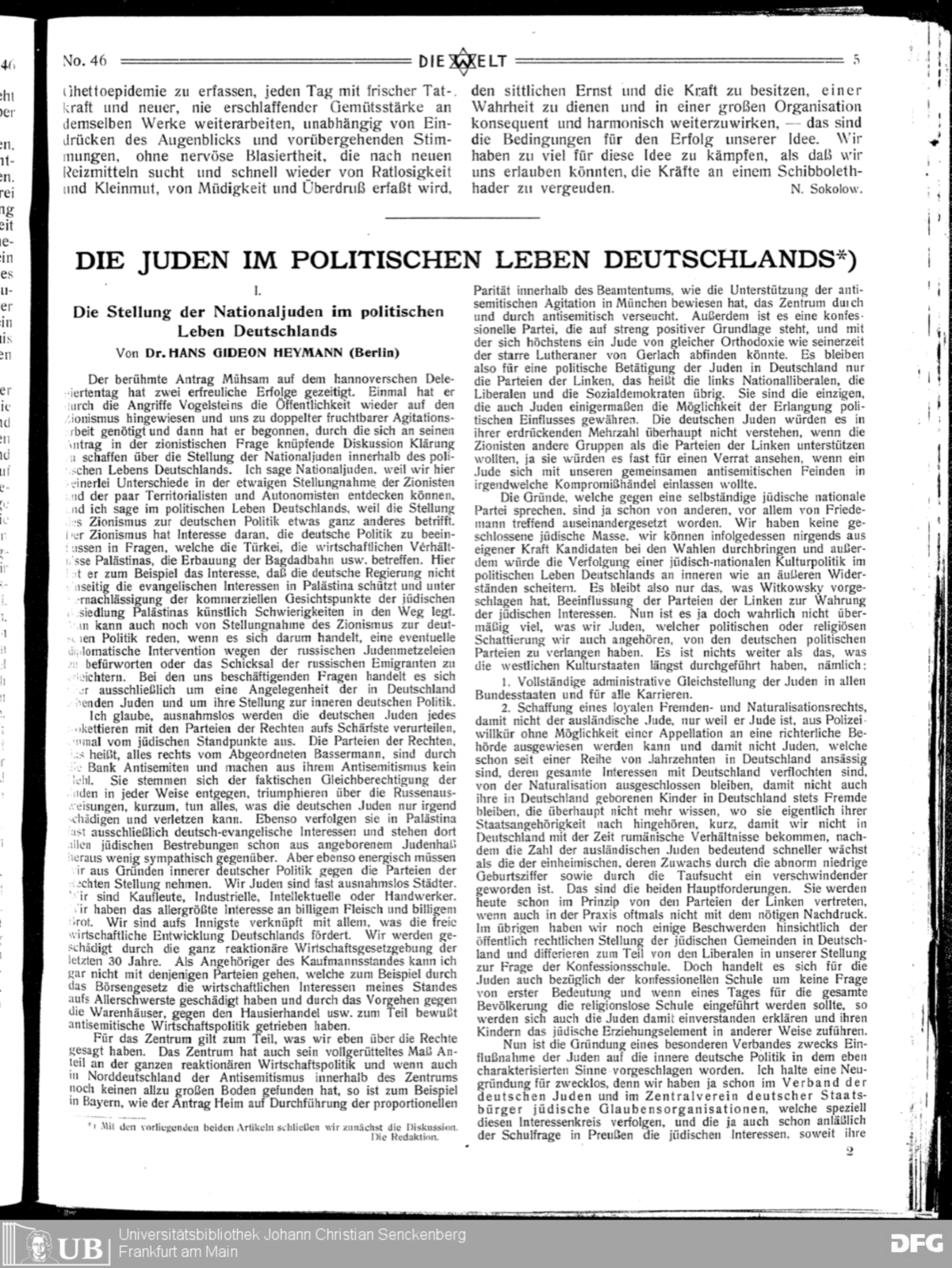
THE JEWS IN THE POLITICAL LIFE OF GERMANY*)
I. The Position of the National Jews in the Political Life of Germany
By Dr. HANS GIDEON HEYMANN (Berlin)
The celebrated Mühsam motion at the Hanover Delegates' Conference has produced two gratifying results. First, through Vogelstein's attacks, it has again directed public attention to Zionism and compelled us to doubly fruitful work of agitation; and secondly, through the discussion arising from his motion on the Zionist question, it has begun to bring clarity concerning the position of the National Jews within the political life of Germany. I say National Jews because we can discover here no difference whatever in the possible attitude of the Zionists and of the few Territorialists and Autonomists; and I say in the political life of Germany because the position of Zionism towards German policy concerns something quite different. Zionism has an interest in influencing German policy on questions concerning Turkey, the economic conditions of Palestine, the building of the Bagdad Railway, etc. Here, for example, it has an interest in the German Government's not one-sidedly protecting Protestant interests in Palestine and, neglecting commercial considerations, artificially placing difficulties in the way of Jewish settlement in Palestine. One may also still speak of the attitude of Zionism towards German policy when it is a question of advocating a possible diplomatic intervention on account of the Russian massacres of Jews, or of easing the lot of the Russian emigrants. The questions occupying us, however, concern exclusively a matter of the Jews living in Germany and their attitude towards internal German politics.
I believe the German Jews will without exception condemn most sharply any coquetting with the parties of the Right — first, from the Jewish standpoint. The parties of the Right, that is to say, everything to the right of Deputy Bassermann, are anti-Semites one and all and make no secret of their anti-Semitism. They oppose the actual equality of the Jews in every way, exult over the expulsions of Russians, in short do everything that can in any way harm and injure the German Jews. Likewise in Palestine they pursue almost exclusively German-Protestant interests and, out of innate hatred of Jews alone, regard all Jewish endeavours there with little sympathy. But just as energetically must we take a stand against the parties of the Right for reasons of internal German politics. We Jews are almost without exception town-dwellers. We are merchants, industrialists, intellectuals or artisans. We have the very greatest interest in cheap meat and cheap bread. We are most intimately bound up with everything that furthers the free economic development of Germany. We are injured by the wholly reactionary economic legislation of the last 30 years. As a member of the mercantile class I cannot possibly go with those parties which, for instance through the Stock Exchange Law, have most grievously injured the economic interests of my class, and which, by their proceedings against the department stores, against peddling, etc., have in part consciously pursued an anti-Semitic economic policy.
Of the Centre, what we have just said of the Right holds good in part. The Centre too has its full measure of share in the whole reactionary economic policy, and even though in North Germany anti-Semitism has not yet found too much ground within the Centre, yet in Bavaria, for example, as the Heim motion for carrying out proportional parity within the civil service, and as the support of the anti-Semitic agitation in Munich, have proved, the Centre is infected through and through with anti-Semitism. Moreover it is a confessional party standing on a strictly positive basis, with which at most a Jew of the same orthodoxy as the rigid Lutheran von Gerlach in his day could come to terms. There remain, therefore, for the political activity of the Jews in Germany only the parties of the Left, that is to say the left-wing National Liberals, the Liberals and the Social Democrats. They are the only ones that grant Jews too some measure of possibility of attaining political influence. The German Jews in their overwhelming majority would not understand at all if the Zionists wished to support groups other than the parties of the Left; indeed they would regard it almost as treason if a Jew were willing to enter into any sort of compromise-dealing with our common anti-Semitic enemies.
The reasons that tell against an independent Jewish national party have already been aptly set forth by others, above all by Friedemann. We have no compact Jewish mass; consequently we can nowhere carry candidates at the elections by our own strength, and moreover the pursuit of a Jewish-national cultural policy in the political life of Germany would founder on inner as well as outer resistance. There remains, therefore, only what Witkowsky has proposed: influencing the parties of the Left to safeguard Jewish interests. Now it is truly not excessively much that we Jews, to whatever political or religious shade we may belong, have to demand of the German political parties. It is nothing more than what the Western civilised states have long since carried out, namely:
-
Complete administrative equality of the Jews in all the federal states and for all careers.
-
The creation of a loyal law of aliens and of naturalisation, so that the foreign Jew may not, merely because he is a Jew, be expelled through police caprice without possibility of appeal to a judicial authority; and so that Jews who have been resident in Germany for a number of decades, whose entire interests are interwoven with Germany, may not remain excluded from naturalisation; so that their children born in Germany may not also remain for ever strangers in Germany, who no longer know at all where in point of nationality they really belong; in short, so that we may not in time come to have Roumanian conditions in Germany, since the number of foreign Jews is growing considerably faster than that of the native ones, whose increase has dwindled to a vanishing point through the abnormally low birth-rate as well as through the craze for baptism. These are the two principal demands. They are already advocated in principle today by the parties of the Left, even if in practice often not with the necessary emphasis. For the rest, we have still some grievances regarding the public-law status of the Jewish communities in Germany, and differ in part from the Liberals in our attitude to the question of the denominational school. Yet for the Jews the denominational school too is no question of the first importance, and if one day the non-religious school should be introduced for the whole population, the Jews too will declare their agreement and supply their children with the Jewish element of education in another way.
Now the founding of a special association has been proposed for the purpose of the Jews' exerting influence upon internal German politics in the sense just characterised. I consider a new foundation pointless, for we already have, in the Union of German Jews and in the Central Association of German Citizens of the Jewish Faith, organisations which pursue specifically this sphere of interests, and which, moreover, already on the occasion of the school question in Prussia, the Jewish interests, so far as their
*) With the present two articles we close the discussion for the time being.
The Editors.