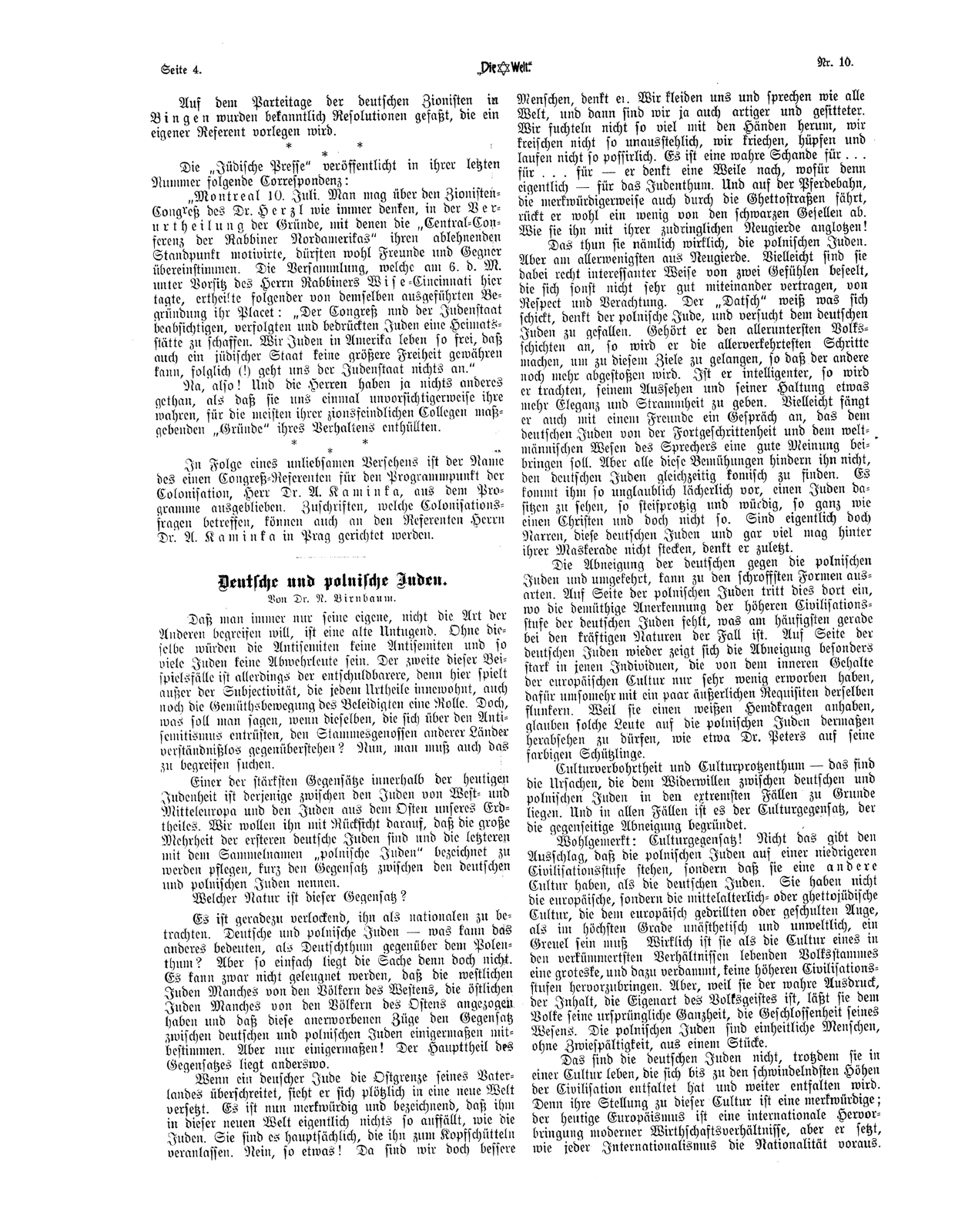
Page 4. — "Die Welt". — No. 10.
At the party conference of the German Zionists at Bingen, resolutions were, as is well known, adopted, which a rapporteur of its own will present.
* * *
The "Jüdische Presse" publishes in its latest number the following correspondence: "Montreal, 10th July. Whatever one may think of Dr. Herzl's Zionist Congress, friends and opponents alike are likely to agree in their judgment of the grounds by which the 'Central Conference of the Rabbis of North America' justified its attitude of refusal. The assembly, which met on the 6th inst. under the chairmanship of Rabbi Wise of Cincinnati, gave its placet to the following justification put forward by him: 'The Congress and the Jewish State propose to create a homeland for persecuted and oppressed Jews. We Jews in America live so freely that even a Jewish State could grant no greater freedom; consequently (!) the Jewish State is no concern of ours.'" Well, there you have it! And the gentlemen have done nothing else than incautiously disclose to us for once the true "grounds" of their conduct — the grounds that govern most of their anti-Zionist colleagues.
* * *
Through an unfortunate oversight, the name of one of the Congress rapporteurs for the programme item of colonisation, Dr. A. Kaminka, has been omitted from the programme. Communications concerning questions of colonisation may also be addressed to the rapporteur, Dr. A. Kaminka, in Prague.
German and Polish Jews.
By Dr. N. Birnbaum.
That a man will always seek to understand only his own kind and never the kind of others is an old failing. Without it the anti-Semites would be no anti-Semites, and so many Jews no defence-men. The second of these two instances is, to be sure, the more excusable, for here, besides the subjectivity that dwells in every judgment, the emotion of the injured party also plays its part. Yet what is one to say when the very people who are indignant at anti-Semitism stand without comprehension before their kinsmen of other lands? Well, one must seek to understand that too.
One of the sharpest antagonisms within present-day Jewry is that between the Jews of Western and Central Europe and the Jews of the East of our continent. Seeing that the great majority of the former are German Jews, and that the latter are commonly designated by the collective name of "Polish Jews," we shall call it briefly the antagonism between German and Polish Jews.
Of what nature is this antagonism?
It is downright tempting to regard it as a national one. German and Polish Jews — what else can that mean than Germanism as against Polonism? But the matter is not so simple after all. It cannot indeed be denied that the Western Jews have taken on something from the peoples of the West, and the Eastern Jews something from the peoples of the East, and that these acquired traits do to some extent help to determine the antagonism between German and Polish Jews. But only to some extent! The main part of the antagonism lies elsewhere.
When a German Jew crosses the eastern frontier of his fatherland, he sees himself of a sudden transported into a new world. Now it is remarkable and characteristic that in this new world nothing really strikes him so much as the Jews. It is chiefly they who set him shaking his head. No, such a thing! We are better people than that, he thinks. We dress and speak like all the world, and then we are also more decorous and more civilised. We do not flourish our hands about so much, we do not screech so insufferably, we do not creep and hop and run about so drolly. It is a real disgrace to . . . to . . . to — he reflects a while upon what it is actually a disgrace to — to Judaism. And on the horse-tramway, which curiously enough runs through the ghetto streets as well, he edges away a little from the black-coated fellows. How they gape at him with their importunate curiosity!
For that is just what they really do, the Polish Jews. But least of all out of curiosity. Perhaps they are, in a very interesting fashion, animated in this by two feelings that do not otherwise agree very well together — by respect and by contempt. The "Datsch" knows what is proper, thinks the Polish Jew, and tries to please the German Jew. If he belongs to the very lowest strata of the people, he will take the most misguided steps to attain this end, so that the other is repelled all the more. If he is of the more intelligent sort, he will endeavour to give his appearance and his bearing something more of elegance and smartness. Perhaps he will also begin a conversation with a friend which is meant to impart to the German Jew a good opinion of the speaker's advancement and man-of-the-world character. But all these exertions do not prevent him from finding the German Jew comical at the same time. It seems to him so incredibly ridiculous to see a Jew daitzen, so stiffly pompous and dignified, so entirely like a Christian and yet not so. They are really fools after all, these German Jews, and there cannot be very much behind their masquerade, he thinks at last.
The aversion of the German Jews to the Polish, and conversely, can degenerate into the harshest forms. On the side of the Polish Jews this occurs where the humble acknowledgment of the higher stage of civilisation of the German Jews is wanting, which is most frequently the case precisely with the more vigorous natures. On the side of the German Jews, again, the aversion shows itself particularly strongly in those individuals who have acquired very little of the inner substance of European culture, and who swagger all the more with a few of its outward trappings. Because they wear a white shirt-collar, such people believe themselves entitled to look down upon the Polish Jews much as Dr. Peters looks down upon his coloured wards.
Cultural obduracy and cultural profiteering — these are the causes that in the most extreme cases underlie the repugnance between German and Polish Jews. And in all cases it is the cultural antagonism that gives ground for the mutual aversion.
Mark well: cultural antagonism! What is decisive is not that the Polish Jews stand upon a lower stage of civilisation, but that they have a different culture from the German Jews. Theirs is not the European but the mediaeval or ghetto-Jewish culture, which to the eye drilled or schooled in Europe must be an abomination, as unaesthetic and unworldly in the highest degree. It is indeed, as the culture of a branch of the people living in the most stunted conditions, a grotesque one, and condemned to bring forth no higher stages of civilisation. But because it is the true expression, the content, the distinctive character of the spirit of the people, it leaves that people its original wholeness, the integrity of its being. The Polish Jews are undivided men, without inner cleavage, all of a piece.
That the German Jews are not, notwithstanding that they live in a culture which has unfolded, and will further unfold, to the most dizzying heights of civilisation. For their position towards this culture is a curious one; present-day Europeanism is an international product of modern economic conditions, but it presupposes, as every internationalism does, nationality.