No. 10. — "Die Welt" — Page 5.
One cannot be a European without being so in some national variation, just as there is, for example, no tree that is not either an oak or a palm or something else. The German Jews, however, have brought off the impossible feat of being trees as such. For they have indeed adopted European culture, but they have as little developed a Jewish variation of it as they have really accepted one of the other variations. Thus they have become walking abstractions, living theories — neither fish nor flesh, strangers to European culture and destitute of a Jewish one. It is this that fills the Polish Jew, even the humblest, with quiet contempt for his more civilised namesakes. He sees before him men patched together out of pieces, while he himself is whole and undivided.
Thus the aversion of the German Jews to the Polish and of these to those appears comprehensible. Yet on that account one need not abandon the hope that one day the gulf will be bridged. For it seems that the paths of the two Jewish groups, driven by inexorable facts, must draw nearer to one another. On the one hand, the Polish Jews cannot in the long run resist Europeanism, owing to their economic life in common with the Europeans. It is only a question of time when they will have become men of modern culture. On the other hand, the German Jews, in consequence of the bankruptcy of assimilation, are beginning to bethink themselves of their nationality. Thereby both will attain a higher fitness to create a Europeanism of Jewish variation — that ideal of Zionism. But once the German Jews have nationalised their Europeanism and the Polish Jews have Europeanised their nationalism, then the gulf will be bridged and the antagonism between German and Polish Jews will have ceased to be.
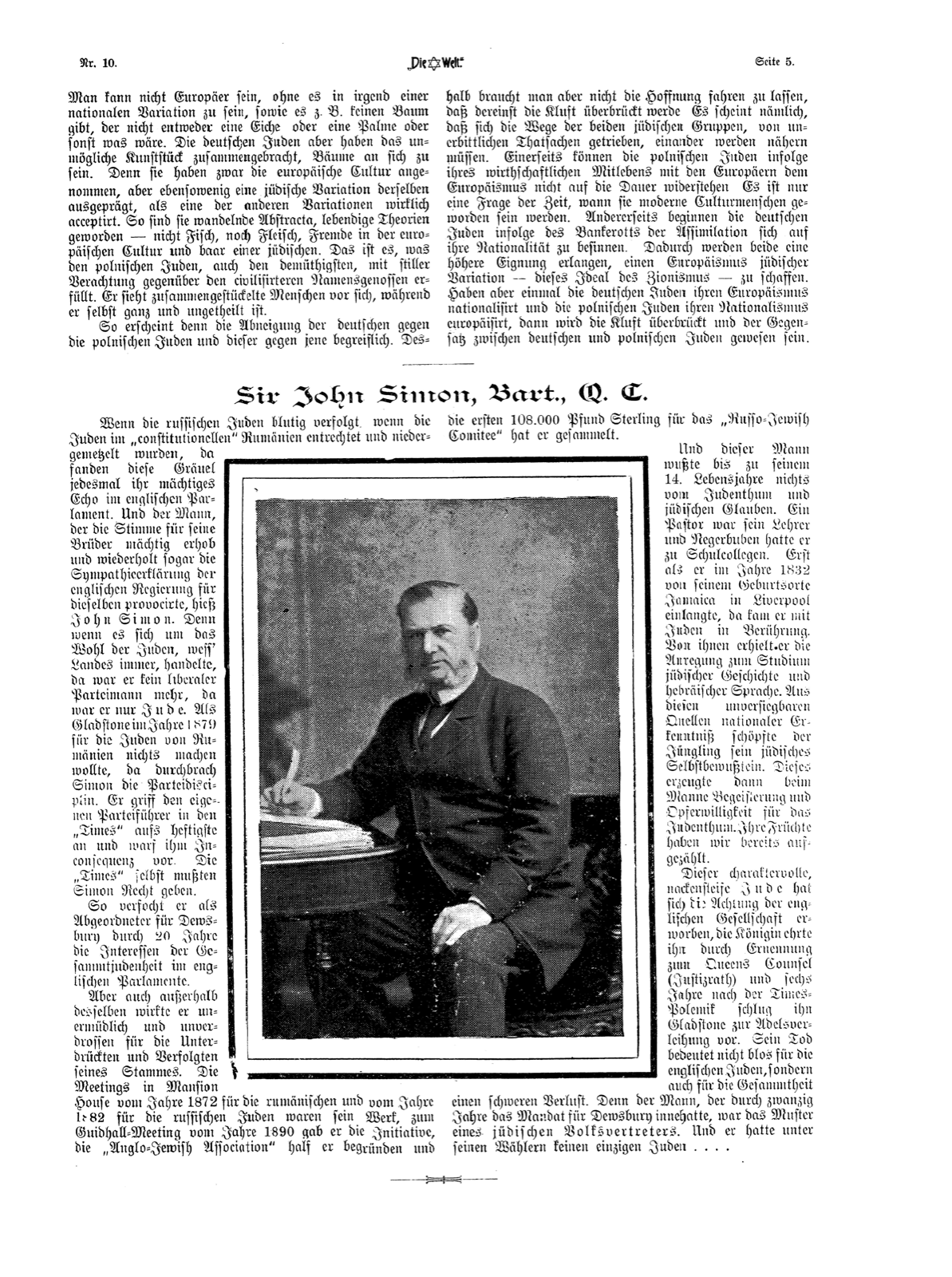
Sir John Simon, Bart., Q. C.
When the Russian Jews were bloodily persecuted, when the Jews in "constitutional" Roumania were stripped of their rights and cut down, these atrocities found each time their powerful echo in the English Parliament. And the man who raised his voice mightily for his brethren, and who repeatedly even called forth a declaration of sympathy for them from the English Government, was named John Simon. For when the welfare of the Jews was at stake, of whatever land, he was no longer a Liberal party man; he was only a Jew. When Gladstone in the year 1879 would do nothing for the Jews of Roumania, Simon broke through party discipline. He attacked his own party leader in the "Times" in the sharpest manner and reproached him with inconsistency. The "Times" itself was obliged to acknowledge that Simon was right.
Thus, as member for Dewsbury, he championed for twenty years the interests of the whole of Jewry in the English Parliament.
But outside it also he laboured untiringly and undauntedly for the oppressed and persecuted of his race. The meetings in Mansion House of the year 1872 for the Roumanian and of the year 1882 for the Russian Jews were his work; to the Guildhall Meeting of the year 1890 he gave the initiative; the "Anglo-Jewish Association" he helped to found; and the first 108,000 pounds sterling for the "Russo-Jewish Comitee" he collected.
And this man knew nothing until his fourteenth year of Judaism and of the Jewish faith. A pastor was his teacher, and he had negro boys for schoolfellows. Only when in the year 1832 he arrived at Liverpool from his birthplace Jamaica did he come into contact with Jews. From them he received the impulse to the study of Jewish history and of the Hebrew tongue. From these inexhaustible springs of national knowledge the youth drew his Jewish self-consciousness. This afterwards begot in the man enthusiasm and readiness for sacrifice on behalf of Judaism. Its fruits we have already enumerated.
This Jew of character and stiff neck won for himself the esteem of English society; the Queen honoured him by appointment as Queen's Counsel (Justizrath), and six years after the Times polemic Gladstone proposed him for ennoblement. His death signifies a heavy loss not merely for the English Jews, but for the whole body. For the man who for twenty years held the mandate for Dewsbury was the model of a Jewish representative of the people. And among his electors he had not a single Jew . . . .