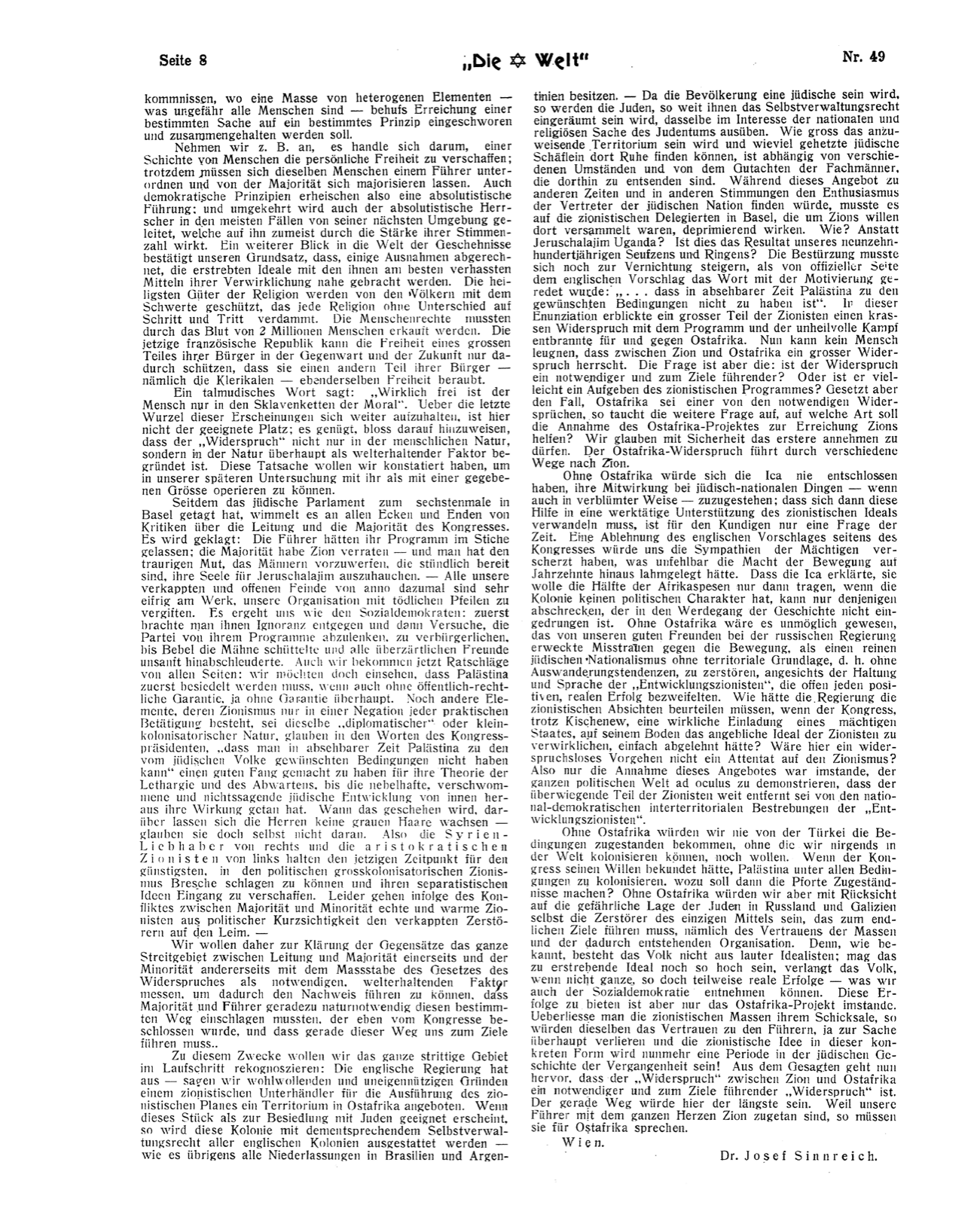
Page 8 — "Die Welt" — No. 49
(continued from page 7)
…rences in which a mass of heterogeneous elements — which is roughly what all men are — is to be sworn to a definite principle and held together for the attainment of a definite end.
Let us suppose, for example, that the aim is to procure personal freedom for a class of men; nevertheless these same men must subordinate themselves to a leader and allow themselves to be outvoted by the majority. Even democratic principles, then, require an absolutist leadership; and conversely the absolutist ruler, too, is in most cases guided by his immediate entourage, which works upon him mostly through the strength of its numbers. A wider glance into the world of events confirms our principle that, a few exceptions apart, the ideals striven for are brought near to their realisation by the very means most hateful to them. The holiest possessions of religion are protected by the nations with the sword, which every religion without distinction condemns at every turn. The Rights of Man had to be purchased with the blood of 2 millions of men. The present French Republic can protect the freedom of a great part of its citizens, in the present and in the future, only by robbing another part of its citizens — namely the Clericals — of that very same freedom.
A Talmudic saying runs: "Man is truly free only in the slave-chains of morality." This is not the fitting place to dwell further upon the ultimate root of these phenomena; it suffices merely to point out that "contradiction" is grounded as a world-sustaining factor not only in human nature but in nature altogether. We wish to have established this fact in order to be able to operate with it as a given quantity in our later inquiry.
Ever since the Jewish Parliament sat in Basle for the sixth time, criticisms of the leadership and of the majority of the Congress have been swarming at every turn. The complaint runs: the leaders have abandoned their programme; the majority has betrayed Zion — and people have the sorry courage to cast this reproach at men who are ready at any hour to breathe out their souls for Jeruschalajim. — All our masked and open enemies of days gone by are very busily at work poisoning our organisation with deadly arrows. It fares with us as with the Social Democrats: first they were met with disregard, and then with attempts to divert the party from its programme, to make it bourgeois, until Bebel shook his mane and roughly flung off all his over-tender friends. We too are now receiving advice from every side: we should surely see that Palestine must be settled first, even without a guarantee in public law, indeed without any guarantee at all. Still other elements, whose Zionism consists only in the negation of every practical activity, be it "diplomatic" or of the petty-colonising kind, believe they have made a good catch for their theory of lethargy and waiting — waiting until the nebulous, vague and meaningless Jewish development from within has done its work — in the words of the President of the Congress, "that Palestine cannot be had within a measurable time on the terms desired by the Jewish people." When that will come to pass, the gentlemen do not trouble their heads about — for they do not believe in it themselves. And so the Syria-lovers on the right and the aristocratic Zionists on the left consider the present moment the most favourable for making a breach in political, large-scale colonising Zionism and gaining an entrance for their separatist ideas. Unhappily, in consequence of the conflict between majority and minority, genuine and warm-hearted Zionists, out of political short-sightedness, are being taken in by the masked destroyers. —
For the clarification of these antagonisms, therefore, we propose to measure the whole field of dispute between the leadership and majority on the one hand and the minority on the other by the standard of the law of contradiction as a necessary, world-sustaining factor, in order thereby to be able to demonstrate that the majority and the leaders were obliged, by a very necessity of nature, to take precisely this path which the Congress resolved upon, and that it is this very path which must lead us to the goal..
To this end let us reconnoitre the whole disputed field at the double: the English Government has, for — let us say benevolent and disinterested reasons, offered a Zionist negotiator a territory in East Africa for the carrying out of the Zionist plan. If this tract appears suitable for settlement by Jews, this colony will be endowed with the corresponding right of self-government enjoyed by all English colonies — as, for that matter, all the settlements in Brazil and the Argentine possess it. — Since the population will be a Jewish one, the Jews, so far as the right of self-government is granted them, will exercise it in the interest of the national and religious cause of Judaism. How large the territory to be assigned will be, and how many hunted Jewish lambs may find rest there, depends on various circumstances and on the report of the experts who are to be sent there. While this offer would at other times and in other moods have met with the enthusiasm of the representatives of the Jewish nation, it could not but have a depressing effect upon the Zionist delegates in Basle, who were assembled there for Zion's sake. What? Uganda instead of Jeruschalajim? Is this the result of our nineteen hundred years of sighing and struggling? The consternation was bound to mount to utter despair when the English proposal was advocated from the official side with the argument: "... that Palestine is not to be had within a measurable time on the desired terms." In this pronouncement a great part of the Zionists saw a flagrant contradiction of the programme, and the disastrous struggle for and against East Africa flared up. Now no one can deny that a great contradiction exists between Zion and East Africa. The question, however, is this: is the contradiction a necessary one, and one that leads to the goal? Or is it perhaps an abandonment of the Zionist programme? But supposing East Africa to be one of the necessary contradictions, the further question arises: in what way is the acceptance of the East Africa project to help in the attainment of Zion? We believe we may assume the former with certainty. The East Africa contradiction leads by various paths to Zion.
Without East Africa the Ica would never have resolved to concede its co-operation in Jewish-national matters — even though in veiled fashion; that this help must then turn into active support of the Zionist ideal is, for the initiated, only a question of time. A rejection of the English proposal by the Congress would have forfeited us the sympathies of the mighty, which would infallibly have paralysed the power of the movement for decades to come. That the Ica declared it would bear half the African expenses only if the colony has no political character can deter only him who has not penetrated into the course of history. Without East Africa it would have been impossible to destroy the mistrust of the movement awakened with the Russian Government by our good friends — mistrust of it as a pure Jewish nationalism without territorial basis, that is, without emigrationist tendencies — in view of the attitude and language of the "development Zionists," who openly doubted every positive, real success. How would the Government have been bound to judge the Zionist intentions if the Congress, in spite of Kischenew, had simply rejected a genuine invitation from a mighty State to realise the professed ideal of the Zionists upon its soil? Would not a course free of contradiction have been here an outrage upon Zionism? Thus only the acceptance of this offer was capable of demonstrating ad oculus to the whole political world that the overwhelming part of the Zionists was far removed from the national-democratic, inter-territorial strivings of the "development Zionists."
Without East Africa we should never obtain from Turkey the conditions without which we neither can nor will colonise anywhere in the world. Had the Congress declared its will to colonise Palestine under any conditions whatever, why then should the Porte make concessions? Without East Africa, moreover, in view of the perilous situation of the Jews in Russia and Galicia, we should ourselves be the destroyers of the only means that must lead to the final goal — namely, the confidence of the masses and the organisation that springs from it. For, as is well known, the people does not consist of idealists alone; however lofty the ideal to be striven for, the people demands, if not complete, then at least partial real successes — as we may also learn from Social Democracy. These successes, however, only the East Africa project is able to offer. Were the Zionist masses left to their fate, they would lose confidence in the leaders, indeed in the cause altogether, and the Zionist idea in this concrete form will henceforth be a period of Jewish history belonging to the past! From what has been said it now follows that the "contradiction" between Zion and East Africa is a necessary "contradiction," and one that leads to the goal. The straight road would here be the longest. Because our leaders are devoted to Zion with their whole heart, they must speak for East Africa.
Vienna.
Dr. Josef Sinnreich.